|
|
Amphora dump at P/2,3-6/6,8.
Layer "8b" in Room 6 of Greek House δ.
Trench cut into lower levels next to west wall of Room 6. Fragments of amphorai, tiles.
No coins ... Early Hellenistic ... Amphora dump at P/2,3-6/6,8.
Layer "8b" in Room 6 of Greek House δ.
Trench cut into lower levels next to west wall of Room 6. |
| Pyre in layer "9d" in SW corner of Room 6 of Greek House δ. Ashes and fragments of small bones ... Ca. 225 B.C ... Pyre in layer "9d" in SW corner of Room 6 of Greek House δ. |
Well East of Stoa Room 6 (well with Siana Cup); scanty dumped filling.
No water. Well never used. Estimated Grid ... 600-550 B.C ... Well East of Stoa Room 6 |
Early Roman pit at P/3-6/6,7
Layer 4a in Room 6 of Greek House δ, area P/2,3-6/6,8.
Pit in NW corner of Room 6 bounded by walls of Room to North and West, cut into preexisting layers to east, cutoff by ... 17 May 1971 ... Early Roman pit at P/3-6/6,7
Layer 4a in Room 6 of Greek House δ, area P/2,3-6/6,8.
Pit in NW corner of Room 6 bounded by walls of Room to North and West, cut into preexisting layers to east, cutoff by Byzantine pithos to South. |
House N, room 6=House T: Pit with Kalikia in Room 2W. Roughly rectangular pit, length 7.10m., possibly dug to obtain clay for flooring in nearby houses ... Ca. 500-480 B.C ... House N, room 6=House T: Pit with Kalikia in Room 2W. |
| Well in Room 6 of Street Stoa U/2,U/3-13/15.
Associated with the building lying under the Roman Street Stoa. Its fills divided into 5 separate layers, with the bulk of finds belonging to Layer 1, the ... 14 June-21 August 1973 ... Well in Room 6 of Street Stoa U/2,U/3-13/15 |
Pit in SE corner of room at 14-19/ΙΖ-ΚΑ ... 4th century B.C. |
| Pyre in layer 2a in Room 9 SE of Greek House δ. Sand, gravel, ashes, iron nails, carbon, some bones partially cut away by foundation trench of SYPE wall.
Coin
1 July 1971 #459 ... 260-200 B.C. |
Early Roman pit at P/7-6/4,6
layer Ia in Room 7 of Greek House δ. Black earth fill with much carbon.
Plaster, nails, glass, bones (also bones from deposit P 6:4).
Coin
5 June 1971 #395 ... Early Roman ... Early Roman pit at P/7-6/4,6
layer Ia in Room 7 of Greek House δ ... Plaster, nails, glass, bones (also bones from deposit P 6:4).
Coin
5 June 1971 #395 |
| Laura Gawlinski ... Well in courtyard of Early Building I, adjacent to wall of Room B. Tile lined; upper course in situ, lower two collapsed probably in antiquity. Letters inscribed on rims (eta, phi, omicron, theta). Medium ... First quarter of the 4th c. B.C. |
| Pyre in House N, room 4 (RSY=Pyre 7), in the industrial area west of the Areopagus.
Pottery, mall pieces of calcined bone, log, wood cinders, and charcoal in diamond-shaped pit in floor sequence. The pyre ... Late 4th-early 3rd c. B.C ... Pyre in House N, room 4 (RSY=Pyre 7), in the industrial area west of the Areopagus.
... Layer 4 ran over the foundation of the wall between rooms 5 and 6; a layer of decayed mudbrick covered layer 4. |
A well in House T, Room 2W (Publ. House D), industrial area west of the Areopagus. Lower filling of dug bedrock including a small amount of pottery of the Geometric period. Gravelly filling in collapsed ... 3rd. quarter of 8th. c. B.C. |
Fifth century Pit E of Stoa Room 11 with coarse pottery and a few black-glazed, some with stamping and red-figured pieces ... Ca. 450-425 B.C. |
| Disturbed pyre dispersed in fill of Room 5, House D.
Pyre pots in very fragmentary condition were noticed by Barbara Tsakirgis in later analysis of pottery that had been excavated in 1938; no mention of ... 14 June 1938 |
Found while excavating Stoa Pit E in 1933. See also I 849 (Ε 329) found in the North Well in Stoa Pit E (Deposit H 9:1). Fragment Ε 496 of this inscription, listed with the finds of H 10:6, is likely from ... 8-10 May 1933
17 May 1935
18-26 May 1937 |
House C, Room 5, small hoard. Deposit created by A.W. and first appears in his thesis (Biblio. below).
"Another small hoard or purse of Herulian date", A.Walker (1980), p. 127. Coins:
23 June 1947 #7-#13 ... Ca. 267 A.D. |
House N, Room 4, Pit through layers 5-6. Debris filling, mixed context. Estimated Grid ... Late 4th. c. B.C. into early 3rd c. B.C ... House N, Room 4, Pit through layers 5-6. |
Plaster dump at Q/2,5-6/7,9.
Layer 5 in "Wall Painted Room" of Roman House ε. Layer resting on bedrock and covered partially by good strosis (55.26m.). Fill was red with mudbricks, tiles, much plaster ... Late 1st-early 2nd c. A.D ... Plaster dump at Q/2,5-6/7,9.
Layer 5 in "Wall Painted Room" of Roman House ε. |
| Well in Room 7 of Roman House H, partially covered by caldarium of added bath complex (Room 6). Stone well-head; 0.85m in diameter. Stpped because of danger of collapse. Cut through bedrock, water from ... 6th c. A.D ... Well in Room 7 of Roman House H, partially covered by caldarium of added bath complex (Room 6). |
| Pyre in layer 8a in SW corner of Room 7 of Greek House δ.
Oval pyre; 0.60 (n-s)x 0.35 (e-w).
The pyre was covered by the surface of layer 8 and extended slightly into layer 9 below it. Small bone fragments, ... 325-300 B.C ... Pyre in layer 8a in SW corner of Room 7 of Greek House δ.
... No pottery remaining, bones in plastic bag in tin 212 (deposit P 6:3). |
| Stephen G. Miller ... Irregular circular tomb (Diam. 2.20-2.60) with blocked dromos to northwest. Top of tomb lost in Archaic grading of area, center disturbed by Byzantine pit, overbuilt by northern-eastern walls of Room 3 ... LH III |
Flask-shaped cistern (1959) (Cistern under Room 4 in NE corner of Section). Upper filling soft silt with a little pottery. Lower filling hard silt, almost no pottery.
1.35m in diameter at the floor with ... End of the 4th c. B.C. |
Greek House J, under room 8 of Roman House H.
Typical though very fragmentary pyre pottery lay dispersed in a stratum over bedrock with pottery ranging from the 5th to the mid-3rd c.
In same general area ... Early 4th c. B.C.? |
Filling inside N room of Temple of Apollo, including directly under the foundations of the N room ... Ca. 350 B.C. and earlier |
| Marcie Handler ... The Pyre was revealed in a layer of 4th c. fill in the north end of Room 6, just south of Wall 8. Room 6 is defined by the street wall (Wall A) on the west, Wall 7 on the east, Wall 9 on the south (preserved ... 4th c. B.C ... The Pyre was revealed in a layer of 4th c. fill in the north end of Room 6, just south of Wall 8. Room 6 is defined by the street wall (Wall A) on the west, Wall 7 on the east, Wall 9 on the south (preserved only as a stub on the east side of the area), and possibly Wall 8 or Wall 6 on the north.
2.5 meters SW of the pyre, a patch of floor surface at J/10-1/20 at 52.188 masl. was found. |
| Coin hoard. Room 2: soft soil north of floor surface. Coins:
23 July 1999 #924-#944. Anonymous folles with the head of Christ on the obverse dating between 770-1059 ... 23 July 1999 |
Pithos in NW corner (room) of Poros Building. Marble chips ... Mid-4th c.? |
In front of room III from the South. Coins:
28 June 1933 #1
1 July 1933 #1
8 July 1933 #1 (dump)
12 July 1933 #1 (dump)-#2 (dump)
3 May 1934 #1
12 May 1934 #1 Estimated Grid ... Byzantine |
| Pyre in House N, room 2, layer 5 (RSY=Pyre 8).
Near northern corner of room 6. Artifacts, bone, burnt logs, and cinders in square pit dug from level of layer 5, through layers 5 and 6; thin clay floor ... 325-300 B.C ... Pyre in House N, room 2, layer 5 (RSY=Pyre 8).
Near northern corner of room 6. Artifacts, bone, burnt logs, and cinders in square pit dug from level of layer 5, through layers 5 and 6; thin clay floor laid over it. Young identified layer 6 as the latest house floor and concluded that this pyre was buried after the abandonment of the house. |
| Pyre in Room 8 of Roman House H. Concentration of artifacts, bone, and flecks of carbon in stratum, no pit discerned. the pyre lay within a red fill apparently contemporary with it, but with some later ... 300-290 B.C. |
Pit in House T, Room 3 (through layer 6), in the industrial area west of Areopagus. Very likely pit may have been respectable archaic context, but nothing to go on beyond the two catalogued pieces (LT ... Ca. 500-480 B.C ... Pit in House T, Room 3 (through layer 6), in the industrial area west of Areopagus. ... No container for this pit, and also apparently none for layer 6? Layer 5 us described as "5th-4th c. |
| Pyre in Room 1, area west of street (RSY=Pyre 11).
Early in the third quarter of the 4th. c. B.C.
In courtyard. Artifacts, bone, and cinders in irregular pit in floor sequence. The pit had been dug into ... 350-330 B.C. |
| Pyre in House C, Room 8 (RSY=Pyre 6).
Near east corner of room 8. Artifacts, burnt bone, burnt sticks, and large cinders in a shallow pit dug into surface of layer 3, and covered by layer 2. Some cinders ... 350-325 B.C.-end of 4th c. B.C ... Pyre in House C, Room 8 (RSY=Pyre 6).
Near east corner of room 8. Artifacts, burnt bone, burnt sticks, and large cinders in a shallow pit dug into surface of layer 3, and covered by layer 2. |
| Classical Pyre between floors in Room 2 of Classical Building II.
Below floor at 51.66 7masl. Broken pyre pots in fill of ash and carbon, from 51.541-51.513, resting on next floor at 51.513 masl, next ... Ca. 400-390 B.C. |
House C, Room 4 (Pottery dump of stamnos wall and fill below floor). Coins:
1 July 1947 #13
2 July 1947 #1
Coins from House IV:
14 May 1947 #1-#2
19 May 1947 #6-#7
20 May 1947 #32 ... First half 3rd c. B.C ... House C, Room 4 (Pottery dump of stamnos wall and fill below floor) ... Coins:
1 July 1947 #13
2 July 1947 #1
Coins from House IV:
14 May 1947 #1-#2
19 May 1947 #6-#7
20 May 1947 #32 |
Pit at 79-83/ΜΒ-ΜΖ (or 81/ΜΣΤ=pit under floor of Room 11 in Roman Bldg. 2, 82/ΜΓ, 83/ΜΕ=well at 83/ΜΗ). Purpose of pit obscure. Evidently filled in Hellenistic times and disturbed in Roman times. Coins: ... 275-200 B.C. with later disturbance ... Pit at 79-83/ΜΒ-ΜΖ (or 81/ΜΣΤ=pit under floor of Room 11 in Roman Bldg. 2, 82/ΜΓ, 83/ΜΕ=well at 83/ΜΗ). ... Coins:
26 February 1937 #1-#2
27 February 1937 #2-#3
1 March 1937 #1
3 March 1937 #1
6 March 1937 #1-#3
9 March 1937 #1-#4
29 March 1937 #4
3 April 1937 #4-#6
5 April 1937 #3-#4
6 April 1937 #4-#8
7 May 1937 #1(well dump) |
Debris, Room I of Street Stoa (R/16,20-13/10,15).
The lack of any rooftiles and similar architectural debris suggests that perhaps it was brought in from an adjacent area and dumped in the room. This is ... 6-8 May 1975 ... Debris, Room I of Street Stoa (R/16,20-13/10,15).
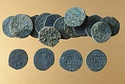
... Another possible explanation is that the room was quarried for clean bedrock fill (perhaps by the builders of the Late Roman Building to the east), with the resultant filling of the room with destruction debris from Alaric's attack on the city, perhaps taken from the same area where the bedrock fill was to be used (cf. east, in Room 1 and the south half of Room 2 ... Coins
1 May 1975 #741-#752
6 May 1975 #755-#764
7 May 1975 #765-#787
8 May 1975 #788-#789 |
North of Eleusinion: Fill in Room 3 of Roman Building. 614 sherds (6 miniature shapes, 20 intrusive sherds).
Objects : terracottas; loom weights; spindle whorls; disks; handmade tray; lamps.
Early ware ... First half of 6th c. B.C.-Mixed Fill to ca. 480 B.C ... North of Eleusinion: Fill in Room 3 of Roman Building ... 614 sherds (6 miniature shapes, 20 intrusive sherds).
|
| Marcie Handler ... Located in the south section of Room E in the Byzantine Building east of the North-South Road. The uppermost 1.5 meters of well lining was built of well-coursed stones (some reused marble blocks) and tiles ... 12th c. A.D ... Located in the south section of Room E in the Byzantine Building east of the North-South Road. ... The packing fill for the well consisted almost entirely of fragments of tegulae mammatae (133 were found in the packing fill from 50.657 to 53.001 masl), which gives the destruction of the bath to the southwest in 395/6 AD as a terminus post quem for the original construction phase of the well. |
Cistern at 65/ΚΗ (and Channel). Cistern in the northwest room of the annex to the Poros Building west of the Areopagus. Part of the same system as D 17:4 and D 17:5, the chambers connected by long tunnels ... 300-250 B.C ... Cistern in the northwest room of the annex to the Poros Building west of the Areopagus. ... Coins:
22 June 1950 #4
23 June 1950 #1-#3, #5-#6
24 June 1950 #1 |
|
|