|
|
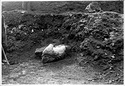
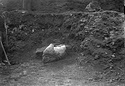
| The moulding Σ 2243 and the piece of sculpture Σ 2244, as found. From the southeast ... AMS Horizontal (normal) ... The moulding Σ 2243 and the piece of sculpture Σ 2244, as found. |
| Statue of Dionysos as found in wall ... 6 Mar 1935 |
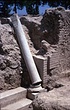
| East column at entrance to Room 3, as found ... =86-401/Roman House H in notebooks. (SD) east ... August 1970 |
Bookidis, Nancy ... American School of Classical Studies at Athens ... The fifth part of the Corinth volume dedicated to the Sanctuary of Demeter and Kore publishes the large-scale terracotta sculpture found in the sanctuary. Extending from the late 7th through the 4th century ... 2010 ... The fifth part of the Corinth volume dedicated to the Sanctuary of Demeter and Kore publishes the large-scale terracotta sculpture found in the sanctuary. Extending from the late 7th through the 4th century B.C., the sculpture consists of fragments from 132 to as many as 147 statues, from half- to nearly life-size. ... This volume greatly expands our knowledge of the history of Corinth, broadening our understanding both of cult practices at the site and of the manufacture of terracotta sculpture. |
| Head of youth, set on a shaft; the whole framed by heavy drapery which covers the top of the head and falls down on both sides and at back. Lower part broken away. Face much worn: mouth and most of nose ... 10 March 1932 |
| Giant in easternmost position in the "Gymnasium" series. The Late Roman Complex was identified as a Gymasium because of its scheme and of an inscription found by Pittakis in 1848 alongside the colossal ... This is OD 181. The neg. was destroyed and replaced by one that is not 88-461 as mentioned on print.(SD) south |
| Fragment of female head, hair in wavy locks drawn towards nape. Proper right side. Pentelic marble. Found in a pit between the Temple of Ares and the altar foundation. Possibly from the same series as ... 4 Aug 1950 |
| Fragment of female head, hair in wavy locks drawn towards nape. Proper right side. Pentelic marble. Found in a pit between the Temple of Ares and the altar foundation. Possibly from the same series as ... AMS Horizontal (normal) ... 4 Aug 1950 |
| Giant in easternmost position in "Gymnasium" series. The Late Roman Complex was identified as a Gymnasium because of its scheme and of an inscription found by Pittakis in 1848 alongside the colossal figures ... south Horizontal (normal) ... ca. 1946 |
| Broken in front at the right. On the sides, two holes for insertion of cross bars. The back is cut as though it stood against a wall, the top as though it carried something. The figure has a beard and ... 15 May 1933 |
| Giant in easternmost position of the "Gymnasium" series. The Late Roman Complex was identified as a Gymasium because of its scheme and of an inscription found by Pittakis in 1848 alongside the colossal ... southwest ... 1949 |
| Giant in easternmost position of the "Gymnasium" series. The Late Roman Complex was identified as a Gymasium because of its scheme and of an inscription found by Pittakis in 1848 alongside the colossal ... AMS southwest Horizontal (normal) ... 1949 |
| Fragment of inscribed columnar base; relief on top; grave stone (?).
Part of a columnar base; broken away on either side and in back. On the sculpture above, two feet are preserved. The figure is broken ... 22 June 1933 ... On the sculpture above, two feet are preserved. The figure is broken away above the ankles, as is also a rectangular projection to the right of the figure which may have served as border to the relief.
... Found in modern foundation wall, north of the Temple of Ares. |
| Giant in easternmost position of the "Gymnasium" series. Proper right side. The Late Roman Complex was identified as a Gymasium because of its scheme and of an inscription found by Pittakis in 1848 alongside ... west ... July 1939 |
| Giant in easternmost position of the "Gymnasium" series. Front view. The Late Roman Complex was identified as a Gymasium because of its scheme and of an inscription found by Pittakis in 1848 alongside ... south ... 1949 |
| Giant in easternmost position of the "Gymnasium" series. Front view. The Late Roman Complex was identified as a Gymasium because of its scheme and of an inscription found by Pittakis in 1848 alongside ... AMS south Horizontal (normal) ... 1949 |
| Giant in easternmost position of the "Gymnasium" series. Proper right side. The Late Roman Complex was identified as a Gymasium because of its scheme and of an inscription found by Pittakis in 1848 alongside ... AMS west ... July 1939 |
| Tomb U, west of the Church of Elias and Charalambos: statue of Herakles from the East Pediment of the Hephaisteion, as found built face down into wall of tomb. Cf. Hesperia 18 (1949), p. 214.
DUPLICATE ... No deposit given yet. Horizontal (normal) ... 19 Mar 1948 ... Site | By Area | South | Miscellaneous | Objects as Found ... Site | By Area | West | Temple of Hephaistos | Sculpture | East Pediment | Standing Male Torso (S 1313) |
| Tomb U, west of the Church of Elias and Charalambos: statue of Herakles from the East Pediment of the Hephaisteion, as found built face down into the wall of the tomb. Cf. Hesperia 18 (1949), p. 214 ... Horizontal (normal) ... 19 Mar 1948 ... Site | By Area | South | Miscellaneous | Objects as Found ... Site | By Area | West | Temple of Hephaistos | Sculpture | East Pediment | Standing Male Torso (S 1313) |
| Tomb U, west of the Church of Elias and Charalambos: statue of Herakles from the East Pediment of the Hephaisteion, as found built face down into the wall of the tomb. Cf. Hesperia 18 (1949), p. 214 ... Horizontal (normal) ... 19 Mar 1948 ... Site | By Area | South | Miscellaneous | Objects as Found ... Site | By Area | West | Temple of Hephaistos | Sculpture | East Pediment | Standing Male Torso (S 1313) |
|
|