|
|
| Finished Well; shaft. Ἐπὶ Δορκυλίδ[α]
Δαλίο[υ] 601, 606, 635 Leica ... 2 April 1937 ... Well; shaft. |
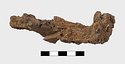
| A solid shaft square in section, twisted.
Broken at both ends and heavily corroded. Many similar fragments left in container ΛΛ 366. Well.
Late Hellenistic. 1488, 1576 Leica ... 13 June 1938 ... A solid shaft square in section, twisted.
... Well.
Late Hellenistic. |
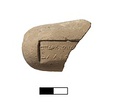
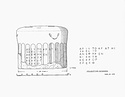
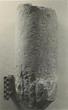
| Inscribed column shaft.
Largely complete though very battered and worn. Several large cuttings from later use as a millstone.
Top drum of the shaft of a large fluted column (Ionic?). The flutes stop well ... May 1971 ... Inscribed column shaft.
Largely complete though very battered and worn. ... Top drum of the shaft of a large fluted column (Ionic?). The flutes stop well below the top which is somewhat larger in diameter, apparently to receive a dedication. |
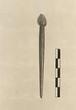
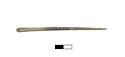
| Point broken off.
Long eye; shaft tapers from flattened eye end. Well. Leica ... 24 April 1936 ... Long eye; shaft tapers from flattened eye end ... Well. |
| Short shaft tapering to a point.
Pointed knob head and grooves around the shaft just below the head. Well, earth. Leica, Various vii-78 ... 12 June 1937 ... Short shaft tapering to a point.
Pointed knob head and grooves around the shaft just below the head ... Well, earth. |
| Oval bowl with central rib. Shaft ending above in a drop.
Rather well preserved.
Decorative rings around the part where bowl and shaft meet.
Cf. Corinth XII, pp. 132-134, pl. 82. In front of late Roman ... 8 May 1947 ... Oval bowl with central rib. Shaft ending above in a drop.
Rather well preserved.
Decorative rings around the part where bowl and shaft meet.
|
| Small, sharp pointed arrow point with three flanges and socket for shaft. Well A. Leica ... 20 March 1959 ... Small, sharp pointed arrow point with three flanges and socket for shaft ... Well A. |
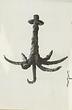
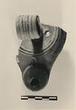
| Complete.
Shaft with suspension ring at top and six up-turned prongs. The shaft extends below the prongs and ends in a single small hook. Turkish well. Leica ... 2 June 1950 ... Complete.
Shaft with suspension ring at top and six up-turned prongs. The shaft extends below the prongs and ends in a single small hook ... Turkish well. |
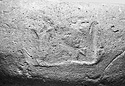
| Device. Finished Well in Metroon Porch to east of Room 2 from south; lower shaft (Geometric), upper late Roman. [---]
device
[---]ων Leica ... 18 May 1937 ... Well in Metroon Porch to east of Room 2 from south; lower shaft (Geometric), upper late Roman. |
| Triangular, flat; roughly flaked.
Flint. Well, Grave in Metroon, Drain cut, from the filling of the shaft. Cf. P 6072, P 6073. Leica ... 22 April 1935 ... Well, Grave in Metroon, Drain cut, from the filling of the shaft. |
| Large heavy moulded head, with fine grooves around shaft just below. Well, earth. Leica, Various vii-78 ... 9 June 1936 ... Large heavy moulded head, with fine grooves around shaft just below ... Well, earth. |
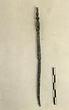
| Both ends broken off.
Long straight shaft with moulded rings around it. Lines of inlaid silver in horizontal and diagonal patterns all along the shaft.
Tapers towards both ends. Well. Upper fill. Leica, ... 7 April 1936 ... Long straight shaft with moulded rings around it. Lines of inlaid silver in horizontal and diagonal patterns all along the shaft.
Tapers towards both ends ... Well. Upper fill. |
| Broken at upper end. Badly corroded.
Blade proper quite thin. Shaft roughly rectangular in section. Well. Container 85. Stoa Gallery Case Leica, LIX-63 ... 7 April 1937 ... Blade proper quite thin. Shaft roughly rectangular in section ... Well. Container 85. |
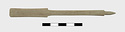
| Intact.
Rectangular shaft, the writing-end inset from it. Οστέινη γραφίδα. Σχεδόν ακέραια. Well north of Nymphaeum. Container 79. Stoa Gallery Case Leica, color slide ... 17 April 1954 ... Rectangular shaft, the writing-end inset from it ... Well north of Nymphaeum. |
| Large fragment preserving the end of a trident. No shaft preserved. Badly corroded. Now attached to plaster. Oscar Broneer, Nb. No. 4. Well V. 23 ... 13 April 1937 ... Large fragment preserving the end of a trident. No shaft preserved. Badly corroded. ... No. 4. Well V. |
The shaft is diamond shaped in section. Intaglio: Pegasus with pointed wing, to left. Well-modelled, rounded not flat. Details careful; proportions bad - head very small, legs [?]. Assembly Place, filling ... 16 October 1932 ... The shaft is diamond shaped in section. Intaglio: Pegasus with pointed wing, to left. Well-modelled, rounded not flat. |
| Globular bead with very large perforation; possibly intended for use around a shaft of pin or the like rather than as a bead.
Bone well polished or worn; stained brown. Pocket with burning.
4th c. B.C ... 4 June 1949 ... Globular bead with very large perforation; possibly intended for use around a shaft of pin or the like rather than as a bead.
Bone well polished or worn; stained brown. |
| Upper half preserved, handle missing.
Dots on rim applied in pattern, outlining triangular shaped leaves.
Poor black glaze, much rubbed.
Reddish-buff clay.
Type XX of Corinth collection. Brick Shaft and ... 11 April 1938 ... Brick Shaft and Drain; lower fill C, south of well. |
| Dionysos seated to right; nude save for a wreath, with a fillet of added clay. At his right shoulder is the shaft of his thyrsos. Relief contour. Well. Box 86. 2229 Leica ... April-May 1936 ... At his right shoulder is the shaft of his thyrsos. ... Well. Box 86. |
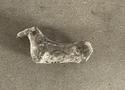
| Legs missing.
The animal has prominent ears and no mane, and could be a dog as well as a horse.
Remains of white slip. Rectangular rockcut shaft. Leica, XXXI-47, 84-61 ... August-September 1932 ... The animal has prominent ears and no mane, and could be a dog as well as a horse.
Remains of white slip ... Rectangular rockcut shaft. |
| One half of the shaft roughly rounded, pointed at the end; the other rectangular, and flattened at the end. Well, from the earth. Leica, XXXIX-51, Various vii-79, Various i-65 ... 13 June 1937 ... One half of the shaft roughly rounded, pointed at the end; the other rectangular, and flattened at the end ... Well, from the earth. |
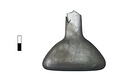
| Mouth and upper part of neck missing.
Broad base, markedly concave; sides well rounded, merging into narrow straight neck.
Bluish green glass. Brick shaft and drain lower fill, fill c. 1593 Leica ... 1 June 1939 ... Broad base, markedly concave; sides well rounded, merging into narrow straight neck.
... Brick shaft and drain lower fill, fill c. |
| Inscribed fragment of columnar grave monument.
Complete circumference preserved.
At bottom of shaft, the surface roughened and knobby for setting into ground. At top of shaft, traces of the ring. Surface ... 3rd.-2nd. centuries B.C ... At bottom of shaft, the surface roughened and knobby for setting into ground. At top of shaft, traces of the ring. Surface badly worn and letters not well cut.
Three lines of the inscription preserved.
|
| Mended from 6 pieces; restored for strength. Top of banded jar; neck and two handles preserved to shoulder.
Clay on section pinkish buff to gray with a red core; contains mica and white bits.
Series ... 1939 ... Series of P 1253 (RRC Shaft) and P 24882 (Stoa Gutter Well) ... Well. |
| Apparently completely preserved, but oxidized and with thick incrustations.
Loop at handle and five teeth set at right angles to shaft. Τρία τμήματα σιδηρού κλειδιού. Well. Container 75. Stoa Gallery Case ... 7 April 1937 ... Loop at handle and five teeth set at right angles to shaft ... Well. Container 75. |
| Nozzle and much of body missing.
Discus with rays; rim with ovules. Handle, pierced, two grooves above and below.
Reverse, within single incised groove, the signature in sunken letters: "ΛΗΝΑΙΟΥ".
The ... May 1940 ... Well shaft proper. |
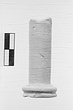
| One end broken away.
A plain shaft with a simple "cap" or "base" in two degrees at one end.
Traces of white on surface.
Pinkish to buff clay. Well.
350-320 B.C. 449 Leica, 81-34-34 ... 11-17 May 1938 ... A plain shaft with a simple "cap" or "base" in two degrees at one end.
... Well.
350-320 B.C. |
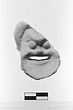
| Comic mask.
Upper right part missing.
Bearded mask, its mouth carefully pierced as a broad slit.
No trace of paint.
Fine buff clay.
ADDENDA: Slave mask with roll of hair and smooth pointed trumpet mouth ... 28 June 1935 ... From the filling of the well-shaft to the west of the Tholos.
|
| Partly disintegrated on one side.
Each of four sides concave, three are inscribed. Butt tapers at one end, hole for insertion of spear shaft on other.
Bronze(?) Ενεπίγραφη χάλκινη βληματοδόχη λόγχης. Well ... 26 July 1971 ... Butt tapers at one end, hole for insertion of spear shaft on other.
Bronze(?) ... Well. |
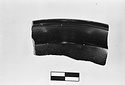
| The handle, part of the top and wall, and one nozzle preserved.
Discus plain, slightly concave, with at least two filling holes; three grooves separating discus from plain rim. Nozzle rounded with flat ... 14 April 1938 ... Handle a plain, slightly tapering shaft, finished with a large quadruple grooved ring.
... Brick Shaft and Drain, fill C; south branch; south of well, in lower layer. |
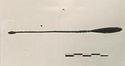
| Intact but for a small chip at spoon.
Shaft, circular in section, flares to a narrow grooved spoon. Opposite end tapers to a very thin point.
Well polished bone. Greenish tint with dark discoloration ... 20 June 2005 ... Intact but for a small chip at spoon.
Shaft, circular in section, flares to a narrow grooved spoon. Opposite end tapers to a very thin point.
Well polished bone. |
| High tapering cylindrical shaft with two moulded rings and beginning of vertical loop handle near the top. Edge of base at bottom broken off. Incised lines showing miltos.
Attic clay, dull glaze, black ... April-May 1935 ... High tapering cylindrical shaft with two moulded rings and beginning of vertical loop handle near the top. ... Well 9. |
| Fragment of rim preserved. Cup fragment, with good black glaze inside and out. Concave rim. Offset inside. Profile near that of Coral cup from rock-cut shaft.
Cf. Hesperia 15 (1946), no. 52, pl. XXXV ... 24 May-9 June 1954 ... Profile near that of Coral cup from rock-cut shaft.
Cf. Hesperia 15 (1946), no. 52, pl. ... Stoa Gutter Well. |
| Inscribed fragment.
Inscribed face and back preserved.
The left side worn to a curve. Surface powdery, from fire (?).
Thirteen lines of the inscription preserved, and a fourteenth well below.
Pentelic ... 425/4 B.C ... Thirteen lines of the inscription preserved, and a fourteenth well below.
Pentelic marble ... -3rd. centuries A.D. in the shaft of a brick drain in fill C, south of the Eleusinion. |
| Substantial ring foot with neatly rounded profile, from a shallow skyphos; trace of handle attachment; cf. P 2751, from the Rectangular Rockcut Shaft.
Very good glaze; outer edge of foot and resting surface ... May-June 1954 ... P 2751, from the Rectangular Rockcut Shaft.
Very good glaze; outer edge of foot and resting surface reserved; also space inside foot, with glazed circles and dot at center of floor.
... Well beneath Stoa gutter. |
| Broken off above. Triangular shaft, at the points of which are carved in relief three standing draped women, holding hands. The heads are worn or broken off; the marble much battered and discolored. The ... 2nd c. B.C. (?) ... Triangular shaft, at the points of which are carved in relief three standing draped women, holding hands. ... Well, late Roman. |
| From an open pot, glazed black inside. On the outside, remains of a goat's head right, an undulating object, snake(?), part of a scabbard and a knee. Tendril in field. Added color on the end of the scabbard ... 15 June 1935 ... Cf. the skyphoi from the Rectangular Rock Cut Shaft, section Α: Group of the White Heron Painter ... Well F, early 5th. c. |
| Mended from many pieces; more than half the rim and much of the bottom missing. The inward sloping sides are very slightly convex; the bottom is set well above the outer edge of the walls, which serve ... August-September 1932 ... The inward sloping sides are very slightly convex; the bottom is set well above the outer edge of the walls, which serve as foot. ... Rectangular rockcut shaft. |
| Mended from ten pieces. Neck missing, as well as upper portion of back and parts of figured scene of Dionysos seated between satyrs. Satyrs on either side advance right, the one to the left bringing grapes; ... August-September 1932 ... Neck missing, as well as upper portion of back and parts of figured scene of Dionysos seated between satyrs. ... Accessory red (fairly well preserved) for Dionysos' wreath and folds of his cloak. ... Rectangular rockcut shaft. |
| The nozzle, part of the side wall, and of the bottom with a very low raised base, preserved.
The nozzle projects well out beyond the rim, and the large wick hole does not in any way encroach upon it.
Red ... August-September 1932 ... The nozzle projects well out beyond the rim, and the large wick hole does not in any way encroach upon it.
... Rectangular rockcut shaft no. 310. |
| Mended from three pieces; part of the bottom, and most of the left side missing. Fragmentary.
Horizontal rim, with the wick hole projecting well into it.
Dull black glaze, on nozzle, rim, and inside. Thinned ... August-September 1932 ... Horizontal rim, with the wick hole projecting well into it.
Dull black glaze, on nozzle, rim, and inside. ... Rectangular rockcut shaft no. 369. |
| Corner of abacus and one volute of an Ionic capital. The bottom of the volute cut down and smoothed, with some pick marks visible. Chisel marks visible throughout.
Pentelic marble. Well. 2541 Leica ... 7 August 1970 |
Part of body, all of base except for a bit of floor. Thin, brownish black glaze on inside. Two unlettered, non-joining wall fragments also belong. P.H. 0.123; diam. of base 0.115.
Torch race. At the left ... Late 5th century B.C ... At the left are the lower part of the shaft and a corner of the base of a goal post; then the lower legs and feet of a youth to right, holding a lighted torch (shaft), facing another (a bit of body). A non-joining unlettered fragment (not illustrated) shows the lower leg and frontal foot as well as the tip of a lighted torch (this figure is probably to the left of the goal post), and another (not illustrated) gives the upper right corner of the panel. |
| Mended from five pieces. Most of the plain back missing. Hare and hound shoulder decoration well preserved and neatly executed. Both animals have red collars. Round base of neck a hollow band painted red ... August-September 1932 ... Hare and hound shoulder decoration well preserved and neatly executed. ... Rectangular rockcut shaft. |
| Intact.
Shaft pierced at bottom. Probably used as handle.
Carefully carved bearded head. Hair marked by grooves around face and behind at sides, where lower part hangs down in a point, but upper part of ... 20 April 1954 ... Intact.
Shaft pierced at bottom. ... Well to north of Nymphaeum. |
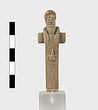
| Almost solid round shaft fragment, broken above and below, preserving upper half to two-thirds of six draped women standing in three pairs facing each other, right hands raised in front of them. Use of ... 7 July 1995 ... Almost solid round shaft fragment, broken above and below, preserving upper half to two-thirds of six draped women standing in three pairs facing each other, right hands raised in front of them. ... Well. |
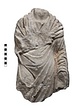
| Neck to mid-thigh of frontal draped male figure with right hand and arm, which is sheared off, held up against chest on left holding mantle folds.
Crisp, harsh folds with a few deeply drilled contours ... 12 August 1977 ... On back in low relief and on a slightly different axis is a small herm with well-modeled portrait bust of a beardless man: tiny drill for corners of mouth and rather roughly chiseled herm shaft and background scooped out unevenly. Herm preserved from middle of head to nearly the full length of the shaft. On lower left a little stone juts forward of the original thickness of the grave relief, into which the second use, the second relief of a herm was cut.
|
| Shoulder fragment and part of wall depicting in figured scene four(?) horses' heads right. A female head to the right looks left and her white hand shows against a black horsehead. Well preserved accessory ... August-September 1932 ... A female head to the right looks left and her white hand shows against a black horsehead. Well preserved accessory white: flesh of woman, the third horse, a series of dots representing the studded bridle of the second horse, another series of black dots, making an ornamental upper border for the scene (not carried all the way to the right). ... Rectangular rockcut shaft. |
| From base of an antler antifact from cervus elaphus.
Full length apparently preserved. Surface has been smoothed; one branch cut off close; another cut off neatly above its root, where there is a large ... 7 June 1937 ... It was perforated just on the tine junction, and bears the imprint of cord or gut wound tightly around it, either to prevent the antler splitting, or to grip firmly whatever (handle or shaft) passed through the perforation, or both.
... Similar artifacts are common all over Europe from mesolithic times onwards, as well as other Greek Bronze Age sites".
... Well Q. |
| Fragment from base drum.
Unfluted; finished with toothed chisel. On underside a well-cut relieving surface, a smoothed resting surface, scratched diameter lines; and an inscribed letter: Λ.
Off-white laminated ... 12 May 1950 |
| Well or cistern curb? Fragment from mouth. The lip is finished with an ovolo, below which is a cavetto.
Gritty yellow clay. Unglazed, save for the cavetto which is painted red.
This and the preceding ... 1932 ... Well or cistern curb? ... Cistern. Draw shaft. |
| Intact except for end of nose, chips from ears and upper eyelids, chips from just above left ear. Left side stained brown.
Made to be set into a shaft; the bottom is approximately the frustrum of a cone ... 2nd c. A.D ... Made to be set into a shaft; the bottom is approximately the frustrum of a cone. ... Headband very sketchily done and not well defined. Two round dowel holes in bottom for attachment. ... Well in east colonnade of Peristyle of Roman House H. |
| Mended from three pieces. The top missing with the handle save for the lower attachment; a bit missing from the shoulder as well as a large piece from the wall near the front, and about a third of the ... August-September 1932 ... The top missing with the handle save for the lower attachment; a bit missing from the shoulder as well as a large piece from the wall near the front, and about a third of the base.
... Rectangular rockcut shaft. |
| Mended from three pieces; part of the left side, a bit from the bottom, and chips from the rim missing.
Flat bottom; nearly vertical sides. Properly speaking there is no rim, but only the finished top ... August-September 1932 ... The nozzle flat on top, well set off from the rim. ... Rectangular rockcut shaft no. 374. |
| Mended from many pieces; fragments missing from walls.
Decoration in panels. Horse and rider right on each side. Scanty incision for interior details; red for the horses' manes, and a line around the ... August-September 1932 ... Thin, rather dull black glaze; well preserved on one side, on the other, much peeled ... Rectangular rockcut shaft. |
| Mended from three pieces, preserving part of wall and rim. The scene depicts satyrs and maenads, the best preserved of which is a satyr with lifted tail who bends and reaches to the right. Behind him is ... August-September 1932 ... Red on hair and beards; white laid carelessly on the satyr's tail as well as the flesh of the maenads. ... Rectangular rockcut shaft. |
| A flake from the lower outer part of a base drum preserving parts of two flutes. Lower part of flute (0.07m.) finished delicately with the drove, upper part more carelessly. Very slight relieving surface ... 13 July 1960 ... Material and scale as well as provenance point to the Square Building - South Stoa II series. ... This would account for the marked difference in the quality of workmanship between the start on this fragment (as also on the capitals A 2006 and A 2926) and that on the upper parts of the shaft as on this fragment and on A 2096 and A 2927.
|
| Mended from 12 fragments; restored in plaster. The medallion preserved complete; about one-quarter of the rim and fragments from the wall missing. Medallion scene depicts youth with jumping halteres. Relief ... August-September 1932 ... Eye drawn full face, very slightly open at the inner angle; the large iris set well back. The fingers not differentiated. ... Rectangular rockcut shaft. |
| Mended from many pieces; two others, one mended from two pieces, do not join. None of the rim preserved; a small piece of the heavy ring foot on the larger piece.
A. Figure mounting chariot; lower half ... August-September 1932 ... Figure mounting chariot; lower half of figure and outstretched arms preserved as well as the chariot wheel and the hind quarters of the horses. ... Rectangular rockcut shaft. |
| The handle missing and nearly all the lip; two small holes in the wall, and one in the floor; the base much chipped. Plump body; low very slightly flaring ring foot. In a panel bordered above and below ... 23 May 1939 ... Behind the bearded figure, at the right of the scene, is a tall smelting furnace seen from the side; it consists of a shaft with a stepped top, and the hooded fire-hole is clearly rendered. ... Well, containers 14-17, middle fill. |
Lower part of wall and all of ring base. On underside of floor, three concentric circles with central dot. Most of the glazed fired red on the inside and on the outside below the figures. P.H. 0.15; diam ... Ca. 430 B.C ... At the left, just next to the handle palmette, there is the base and start of the shaft of a column, then the lower drapery and feet of a woman standing to right. ... Last is a man (drapery, lower legs) seated to left on a stool, holding a staff or spear (part of shaft). B, lower drapery and feet of two women, the left one in a himation and a chiton standing frontally, the right one to left in a chiton. ... The subject is not a very frequent one, and usually Eurykleia is already kneeling on the ground as she is on Rhodes 14174, an unattributed 4th-century pelike (Clara Rhodos 6--7, 1932--1933, pp. 458--459, figs. 13, 14) and the compositions as well as the participants vary considerably, suggesting that there is no one prototype. |
| Mended from many fragments. Of the cylindrical handles, only attachment areas preserved. About two-thirds of the lip complete. Chips from base and gaps in body of vase. Surface badly worn especially on ... August-September 1932 ... Incision for interior details; sometimes well preserved when the glaze is mostly gone, e.g. on the wavy tail.
... Rectangular rockcut shaft. |
| Nine fragments, not all certainly from the same pot.
a) Satyr running right; in front of him, a burning torch held in the hand of another figure. White for flame of torch.
b) Woman in Doric chiton moving ... 28 March 1936 ... Part of the shaft of a thyrsos.
t) Wall fragment. ... Fragments j-t added 1964: from tins of both well and pit, some joining. |
Broken and mended with many missing pieces restored in plaster and painted, notably a large amount of the rim. Three concentric circles on underside of foot. Glaze misfired on A--B from stacking in the ... Ca. 480 B.C ... A youthful warrior with a low-crested Corinthian helmet pushed back on his head, dressed in a short chiton with corslet and cloak, as well as greaves, stands to right, holding a phiale in his outstretched right hand, about to pour a libation on a flaming altar. ... The warrior carries a round shield (part) on his left arm and holds a spear (a bit of the shaft appears next to the handle). ... A bit of his helmet with upturned cheekpieces remains as well as the ends of three pteryges of his corslet. |
| Mended from many pieces; parts of cup and rim, all of one handle and part of the other and most of the foot, restored in plaster. The preserved fragment of the foot does not join directly. Offset rim; ... August-September 1932 ... It has worn much less well. Otherwise, in texture and character, it closely resembles the black, and in color it differs little if at all from the red produced by stacking or by misfiring. ... Rectangular rockcut shaft. |
Fifteen non-joining fragments of wall, P 18278 b--c and P 19582 a--d of torus rim with zone of ornament below. Glaze mottled here and there; has a greenish cast in places; abraded in part on rim. Max ... Ca. 480 B.C ... P 19582 h (illustrated) shows the left shoulder draped with a himation and part of the chest of a man as well as his lower lip and the end of his beard. ... This would help with the thickness problem but would raise the question of how the shield, as well as the spear, was supported. ... But the thickness of the shield fragment as well as the glaze of the wall requires that it belong rather high in the composition. |
Thirteen non-joining wall fragments with thin reddish wash on inside. Mended in antiquity (part of lead repair in b; hole in d). Glaze pitted and abraded here and there. P.H. a) 0.14; max. dim. a) 0.281, ... Ca. 440 B.C ... Fragment a (illustrated) gives the lower right corner of this panel with the two patterns (the chevron frame and the stopped-maeander with saltire-square), as well as a bit of drapery (chiton and himation) worn by someone moving rapidly to left and at the far left a bit of reserve that may represent the heel of one foot of this figure. ... Fragment a (illustrated) preserves the lower left corner of this panel, with a reserved line for the frame and a stopped-maeander pattern below, as well as the lower part of a himation and the right heel of a man or youth standing to right. ... Fragment i (illustrated) shows the shaft of a column and to the right of it a youth (lower face, upper part of body) wrapped in a himation, to left. |
Thirty-two non-joining fragments of rim, wall, and cul. Narrow reserved band on inside of rim, another 0.082 below rim. Glaze pitted on some fragments; has a greenish cast here and there. Max. dim. P 7282 ... Ca. 440 B.C ... P 7282 a (illustrated) shows a satyr (much of head, right shoulder, lower legs missing) running to right towards someone who holds a flaming torch (part of shaft and at the break a bit of the torch-bearer's hand). ... P 7282 e (illustrated) preserves a little of the back of the head of a maenad, part of her himation over her left shoulder as well as her outstretched left hand. ... P 7282 r shows a hand holding a branch and P 7282 s the lower shaft of a staff or thyrsos (the fragment is from just above the ground line). |
|
|