|
|
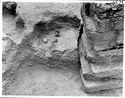
Scanty debris filling in a square pit with 4th. c. sherds at bottom. Notebook says 36-38/ΝΑ-ΝΒ and T 81 ... 1st. qtr. 4th. c. B.C ... Scanty debris filling in a square pit with 4th. c. sherds at bottom. |
Archaic Pit at 25/ΙΓ, near the northeast corner of the market square. Filling in upper part of shaft, cleared only to a depth of 3.10m because of rock conditions ... 600-550 B.C ... Archaic Pit at 25/ΙΓ, near the northeast corner of the market square. |
At the top was roughly square, but below was rounded. The walls were built of small stones laid without much effort where large ancient blocks ( some belonging to Great Drain) formed the sides. At the ... Turkish |
Green Earth at 03-04-05/ΚΑ-ΚΔ, to at least -3.50m. near the southwest corner of the market square. Terracotta figurines; lamps; fragmentary pottery ... Ca. 500-475 B.C. and later |
Cistern at 17-18/ΛΑ (Coroplasts' Dump) outside the market square to the southeast, west of the Panathenaic Way.
Upper and lower fill distinguished during excavation, but material from both appears to ... To ca. 330-320 B.C ... Cistern at 17-18/ΛΑ (Coroplasts' Dump) outside the market square to the southeast, west of the Panathenaic Way.
... The cistern S 19:3 and the well S 19:8, together with a Roman well S 19:1, had collapsed to form a large pit (S 19:5). The cistern was dug separately, although some of its distinctive fill of terracotta figurines and votive material had fallen into the pit S 19:5. |
| Mycenaean Grave at SE corner of Pier 12 (Burial 9).
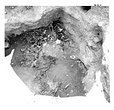
There are no traces of dromos, which must have been located at the north and have been cut away by the trench four the south stylobate of the Square ... Myc. III A:1 ... Mycenaean Grave at SE corner of Pier 12 (Burial 9).
There are no traces of dromos, which must have been located at the north and have been cut away by the trench four the south stylobate of the Square Building. ... The broken bedrock plus the presence of more than one burial is certain indication of a chamber tomb rather than a pit grave. The two skeletons lay along the east side, more or less in order, with the bones resting directly on the bedrock floor |
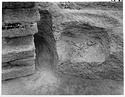
A small square well at 37/ΚΑ (about 0.60x0.70m), on the north slope of the Areopagus. Curbed with rough stones.
Filling of a small shallow well which contained nothing from the POU and since no water was ... Ca. 350-320 B.C ... A small square well at 37/ΚΑ (about 0.60x0.70m), on the north slope of the Areopagus. ... Filling of a small shallow well which contained nothing from the POU and since no water was encountered, may have served only as a storage or rubbish pit.
Thasian amphora dates around 340. |
| David Scahill ... Behind northeast corner of Classical Building; east wall C. Below Hellenistic levels and early Classical pit. Chamber cut through bedrock, depth ca. 0.90m., diameter ca. 2m., roughly square in shape, angling ... LH III A:1 ... Below Hellenistic levels and early Classical pit. Chamber cut through bedrock, depth ca. 0.90m., diameter ca. 2m., roughly square in shape, angling inward toward top. ... Fallen bedrock in northeast corner with geometric pot imbedded in the top. At the floor of the tomb, bone fragments, broken pottery, two figurines and bronze implements along south wall. ... Two distinct clay layers at floor; fine orange layer in northern half, dark brown layer in southern half. |
| Homer A. Thompson ... Cremation burial (trench-and-hole) under S. edge of E-W Street, northern burial. In some records as Grave XLVII.
The western part of the offering trench of the tomb was lost to a Turkish cess pit, and ... Middle Geometric I ... The western part of the offering trench of the tomb was lost to a Turkish cess pit, and disturbances at least as early as the 7th c. ... According to Angel, the cinerary urn contained the cremated remains of an adult male aged ca. 35 years at death. More recent reanalysis confirms the likelihood of an adult aged 30-40 years at death; the sex however is ambiguous, though the skeleton may be female. The cinerary urn also contained at least one burned fragment of an animal bone, identified as the burnt proximal radius of a goat. |
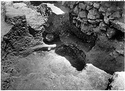
| Mycenaean Grave to W of Pier 12 (Burial 11).
The northern part of the tomb had been cut away by the foundation trench for the south stylobate of the Square Building that preceded the Stoa, and the dromos, ... Myc. IIB-IIIA:1 ... The northern part of the tomb had been cut away by the foundation trench for the south stylobate of the Square Building that preceded the Stoa, and the dromos, if one existed, must have been lost in this operation. ... Although it might be argued from the single internment and the absence of any preserved dromos that this was a pit grave, the location of the body along the edge of the cutting would seem rather to indicate a small chamber tomb that has been cut away at the north. |
|
|