|
|
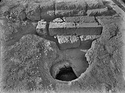
| Pit and drain at SE corner of Apollo Temple. Antedates building of Apollo Temple which was assigned to a date 'late in the third quarter' ... 3rd quarter 4th c. B.C ... Pit and drain at SE corner of Apollo Temple. Antedates building of Apollo Temple which was assigned to a date 'late in the third quarter'. |
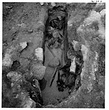
| David Scahill ... Roman temple north. Adult male inhumation. Pit tomb, partially stone-lined ... Late Mycenaean or Final Mycenaean/Submycenaean ... Roman temple north. Adult male inhumation. |
Undisturbed filling to E of Archaic Temple in Eleusinion; fill consisted of a layer of working chips of Kara limestone above a layer of mud brick ... Late 6th c. B.C. and earlier ... Undisturbed filling to E of Archaic Temple in Eleusinion; fill consisted of a layer of working chips of Kara limestone above a layer of mud brick. |
Undisturbed filling inside foundations of small Rectangular Building = Temple of Zeus and Athena. Household pottery, both fine and coarse, and other objects, together with working chips from the construction ... Ca. 375-350 B.C ... Undisturbed filling inside foundations of small Rectangular Building = Temple of Zeus and Athena ... Household pottery, both fine and coarse, and other objects, together with working chips from the construction of the temple. |
Filling in Classical Floor of Agora, to the north of the Temple of Ares; possibly a disturbed pyre ... Early 4th c. B.C ... Filling in Classical Floor of Agora, to the north of the Temple of Ares; possibly a disturbed pyre. |
Pit (e) in bedrock between Temple of Apollo and Metroon. Not A. Walker coin deposit ... 10 March 1936 ... Pit (e) in bedrock between Temple of Apollo and Metroon. |
| Kevin Daly ... Grave in north room of Roman temple, west of well J 2:4; adult inhumation ... Late Helladic IIIC Late-Final Mycenaean/Submycenaean ... Grave in north room of Roman temple, west of well J 2:4; adult inhumation. |
Cistern chamber in the area of the southeast Temple, the mouth cut back in antiquity ... Late 4th - early 3rd c. B.C ... Cistern chamber in the area of the southeast Temple, the mouth cut back in antiquity. |
| Investigations in the area of Archaic Temple Added by E.V June 1963 ΕΛ 324-331. In the annual report for 1959 both the building of the temple itself, and the red limestone addition are dated in the early ... First half of 6th c. B.C. - early 5th c. B.C ... I Pre-Temple levels : Mainly first half of 6th century B.C., with some material as late as the third quarter ... II Temple, first phase: Much first half of 6th c. ... III Temple, red limestone addition: mainly late 6th and early 5th c. |
| Mycenaean Chamber Tomb under north side of Temple of Ares, towards its west end.(1951).
The tomb had a hasty and unfinished appearance oddly at variance with its long history and the quality of the pottery ... 1st: Myc IIB-IIA:1-2, 2nd: Myc. IIIC:1 (1450-1200 B.C.) ... Chamber Tomb under the Temple of Ares |
Filling inside N room of Temple of Apollo, including directly under the foundations of the N room ... Ca. 350 B.C. and earlier ... Filling inside N room of Temple of Apollo, including directly under the foundations of the N room. |
| Pit (f) in bedrock used for casting archaic bronze statue for the first Temple of Apollo Patroos (Hesperia 6 (1937), pp. 82-84) ... 6th c. B.C ... Pit (f) in bedrock used for casting archaic bronze statue for the first Temple of Apollo Patroos (Hesperia 6 (1937), pp. 82-84). |
S.W. of Archaic Temple : Pocket in bedrock. The pocket was cut through a red clay floor. 71 sherds.
Objects: loom weights; lamp.
Early ware: Gray Minyan; Mycenaean; Protogeometric-Late Geometric; Subgeometric; ... Early 6th c. B.C. and earlier ... Pocket in Bedrock South West of Archaic Temple |
The filling from top to bottom uniform, yielding small bits of ancient worked marbles and pottery of the fifth and fourth centuries B.C. mixed with undecorated coarse ware, probably of Byzantine times ... 5th c. A.D.-Byz ... Late Well to West of Temple of Apollo |
Grave in cella of Temple of Hephaisteion. Grave XLVII in notebook. Rotted bones, head to west (adult). Neg. KK 352 ... 9 March 1939 ... Grave in cella of Temple of Hephaisteion. |
Pit with marble chips (disturbed); working chips of the Hephaisteion construction. A few vases apparently contemporary with the building of the temple ... 5th c. B.C. to ca. 450 but disturbed ... A few vases apparently contemporary with the building of the temple. |
Grave in north peristyle of Temple of Hephaisteion. Grave XXXI in notebook. No mention of bones. Coins:
25 February 1939 #4
27 February 1939 #5-#11
6 March 1939 #1 Negs. KK 376, KK 379 ... 25-27 February 1939
6 March 1939 ... Grave in north peristyle of Temple of Hephaisteion. |
| E.D. Townsend Vermeule ... Protogeometric Grave no. 2 at North of Temple of Ares (Grave XXXVII). Rectangular stone-lined pit in filling of Mycenaean chamber tomb (J 7:2); the skeleton of a boy. Cf. P 21275 which is from the "preliminary ... Middle Protogeometric ... Protogeometric Grave no. 2 at North of Temple of Ares (Grave XXXVII). ... P 21275 which is from the "preliminary exploration" of protogeometric burial on the north side of the Temple of Ares, not within this grave. |
E.D. Townsend Vermeule ... PG grave no. 1. Mycenaean Chamber tomb under Temple of Ares. No remains, but cf. P 21275. Cf. under J 7:2 (PG grave no. 1), Agora XIII, pp. 183-190 ... Protogeometric ... Mycenaean Chamber tomb under Temple of Ares. No remains, but cf. |
Cistern System #3: East Chamber at 69/Λ, joined by a crooked passage to 69/ΛΣΤ. Under the southwest corner of the Hellenistic Building to the north of the Temple of Hephaistos ... 175-125 B.C ... Under the southwest corner of the Hellenistic Building to the north of the Temple of Hephaistos. |
Square pit in bedrock southwest of the Hephaisteion. Many marble chips from the construction of the temple of Hephaestus were found here together with a large quantity of pottery and other objects ... Ca. 450 B.C.
Ca. 390-380 B.C ... Many marble chips from the construction of the temple of Hephaestus were found here together with a large quantity of pottery and other objects. |
Hellenistic fill, north of Temple of Ares, on either side of wall running east-west over 50/ΙΓ. Mostly coarse pottery including many stamped amphora handles.
Cf. also nb. P XII, pp. 2297-2298. Coins:
13 ... 275-200 B.C ... Hellenistic fill, north of Temple of Ares, on either side of wall running east-west over 50/ΙΓ. |
| John Camp ... Burial north of Roman temple, E. of polygonal wall.
The tomb, as preserved, consisted of the cinerary urn, which stood in an upright position, its upper part damaged by later disturbance. It contained ... Late Helladic IIIC Late-Final Mycenaean/Submycenaean ... Burial north of Roman temple, E. of polygonal wall.
|
| Julia Shear ... Burial. Roman Temple south half, in fill south of temple crosswall and norh of polygonal wall, layer 37a.
Small, roughly circular pit. The diameter of the pit appeared to be only slightly greater than ... Late Helladic IIIC Late-Final Mycenaean/Submycenaean ... Roman Temple south half, in fill south of temple crosswall and norh of polygonal wall, layer 37a.
|
Diameter of top of well 0.80m.
An early well east of Roman Building, north of Temple of Ares and thus in the region of the Mycenaean cemetery. Sherds almost entirely Mycenaean with nothing later and a ... Mycenaean ... An early well east of Roman Building, north of Temple of Ares and thus in the region of the Mycenaean cemetery. |
Deposit beneath re-used poros blocks.
Fragments of 2 ancient blocks of soft, white poros were reused here for a later foundation. the course of the late wall cannot be traced beyond the length of the two ... 15-17 July 1931 ... Their surface lies -1.38m deep, i.e. 0.82m above the temple stylobate. |
Packing under cobblestones 7 or 8 meters west of the Temple of Hephaistos. A similar filling found in a small hole in bedrock three or four meters north of the Temple. The high quality of the pottery from ... Ca. 500-440 B.C ... Packing under cobblestones 7 or 8 meters west of the Temple of Hephaistos. A similar filling found in a small hole in bedrock three or four meters north of the Temple. The high quality of the pottery from this deposit and the fact that some of it shows signs of burning has suggested that it might have come from a sanctuary destroyed by the Persians. |
| Disturbed Mycenaean chamber tomb.
It was the first Mycenaean burial found in the Agora. It is situated about 20m due south of Tomb VII, only a few meters beyond the south edge of the Augustan foundation ... Myc. IIIA (1st half of 14th c.) ... It is situated about 20m due south of Tomb VII, only a few meters beyond the south edge of the Augustan foundation of the Temple of Ares. |
Burned filling over area of NW Temple (apparently Herulian destruction debris) = Trench I, 18-22/ΛΑ-ΜΣΤ and northwest trench, center at 15-19/ΛΣΤ-Μ Coins:
28 March 1933 #25-#28
29 March 1933 #16-#21
30 ... 28-30 March 1933
5-6 April 1933 ... Burned filling over area of NW Temple (apparently Herulian destruction debris) = Trench I, 18-22/ΛΑ-ΜΣΤ and northwest trench, center at 15-19/ΛΣΤ-Μ |
Cistern System #3: West Chamber at 69/ΛΣΤ, joined by a crooked passage to 69/Λ. Under the southwest corner of the Hellenistic Building to the north of the Temple of Hephaistos. Upper fill of early 1st ... 175-125 B.C ... Under the southwest corner of the Hellenistic Building to the north of the Temple of Hephaistos. |
Within the precinct of the Hephaisteion, about 10m. north of the north stylobate of the temple.
Flask-shaped pit (W. (bottom) 3.14 x 2.73m) probably originally intended as a cistern; used for dumping ... Ca. 375-310 B.C.-Byzantine ... Within the precinct of the Hephaisteion, about 10m. north of the north stylobate of the temple.
Flask-shaped pit (W. |
Evidence of stratification into five layers, although joins between the layers. Layer VI added when the construction of the Roman building above required it. No subdivisions assigned.
Flask-shaped cistern ... Early 3rd-late 2nd c. B.C ... Flask-shaped cistern chamber located on the northern slopes of Agoraios between the NW corner of the Hellenistic Building and the Temple of Aphrodite Ourania. |
Well at U/10-14/4, in Byzantine Room I.
Well is ca. 1.20m in diameter, dug into bedrock. Excavated to depth of roughly -8.00m; sides started collapsing and thus did not dig to full depth. Some stone-lining, ... June 15-16, 17-31 July 1972 ... A much used marble well-head was found collapsed into well midway down period of use fill and a fragment of a ceiling coffer from the Temple of Ares.
Classical dump fill of the 5th-4th c. |
Well on Slopes of Kolonos, apparently with two periods of active service. The earlier dating from ca. the turn of the era well down into the 1st c. A.D. Probable that the well was never cleaned out in ... POU Early to second half 1st c. A.D ... To it may belong the blocks which still lie in situ to the north and east of the well, and with it may be contemporary the propylon between the SE corner of the Apollo temple and the Metroon. |
Well at 15/ΙΕ = Pocket in side of Turkish Pit at 15/ΙΔ.
Shallow well on the lower slopes of the Acropolis, east of the Panathenaic Way, in the area later occupied by the Archaic Building.
Located 3.5m ... 700-675 B.C. with intrusions ... Located 3.5m north of the Archaic peribolos wall, in a spot later covered by the Temple of Triptolemos. |
|
|