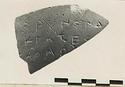
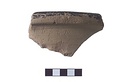
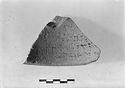
[Agora Object] P 22992: Ostrakon of Kallixenos Aristonymou Xypetaion

Fragment from the foot of a large vase (column krater?) moulded in two degrees. Inscribed on the top. Black glaze, much chipped, on upper surface. Joins the ostraka P 17915 + P 19209, i.e. from the ... 8 April 1953 ... Fragment from the foot of a large vase (column krater?) ... Inscribed on the top. Black glaze, much chipped, on upper surface. Joins the ostraka P 17915 + P 19209, i.e. from the same pot.

[Agora Object] P 30190: Ostrakon of Phrynond[...] Krates[...] Athmo[...]

Broken all around. Parts of three lines inscribed on coarse sherd. Tan-orange clay. The name on the ostraka is Phrynondas not Phrymondas as is written on the card. (PK) Layer 1 of trench in central area ... 25 May 1973 ... The name on the ostraka is Phrynondas not Phrymondas as is written on the card.

[Agora Object] Agora XII, no. 1790

Rolled rim, spreading ring foot, single bell handle. Another, P 23340 H 12:15-U, with a similar tightly rolled rim and space for one handle only (now missing), has a disc foot with rounded profile, similar ... The context, a filling over bedrock below the west part of the Middle Stoa, is inconclusive, being mostly of the second half of the 5th century ... Another, P 23340 H 12:15-U, with a similar tightly rolled rim and space for one handle only (now missing), has a disc foot with rounded profile, similar to the ostraka 1776, 1780, Fig. 21. On 1790 both the foot and the handle, close in shape to that of the one-handler 728, Pl. 30, suggest a date of ca. 500 B.C.

[Agora Object] Agora XII, no. 1794

Base and part of wall. From a small lekane. High flaring ring foot. Inscribed on the underside. For the Graffiti see above under 1792. The neat flaring foot resembles that of 1784, or the ostraka, 1770, ... Context ca. 470-460 B.C ... Inscribed on the underside. For the Graffiti see above under 1792. The neat flaring foot resembles that of 1784, or the ostraka, 1770, 1771; the fragment comes apparently from a pot earlier in type than most of the lekanai from this deposit. The reading of the name Euphronios, restored in the original notice of the graffito and sometimes quoted, cannot be verified.

icon

[Agora Object] P 3786: Ostrakon of Kallixenos Aristonymou Xypetaion

From the rim of a large krater. Rather small rolled rim. Black glaze on the inside, on the rim, and probably for a band below the inscription on the outside. Scratched in the dry clay: Mixed fill over ... 14 May 1934

[Agora Object] Agora XII, no. 1784

Rolled rim, spreading ring foot. Typical of many examples of the late 6th and early 5th centuries. Others similar, but with disc foot, are not necessarily later; cf. 1787, also the fragments used as ostraka, ... Context ca. 520-490 B.C ... Typical of many examples of the late 6th and early 5th centuries. Others similar, but with disc foot, are not necessarily later; cf. 1787, also the fragments used as ostraka, 1773-1779, Fig. 21.

icon

[Agora Object] P 2617: Ostrakon of Megakles Hippokratous Alopekethen

Fragment from the rim of a krater, glazed on the top of the rim, and the inside with red to black glaze nearly all peeled off. The outside so far as preserved, seems to have no glaze decoration but was ... August-September 1932

[Agora Object] Agora XII, no. 1756

Heavy rolled rim flattened on top and meeting the inner face of the wall at a right angle. Ostrakon of Themistokles Neokleous (482 B.C.) ... 482 B.C.

[Agora Object] Agora XII, no. 1761

Narrow outturned rim. Ostrakon of Hippokrates Anaxileo. For the date, probably from "one of the first three or four ostrakophoriai," cf. Hesperia, XV, 1946, p. 272, 6.

icon

[Agora Object] P 5355: Ostrakon of Themistokles Neokleous Phrearrios

Fragment from the bottom of a large open bowl with ring foot. Glazed red inside; a black band outside the foot. Incised on the foot: Cleaning surface of terrace around mouth of well 3. B' building fill ... 9 April 1935

icon

[Agora Object] P 17723: Ostrakon of Themistokles Neokleous Phrearrios

From the bottom of a semi-glazed krater with low base. Incised on the bottom, retrograde: Black glaze inside. Red gravelly fill at end of trench. 4416 Leica PD 1104-4b ... 3 May 1947

icon

[Agora Object] P 12195: Ostrakon of Hippokrates Alkmeonidou Alopekethen

Fragment from rim of a large semi-glazed krater with closely rolled rim, glazed on inside and on the rim. On the inside: Tholos trench L, area of early road drain, layer 7. 2091 Leica, 84-8-30 PD 1104-2a ... 19 February 1938

icon

[Agora Object] P 22993: Ostrakon of Kallixenos Aristonymou Xypetaion

Fragment from foot of semi-glazed krater. Inscribed around lower edge of foot: Glaze red inside, dull black on the outside of the flaring foot. Horos Terrace Trench, heavy stone packing, lower level ... 9 April 1953

icon

[Agora Object] P 3648: Ostrakon of Themistokles Neokleous Phrearrios

Mended from three fragments. From the base of a large open pot with a shallow ring foot. Incised on the bottom: Pinkish buff clay, glazed black inside and around outside of foot. Mixed fill in road ... 25 April 1934

[Agora Object] Agora XII, no. 1781

Rolled rim, spreading ring foot. Narrow glaze band below handles. Large lekane, on the scale of the fragments used as ostraka, 1754 and 1762, Fig. 21. On another equally massive, P 11058 D 15:1, the rolled ... Context ca. 520-480 B.C ... Large lekane, on the scale of the fragments used as ostraka, 1754 and 1762, Fig. 21. On another equally massive, P 11058 D 15:1, the rolled rim is undercut as on 1762. Similar, the foot intermediate between 1753 and 1782, P 24129 Q 12:3 Archaeology, X, 1957, p. 192.

[Agora Object] Agora XII, no. 1771

Flaring ring foot, possibly from a closed pot, not a lekane; the inside left rather rough and apparently never glazed. Ostrakon of Kallixenos Aristonymou (482 B.C.) ... 482 B.C.

icon

[Agora Object] P 12217: Ostrakon of Melanthios Phalanthou

Fragment from base of a large semi-glazed krater, glazed on the inside.Torus profile. Incised on inside: Tholos trench P, layer V. 2163 Leica PD 1104-4d ... 25 February 1938

icon

[Agora Object] P 12081: Ostrakon of Aristeides Lysimachou Alopekethen

Two joining fragments preserve part of the bottom of a krater with black glaze on interior. Incised under foot: Finished Surface. Leica PD 1104-4a, DA 15249, DA 15259 ... 10 March 1938

[Agora Object] Agora XII, no. 1753

Massive rolled rim with unbridged spout; body tapers to echinus ring foot; upcurved handles. Clay a soft light buff, apparently underfired; surface worn; remains of glaze band below handles. For the echinus ... Context ca. 525-500 B.C ... Clay a soft light buff, apparently underfired; surface worn; remains of glaze band below handles. For the echinus foot on other shapes of the first half of the 6th century, see the jug 140, Pl. 8 and the lekane 1839, Pl. 87; Fig. 15. None appear on the fragments used as ostraka, Fig. 21. The tapering body is like that of 1751, but the fully rolled rim is an advance.

icon

[Agora Object] P 17919: Ostrakon of Kallixenos Aristonymou Xypetaion

From the upper wall and rim of a large heavy semi-glazed krater; black glaze inside and on rim. Incised inside, twice over: Red gravelly fill with kalikia. 4955 Leica, 84-8-36 PD 1104-1a ... 7 June 1947

icon

[Agora Object] P 17922: Ostrakon of Themistokles Neokleous Phrearrios

Part of the base of a small semi-glazed krater; base slightly concave beneath. Firm red glaze inside and on outer face of base. Incised on underside: Red gravelly fill with kalikia. 4955 Leica PD 1104-5b ... 7 June 1947

icon

[Agora Object] P 16995: Ostrakon of Themistokles Neokleous Phrearrios

Two joining fragments from rim of a semi-glazed krater. Incised through the black glaze inside: This was noted here as C 18:11 but not in deposit notebook, not within grid for C 18:11. Sand fill. 1743 ... 29 May 1939

icon

[Agora Object] P 19295: Ostrakon of Hippokrates Alkmeonidou Alopekethen

Fragment from the rim of a large semi-glazed krater with very heavy rolled rim, projecting inside as well as overhanging outside. Incised on top of rim: Black glaze on rim and inside. House N, pit ... 24 April 1948

icon

[Agora Object] P 17915: Ostrakon of Kallixenos Aristonymou Xypetaion

From the base of a krater with double torus moulding. Black glaze. Incised on upper face: Joins P 19209 (joined) and P 22992 (two ostraka from the same pot). Fragment ΝΝ 2899: Red gravelly fill with ... 6 June 1947 ... From the base of a krater with double torus moulding. ... Incised on upper face: Joins P 19209 (joined) and P 22992 (two ostraka from the same pot).

[Agora Object] PNT 72: Plastic Spout of Vase with Graffito

Male phallos, attached as spout to the side of a vase. On the inside is a ledge for the reception of a lid. Scratched into the clay on the upper part of the outer face: ΚΕΡΚΙΩ. Clay: Fine, buff, burned ... Early fifth century B.C ... Male phallos, attached as spout to the side of a vase. On the inside is a ledge for the reception of a lid. Scratched into the clay on the upper part of the outer face: ΚΕΡΚΙΩ.

[Agora Object] T 2379: Gorgoneion

Head in relief; grinning mouth and projecting tongue. The back plain and slightly concave, looking as if it had been affixed to something. Apparently complete. Faint traces of white. Gray clay. Red gravelly ... 10 June 1947 ... Head in relief; grinning mouth and projecting tongue. The back plain and slightly concave, looking as if it had been affixed to something. ... Red gravelly fill with kalikia; with ostraka.

[Agora Object] T 2378: Head of Figurine

Grotesque head with large features and prominent brows; fangs at the corners of the mouth. Headdress consists of a stephane under which is a close-fitting cap with ear-flaps (or is this the hair?). The ... 7 June 1947 ... Grotesque head with large features and prominent brows; fangs at the corners of the mouth. Headdress consists of a stephane under which is a close-fitting cap with ear-flaps (or is this the hair?). The back flat, as if from a relief plaque. ... Red gravelly fill with kalikia; with ostraka.

icon

[Agora Object] P 17916: Column Krater Fragment

Fragment from a neck amphora? Glazed inside to base of neck. Head of a bearded man left; fillet in added purple; above, at junction with neck, band of tongues. Relief contour for nape, neck and shoulder ... 6 June 1947 ... Additional fragments give the raised left hand of Dionysos, holding a vine branch. ... Red gravelly fill with kalikia; ostraka fill.