|
|
| Preliminary Report on the 2000 Excavation Season ... John McK. Camp II ... Excavations were carried out in three sections, two to the northwest, (ΒΖ and ΒΕ) and one to the southeast of the Agora square (ΕΛ).
In Section ΒΖ the investigation of the remains of the 11th century settlement ... 6 Jun-28 Jul 2000 ... Excavations were carried out in three sections, two to the northwest, (ΒΖ and ΒΕ) and one to the southeast of the Agora square (ΕΛ).
In Section ΒΖ the investigation of the remains of the 11th century settlement continued. ... The last of the fill containing ostraka was cleared adding another dozen or so to the total number of ostraka found, and the excavation of the 5th century B.C. well was completed.
|
| Agora Excavations 1997 Season Preliminary Report ... John McK. Camp II ... Excavations were carried out in two separate areas: under the Middle Stoa in the Agora square, and just north of the northwest entrance of the Agora. The excavations produced material covering a wide chronological ... 10 Jun-1 Aug 1997 ... Excavations were carried out in two separate areas: under the Middle Stoa in the Agora square, and just north of the northwest entrance of the Agora. The excavations produced material covering a wide chronological span, from the earliest Iron Age to the beginning of the Hellenistic period. ... Over hundred pieces of ostraka were recovered from the late Archaic period. |
| Section ΝΝ: 1947 ... Rodney S. Young ... Excavation continued in section ΝΝ with the aim of clearing the area for the new museum. Because of the unforeseen depth of filling, the area remained unfinished.
Several features were dug and examined ... 10 Mar-3 Nov 1947 ... Excavation continued in section ΝΝ with the aim of clearing the area for the new museum. Because of the unforeseen depth of filling, the area remained unfinished.
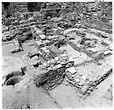
Several features were dug and examined. The Great Drain and the Post-Sullan Drain were cleared out throughout their length within the section, as was the Late Roman Water Channel running under the Roman Bath, which was proved to have two periods of use. |
| AGORA 2022 - Preliminary Report ... John McK. Camp II ... The initial plan to excavate under the modern building at 14 St. Philip Street had to be postponed due to delayed demolition. Instead, excavations were carried out around and inside the Stoa Poikile.
In ... 14 Jun-5 Aug 2022 ... The initial plan to excavate under the modern building at 14 St. ... A reused Ionic column base was found, and more of the lowest step of the façade of the stoa was revealed.
In Section ΒΖ, the area of a collapsed late Roman wall was cleared, and excavation took place in late Archaic and early Classical layers, where a large number of ostraka was found.
|
| Athenian Agora
Excavation Summary for 2021 ... John McK. Camp II ... Excavations continued in sections ΒΖ and ΒΘ in and under the Classical Commercial Building, the Painted Stoa, and the orthostate enclosure suggested to be the Leokoreion.
In section ΒΖ the goal was to ... 14 Jun-6 Aug 2021 ... Excavations continued in sections ΒΖ and ΒΘ in and under the Classical Commercial Building, the Painted Stoa, and the orthostate enclosure suggested to be the Leokoreion.
In section ΒΖ the goal was to find out more about the later Archaic remains, perhaps houses or shops, underlying the Classical building. ... A number of ostraka were found in Persian destruction fills, and a fragment of a small gravestone of the 4th century, probably of a slave, was discovered.
|
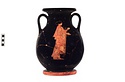
| ΚΚ Excavation Report 1936 ... Dorothy Burr Thompson ... Section ΚΚ, the area inside the modern fence around the so-called Theseion, was cleared to bedrock in order to determine the entire history of that portion of Kolonos Agoraios. Excavation revealed that ... 10 Feb-13 Mar 1936 ... Section ΚΚ, the area inside the modern fence around the so-called Theseion, was cleared to bedrock in order to determine the entire history of that portion of Kolonos Agoraios. ... Then simple houses and workshops, chiefly dealing with metal, were built. The filling of a pit provided extremely fine fragments from red figure and black figure vases, as well as ostraka.
... Dumps of working chips of poros and marble from the time of the of construction of the temple, and the pottery found within them, suggest that work must have begun about the middle of the 5th century. |
| Preliminary Report on the 2010 Excavation Season ... John McK. Camp II ... Excavations took place in five sections: ΒΗ, ΒΘ, ΒΖ, Γ and Δ.
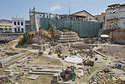
In Section ΒΗ, excavation continued and late fills overlying the Stoa Poikile were cleared. A good cross-section of the stoa foundations was ... 15 Jun-6 Aug 2010 ... Also recovered were fragments of a terracotta aqueduct running along the back wall of the Stoa. Two Byzantine wells within the interior of the building were left undug. ... Below the floor in one of the rooms, several dozen ostraka were found.
|
| Agora Volunteer Report 2017 ... John McK. Camp II ... Excavations took place in three sections, ΒΘ, ΒΖ and ΟΟ, covering a time span from the 14th century B.C. to the 12th century A.D.
In Section ΒΘ work continued in later layers over and in front of the Stoa ... 12 Jun-4 Aug 2017 ... Excavations took place in three sections, ΒΘ, ΒΖ and ΟΟ, covering a time span from the 14th century B.C. to the 12th century A.D.
... In ΒΘ West, more of the remains of the Middle Byzantine settlement were explored; in ΒΘ East, deeper fills were excavated. A collapse of the fill over the Eridanos river opened up part of its south channel and it was possible to see large Doric column drums used as part of the channel construction. |
|
|