|
|
| Marcie Handler ... The contents of this Hellenistic cistern shaft were excavated in a series of layers: the preserved top of the shaft, six layers in the shaft and the fill within the tunnel. At the bottom of the shaft on ... POU: Mid-3rd c. BC
Dumped fill: after 225 BC ... Excavations | 2007 | Trenches | Handler | Room M | East of Wall 7 | Cistern J 1:7 |
| David Scahill ... Protogeometric/Early Geometric well under floors in Room 1, Classical Building II, on north side of south ashlar wall. See J 3:9 for the burial within this well.
Cf. Hesperia Suppl. 50 (2018), p. 106, ... 27 June 2001
17 July 2002 ... Protogeometric/Early Geometric well under floors in Room 1, Classical Building II, on north side of south ashlar wall. See J 3:9 for the burial within this well.
|
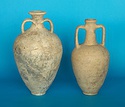
| Marcie Handler ... A deposit of six amphorae and one micaceous water jar was excavated between 20 June and 6 July 2005 in the area north of Wall K. The neck and one handle of one of the amphorae (BZ 1213) had been poking ... Ca. 1st c. A.D ... Excavations | 2005 | Trenches | Handler | Area north of Wall K | Deposit of Amphoras J 1:3 |
Above well at 48/ΙΕ (J 15:1) ... Early Roman |
Pocket in bedrock behind stepped retaining wall ... 7th c. B.C. |
| Marcie Handler ... The Pyre was revealed in a layer of 4th c. fill in the north end of Room 6, just south of Wall 8. Room 6 is defined by the street wall (Wall A) on the west, Wall 7 on the east, Wall 9 on the south (preserved ... 4th c. B.C ... The Pyre was revealed in a layer of 4th c. fill in the north end of Room 6, just south of Wall 8. Room 6 is defined by the street wall (Wall A) on the west, Wall 7 on the east, Wall 9 on the south (preserved only as a stub on the east side of the area), and possibly Wall 8 or Wall 6 on the north.
2.5 meters SW of the pyre, a patch of floor surface at J/10-1/20 at 52.188 masl. was found. |
| Marcie Handler ... It was situated in the NW corner of Room 3 in the Classical Commercial Building, just S of Wall 11, the cross-wall that divides Room 3 from Room 4 to the north. The pyre pots were found surrounded by ... Late 4th c. B.C ... It was situated in the NW corner of Room 3 in the Classical Commercial Building, just S of Wall 11, the cross-wall that divides Room 3 from Room 4 to the north. The pyre pots were found surrounded by fill with charcoal and burnt bone below a floor surface preserved immediately to the E (J/13,14-2/7,8; 52.20 masl.).
The pyre deposit continued up to the north face of late Roman Wall C, suggesting that these lower courses of Wall C were packed into a narrow trench instead of built up within a wider foundation trench. |
Well E (diameter 1.10-1.20m) just outside the northwest corner of the southwest Fountain House.
Dug initially as a pit (J 15:2) partially covered by an early Roman wall ... Early 7th c. B.C ... Dug initially as a pit (J 15:2) partially covered by an early Roman wall. |
Brian Martens ... This deep stratum (ca. 030m) is delayed Persian destruction cleanup deposited in the 470s B.C. it contains about one generation's worth of pottery, almost exclusively dating between about 500-470 B.C ... 29 June-19 July 2017
12–15 July 2022 ... The stratum abutted E-W polygonal Wall 8 and was laid down for Post-Persian renovations of the building. The dump of pottery raised the floor level of the building; atop J 1:18 was a layer of crushed bedrock and a renewed floor surface.
The deposit joins fill taken in 2013 that runs under the scarp of Wall G.
Addendum 2022: The collapse of Wall G’ allowed further work on deposit J 1:18 in the 2022 season. |
| Pyre against north face of polygonal wall, Room 2, Classical Building II. No floor preserved above, but the pyre is below floor level 51.820masl, preserved just to the east and above patchy floor with ... Ca. 275-260 B.C. |
Small pit north of Wall C (appr. 0.50 E-W x 0.35m N-S). Coins:
11 August 1994 #1125-#1127 ... 3rd c. B.C. |
Located just north of the stepped retaining wall between the Great Drain and the Poros Monument (Propylon).
Short period of use; dumped filling above, mostly cemetery debris ... Early Protogeometric |
| Initially uncovered with a diameter of c. 1.05m. Its south side extends under the south wall of the Classical structure and so clearly predates it. The highest preserved portion of the well shaft (at the ... 22 July-9 August 1994
26 June 1995
3-7 July 1995 ... Its south side extends under the south wall of the Classical structure and so clearly predates it. ... Because the south side of the well shaft projects beneath the E-W Classical Wall at J/6,7-2/20, we attempted to leave undug the portion of the well fill that underlies that wall. ... Human bones associated with Grave J 2:11 |
| David Scahill ... Burial in Geometric well (J 3:8), in Classical Building II, Room I, next to south ashlar wall. "No grave goods!"
ADDENDA: J. Papadopoulos later associated P 34449 and P 34450 to that grave. (Cf. Agora ... Geometric ... Burial in Geometric well (J 3:8), in Classical Building II, Room I, next to south ashlar wall ... ADDENDA: J. Papadopoulos later associated P 34449 and P 34450 to that grave. |
| Brian Martens ... It was partially excavated during the 2012 and 2013 seasons. The tomb, located at the center of Room III in the NE area of section ΒΖ, was found under fill surrounding perpendicular mid-to late 6th c ... LHIIIA ... B.C. walls (Walls 17 and 18). N-S Wall 17 and E-W Wall 18 were found during the 2012 excavation season and were excavated below their lowest courses. ... A strip of fill at the north side of the cutting, just below the scarp of Wall L remained unexcavated at the end of the season (J/17,18-1/10,11; 51.290-51.376 masl.)
2018:
We removed a final strip of fill in the chamber below the scarp under Wall K (J/17,19-1/10,11). ... Scarping revealed the blocking wall of the chamber. |
| A closely compacted group of 431 bronze coins found at ca. 52.50m., against the east brick wall. No sign of a container. Others dribbled down against the channel wall in a restricted area to as deep as ... Late Roman |
| Terracotta deposit in SW corner of Room K and E of Roman Wall L. Roman layer of red, compact earth.
Baskets 50,52,54. Coins:
18 July 2002 #1282
19 July 2003 #1295 ... 4th c. A.D. |
| Marcie Handler ... Fill within the drain from the basin on the west side of Roman Room B through Wall A.
After we removed the fill within the basin on the west side of Roman Room B (BZ XXVII p. 5325), we began excavating ... Late Roman |
| Marcie Handler ... Pyre under floor no. 9 in the center of Room 4. It was adjacent to the southern face of Wall 4, but at lower elevation than the lowest course of the wall foundation (which was found at 52.250 masl.), suggesting ... 375-350 B.C ... It was adjacent to the southern face of Wall 4, but at lower elevation than the lowest course of the wall foundation (which was found at 52.250 masl.), suggesting that the pyre was deposited during a phase of the building that predates Wall 4. Pyre J 2:30 was located approximately 0.20m below Pyre J 2:28, which was excavated during the 2007 excavation season.
The oblong pit for Pyre J 2:30 was cut into Floor no 10 (removed in Lot ΒΖ 2122) and was covered by Floor no 9 (removed in Lot ΒΖ 2120), both of which dated approximately to the last quarter of the 5th c. |
| Brian Martens ... Mycenaean Chamber Tomb J 1:11, located in the area north of Wall K, was partially excavated during the 2014 season. At this point the full western extent of the chamber has not been located because of ... LHIIIA ... Mycenaean Chamber Tomb J 1:11, located in the area north of Wall K, was partially excavated during the 2014 season. ... The skeleton along the southern wall wore a necklace of carnelian and glass-paste beads, which was excavated in situ. ... The work on J 1:11 was concluded in the 2015 season. |
|
|