|
|
Dug as Tholos Trench V, Room E, burnt filling of plundered wall trench of S wall of court. See also lot Ζ 484 ... Late 6th c. B.C ... Dug as Tholos Trench V, Room E, burnt filling of plundered wall trench of S wall of court. |
Rectangular cutting at 58-60/ΚΘ-Λ, probably a plundered wall trench ... 350-290 B.C ... Rectangular cutting at 58-60/ΚΘ-Λ, probably a plundered wall trench. |
Pit along house wall foundations to south = footing trench. Uncertain context, possibly no later than ca. 425 B.C ... 450-400 B.C ... Pit along house wall foundations to south = footing trench. |
Filling in the footing trench of the late Roman Fortification.
Includes Layer 1 and Layer 2 of Library Colonnade opposite Room 2. "Note: both these layers are fill thrown into V.W. footing trench." (nb.p ... End 3rd. c. A.D ... Footing Trench of Venetian/Valerian Wall |
Investigations within the Stoa of Zeus, the north part, various levels.
Notebook references: Stoa Trench E Layers IV and V, Stoa Pits A, B and C, and Layers I and II of area between back wall and retaining ... 5th c. B.C ... Notebook references: Stoa Trench E Layers IV and V, Stoa Pits A, B and C, and Layers I and II of area between back wall and retaining wall of Stoa. Also in Trench E the footing trench of Pier V, all layers; also Trench D, Pier III, all layers; also trench F, layers III and IV. |
Pocket in bedrock, 50/Λ (= Trench, 50-54/Λ), measuring 4.00x0.60m, 0.60-0.90m deep; possibly cutting for wall foundation Coins:
22 April 1932 #1 ... 330-300 B.C ... Pocket in bedrock, 50/Λ (= Trench, 50-54/Λ), measuring 4.00x0.60m, 0.60-0.90m deep; possibly cutting for wall foundation |
| Marcie Handler ... It was situated in the NW corner of Room 3 in the Classical Commercial Building, just S of Wall 11, the cross-wall that divides Room 3 from Room 4 to the north. The pyre pots were found surrounded by ... Late 4th c. B.C ... It was situated in the NW corner of Room 3 in the Classical Commercial Building, just S of Wall 11, the cross-wall that divides Room 3 from Room 4 to the north. ... The pyre deposit continued up to the north face of late Roman Wall C, suggesting that these lower courses of Wall C were packed into a narrow trench instead of built up within a wider foundation trench. |
Material from trenches:
a) 1.00-7.00m. from East End of Stoa.
b) 18.40-21.40m. from East End of Stoa.
c) 46.60-48-60m. from East End of Stoa.
d) 51.00-53.00m. from East End of Stoa.
e) 79.00-81.00m. from ... 2nd c. B.C ... Includes drain trench in front of back wall of Stoa (some disturbed, some undisturbed fill), soft fill above stone drain, fill from within stone drain, channel behind stylobate. |
| Pyre in layer 2a in Room 9 SE of Greek House δ. Sand, gravel, ashes, iron nails, carbon, some bones partially cut away by foundation trench of SYPE wall.
Coin
1 July 1971 #459 ... 260-200 B.C ... Sand, gravel, ashes, iron nails, carbon, some bones partially cut away by foundation trench of SYPE wall.
|
Amphora dump at P/2,3-6/6,8.
Layer "8b" in Room 6 of Greek House δ.
Trench cut into lower levels next to west wall of Room 6. Fragments of amphorai, tiles.
No coins ... Early Hellenistic ... Layer "8b" in Room 6 of Greek House δ.
Trench cut into lower levels next to west wall of Room 6. |
Fill around the upper block of the southwest corner of the early (Archaic) peribolos wall, south of the Propylon, and hard fill at the side of a trench for a modern wall.
Uncatalogued material: 181 sherds ... 2nd c. B.C ... Fill around the upper block of the southwest corner of the early (Archaic) peribolos wall, south of the Propylon, and hard fill at the side of a trench for a modern wall.
|
Two pebble floors of Roman date, broken into at the SE and north, covered a 6x5m trench in ΕΛ, bounded by the unexcavated east trench and a wall from Byzantine Building D (Wall A). Under these pebble floors ... 220 - 150 B.C ... Two pebble floors of Roman date, broken into at the SE and north, covered a 6x5m trench in ΕΛ, bounded by the unexcavated east trench and a wall from Byzantine Building D (Wall A). |
Soft Trench behind Stoa Stylobate, opposite Piers 21 and 22, along W face of Shop front wall. Herulian destruction debris at the north end of the Stoa of Attalos. Coins:
20 February 1954 #1-#2
22 February ... Late 3rd c. A.D ... Soft Trench behind Stoa Stylobate, opposite Piers 21 and 22, along W face of Shop front wall. |
Investigations in the Hellenistic Metroon, various levels. Stoa Pits A, B, C, D, E, F, H and I (various layers).
Locations include:
SW corner of Primitive Bouleuterion; from contemporary filling alongside ... 8th-6th c. B.C ... Locations include:
SW corner of Primitive Bouleuterion; from contemporary filling alongside its south wall.
Footing trench of the Primitive Bouleuterion and from filling accumulated during the period of use of the Primitive Bouleuterion.
... B.C. but with much earlier material
- back fill in footing trench of Hellenistic Metroon=footing trench of Period IV of mixed fill ... Coins:
20 April 1934 #1 (from Pit F, footing trench of Period IV, foundation of colonnade) - #2 (Pit E, from dump, probably from footing trench of Period IV). |
The data in the Deposit Notebook is presented by trench; an attempt is made here to accumulate data from similar layers across the trenches. Subdivisions:
.1=Post Hadrianic cleanup
.2=Marble working waste ... 2nd c. B.C.-3rd c. A.D ... The data in the Deposit Notebook is presented by trench; an attempt is made here to accumulate data from similar layers across the trenches ... Subdivisions:
.1=Post Hadrianic cleanup
.2=Marble working waste
.3=Iron working waste
.4=Industrial period
.5=Construction fill of South Stoa II
.6=Drain and drain channels/trenches at Stoa back wall |
| Pyre in Horos Terrace Trench, East end, set into Strosis 5.
In room 1 (court), near north wall. Concentration in stratum, no pit discerned; described as a "little nest of pots" within layer V (Lot ΜΣ ... 350-325 B.C ... Pyre in Horos Terrace Trench, East end, set into Strosis 5.
In room 1 (court), near north wall. Concentration in stratum, no pit discerned; described as a "little nest of pots" within layer V (Lot ΜΣ 115), which overlay the hard strosis 5, the uppermost preserved floor of the house. |
Laura Gawlinski ... Pebble floors of Roman date covered the northern half of a 6x6m square trench in ΕΛ, bounded to the west by the post-Herulian Wall and to the east by a wall from Byzantine Building D (Wall A) to the east ... Hellenistic/ 220-150 B.C ... Pebble floors of Roman date covered the northern half of a 6x6m square trench in ΕΛ, bounded to the west by the post-Herulian Wall and to the east by a wall from Byzantine Building D (Wall A) to the east. |
| Marcie Handler ... Continued from 2000 season, 10-12 July 2000; BZ XXIII p. 4472.
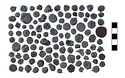
The hoard was originally excavated during the 2000 season (Lot BZ 1049, 5th-6th centuries AD), from a higher elevation through a gap in the ... 10-12 July 2000
21-22 July 2003 ... The hoard was originally excavated during the 2000 season (Lot BZ 1049, 5th-6th centuries AD), from a higher elevation through a gap in the stones of Wall A, and was thought to be the bottom of a foundation trench for the wall. ... Foundation trench of N/S street wall, in ash pit. 53.505m-53.089m. |
Pit in Tholos Trench V (below Layer e).
In plan it would seem to have been oval, though its east end is c/../ by the south wall of the North Archaic Home. Its N-S width is 1.25m, its E-W length is 1.40m ... 7th-early 6th c. B.C ... Pit in Tholos Trench V (below Layer e).
In plan it would seem to have been oval, though its east end is c/../ by the south wall of the North Archaic Home. |
Channel J (in ΗΗ)
Cutting that probably originally held a drain. Packed with amphoras and other coarse pottery. It tapped the poros aqueduct wall just East of our explanatory trench at the East end of ... 1st c. B.C. - early 1st. A.D ... It tapped the poros aqueduct wall just East of our explanatory trench at the East end of ΗΗ. |
Ostrakon Pit (Horos Terrace Trench). Oval pit cut into bedrock. Packed filling of stones, coarse sherds and roof tiles; among these a few fragments of finer vases and 22 ostraka, probably from the ostracaphoria ... Ca. 490-480 B.C. and later ... Ostrakon Pit (Horos Terrace Trench). Oval pit cut into bedrock. ... Some joins also from Strosis 6-7 against polygonal terrace wall, outside pit. |
Trial trench IV. A thin strip of undisturbed fill excavated on the north side of the upper terrace, just inside the line of the Archaic peribolos wall.
Probably this small patch of clay represents part ... Protoattic ... Trial trench IV. A thin strip of undisturbed fill excavated on the north side of the upper terrace, just inside the line of the Archaic peribolos wall.
|
| North of House G (RSY=Pyre 13).
Concentration of artifacts, small pieces of bone, and burnt material in stratum, no pit discerned. The pyre is cut by the trench of a wall of a Roman house to north. It ... 290-250 B.C ... The pyre is cut by the trench of a wall of a Roman house to north. |
| C.G. Thomas ... Geometric grave. Bones discarded.
Tomb located about 2m west/west-southwest of the EG1 child inhumation, beneath the restored line of a hypothetical wall connecting the western "apse' and the south wall ... Middle Geometric II ... Tomb located about 2m west/west-southwest of the EG1 child inhumation, beneath the restored line of a hypothetical wall connecting the western "apse' and the south wall of the Geometric House. ... The highest preserved side of the trench was approximately 65.15 masl. Oriented more or less to the points of the compass, the trench measured about 0.80m (east-west) by about 0.70m (north-south). |
| Anne McCabe ... Enchytrismos burial of an infant in Byzantine Room C, L/15-2/13, at 52.915m. Although disturbed by roots, the skeleton (AA 373) was articulated and lay parallel to Wall 1, with head at the NW and feet ... 14-15 June 2007 ... Although disturbed by roots, the skeleton (AA 373) was articulated and lay parallel to Wall 1, with head at the NW and feet SE. ... The layer in which the burial was set, and into which the footing trench along the N face of Wall 23 appears to have been cut,, was excavated from 52.911-52.555m with no soil change (Lot ΒΗ 505). |
| Homer A. Thompson ... Cremation burial (trench-and-hole) under S. edge of E-W Street, northern burial. In some records as Grave XLVII.
The western part of the offering trench of the tomb was lost to a Turkish cess pit, and ... Middle Geometric I ... Cremation burial (trench-and-hole) under S. edge of E-W Street, northern burial. ... The western part of the offering trench of the tomb was lost to a Turkish cess pit, and disturbances at least as early as the 7th c. B.C. had cut away the upper part of the cinerary urn and the adjoining trench filling. The tomb was found directly below a Classical wall. |
Construction fill below floor of Brick Building.
Areas involved:
a) Western portion of Room A: packing below floor.
b) Room B: packing below floor of northern,larger room.
c) Fill over water channel in ... First quarter 2nd century, before its end ... Areas involved:
a) Western portion of Room A: packing below floor.
b) Room B: packing below floor of northern,larger room.
c) Fill over water channel in smaller, southern room B; channel discovered by builders of Brick Building,rebuilt by them and covered over.
d) Foundation trench of earlier building beneath Brick Building, filled and covered by builders of Brick Building.
e) "Apparently from below floor of building" (nb.p. 1282).
... Lot 20 "Ash, Carbon and Slag Fill, against the west face of dividing wall between Rooms A and B" of 1936 excavations including P 19790, SS 5379 and coin ΣΑ-16. It was believed to antedate the construction of the building since the wall of the building seemed to cut it. |
Investigations to the south of the Metroon, in the passageway between the Metroon and the Tholos; accumulated layers, from the Geometric and earlier periods to the 3rd and 2nd centuries B.C.
Cf. Hesperia ... Geometric to second c. B.C ... Not included in this deposit are disturbed areas west of Propylon and footing trench of south face of Metroon but cf. ... No finds from section Ζ are included in this deposit although some consideration has been given to this in the deposit notebook. Trench A (Nbp. 1535, Ζ), in particular, was singled out to be included with this deposit. However, as it represents an area south of the polygonal wall it has been included with G-I 11-12 and the other Tholos Trenches of section Ζ. |
Roman Water Mill: construction fill in footing trench of mill race wall Coins:
24 April 1933 #2-#30, #39-#40, #43-#44, #46-#67, #69-#76, #82-#95
25 April 1933 #30, #32-#35, #37-#40, #42-#43, #45, #47 ... 450-475 A.D ... Roman Water Mill: construction fill in footing trench of mill race wall |
N-S Cut on 20m. line (area of Road, area of Stoa, area N of Stoa)
various levels and dates over the three areas.
Investigations to the northwest of the market square in the area of the road that bordered ... Protogeometric to Late Roman ... Plundered trench of early N-S wall: geometric to 4th c. |
| James Artz Pirisino Daniele Kylindreas Miltiades ... Excavation in Room 3 of ΒΘ West revealed 5 ceramic vessels in a row against the eastern face of Wall 12. 3 complete vessels (ΒΘ 122, 124, and 125) were catalogued, along with the base of a plain glazed ... 9th-11th c. A.D ... Excavation in Room 3 of ΒΘ West revealed 5 ceramic vessels in a row against the eastern face of Wall 12. 3 complete vessels (ΒΘ 122, 124, and 125) were catalogued, along with the base of a plain glazed flat-bottomed basin (ΒΘ 121). In addition to the vessels along the face of Wall 12, 5 coins were found within the fill, as well as a bronze ring and fragments of painted plaster (ΒΘ 134) from a wall.
... Many fragments of a deep bowl with poorly preserved glaze (ΒΘ 171) were wedged between the wall of the pithos and the southern face of Wall 23. |
| Eugene Vanderpool ... Grave (E.L. Smithson: Grave II: SM).
Unlined trench, roughly the size of the deceased, cut into bedrock to a depth of just over 1.50m. Oriented north-south, the tomb pit measured 1.69m in length (length ... Late Mycenaean/Submycenaean-Earliest Protogeometric ... Unlined trench, roughly the size of the deceased, cut into bedrock to a depth of just over 1.50m. Oriented north-south, the tomb pit measured 1.69m in length (length of the skeleton in situ, 1.65m), and had a width, as excavated, of 0.40-0.58m. the west side was slightly undercut, and a small part of the east side was cut buy the cellar wall of a modern house, but only the very edge of the tomb at an upper level was touched, whereas the contents of the grave were untouched. |
| Eugene Vanderpool ... Grave (adult female). (In some records as Grave XXXI).
The tomb was partly destroyed in antiquity; there are sherds of all periods down to Late Roman (and later) note din the fill immediately above it ... Middle Geometric I ... A modern well was partly cut into the northeast portion of the tomb as preserved, and an ancient block, reused in a modern wall, was founded directly on bedrock just to the southwest of the tomb.
... The cinerary urn, probably once stood in a shallow sinking a little in from the northwest end (cf. trench-and-hole). the cutting itself proved to be an enlargement of the mouth of the filled in Protogeometric well M 17:5. |
| Dorothy Burr Thompson ... Child's Grave (E.L. Smithson: Grave XXVIII: G).
Cf. Container Lot ΣΤ 165 (fill over geometric grave).
Neat, rectangular, unlined trench, cut into bedrock to a preserved depth of 0.20m,below the level ... Early Geometric I ... Neat, rectangular, unlined trench, cut into bedrock to a preserved depth of 0.20m,below the level of the floor of the so-called Geometric House. The tomb was located in the area between pits A and D, and was just over 2m to the east of the preserved west wall of the Geometric House. |
|
|