|
|
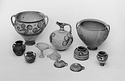
Cistern System #3: West Chamber at 69/ΛΣΤ, joined by a crooked passage to 69/Λ. Under the southwest corner of the Hellenistic Building to the north of the Temple of Hephaistos. Upper fill of early 1st ... 175-125 B.C ... E 6:2 (upper fill): Three Knidian amphora handles; type 51 C lamp; long-petal bowls.
E 6:1 and E 6:2 (lower fill): Joins between objects in both chambers and tunnel between them indicate fill the same. Twenty stamped amphora handles; long petal bowls; figured bowls with thick walls and small indistinct figures must date in second quarter of 2nd c. |
Filling of Middle Drain (Tr. H+F in Section Ζ). Sand and gravel filling of the old course of the west branch of the Great Drain, a large (ca. 1.00m. deep and 1.30m. wide) underground channel in the area ... 150-100 B.C ... Figured bowls have thick walls, small stamps, and were produced in worn molds of coarse workmanship. Half of bowls long-petal. One long-petal mold. |
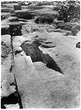
| Mycenaean Chamber Tomb with niches.
One of the few tombs found in the Agora that has an almost architectural regularity with squares chamber (1.75m wide by 2.10m deep) and axially centered dromos (4m long ... Myc. III A 1:2 ... One of the few tombs found in the Agora that has an almost architectural regularity with squares chamber (1.75m wide by 2.10m deep) and axially centered dromos (4m long by 1.10m wide tapering upward to 0.80m). ... The tomb had not been robbed or disturbed in post-Mycenaean times, for the doors of the main chamber and the niches were found closed with rough rubble walls. |
Evidence of stratification into five layers, although joins between the layers. Layer VI added when the construction of the Roman building above required it. No subdivisions assigned.
Flask-shaped cistern ... Early 3rd-late 2nd c. B.C ... Moldmade bowls with thick walls and small indistinct figures similar to those on bowls in G 5:3 and some examples in Thompson's Group C. No long-petal bowls. |
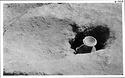
| Rodney S. Young ... Grave 6 in notebook (E.L. Smithson: Grave XXII: PG). Bones discarded. Urn cremation (trench-and-hole).
JP
Roughly rectangular trench cut through hard earth into bedrock to a depth of about 0.35m, approximately ... Late Protogeometric ... JP
Roughly rectangular trench cut through hard earth into bedrock to a depth of about 0.35m, approximately 1m long and 0.50m wide. ... The ground around the mouth of the trench, its rims and walls, were reddened and baked hard by burning in situ. |
| Mycenaean Chamber Tomb below Middle Stoa Terrace.
The tomb was entered from the west by a stepped dromos, at least 4.20m long by 1.10 to 1.50m. wide, splaying slightly toward the doorway, which was 1.26m ... Myc. IIIA:1 ... The tomb was entered from the west by a stepped dromos, at least 4.20m long by 1.10 to 1.50m. wide, splaying slightly toward the doorway, which was 1.26m high by 0.60m wide at the base with a lightly arched top. ... Although the roof had collapsed, the walls were preserved to an average height of 1.35m.
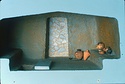
... These fibrous remains seem certainly to represent coffins rather than biers, perhaps rough unsmoothed boxes of cypress or pine measuring 1.65m long by 0.45m. broad and about 0.40-0.43m high. |
| Mycenaean Chamber Tomb occupies a considerable part of the western half of section ΕΕ; lies about half way up the north slope of the Areopagus towards its eastern end, just below the highest point of the ... Myc. III A:1 ... The tomb consists of a roughly rectangular chamber approached from the north by a long dromos. it is entirely hewn out of the rock of the hill and except for the wall of rough stones that blocked the doorway, there is no masonry. ... Neither of these walls disturbed the tomb proper in any way.
Body and offerings were removed from the grave not long after they had been placed there (Mycenaean times); the chamber must had been entered by digging down from the top in the western half. |
|
|