|
|
| Section Ζ, 1954 Excavation Report ... Dorothy Burr Thompson ... The area excavated in 1954 fn Section Ζ φell within the Middle Stoa to the east, the Great Drain to the north and west, and the terrace walls to the south. Various parts had been previously excavated under ... 16 Apr-6 Jul 1954 ... The area excavated in 1954 fn Section Ζ φell within the Middle Stoa to the east, the Great Drain to the north and west, and the terrace walls to the south. Various parts had been previously excavated under other section names.
|
| Preliminary Report on the 2004 Excavation Season ... John McK. Camp II ... All the work during the season 2004 was concentrated on the northwest corner of the Agora north of the Panathenaic Way.
In BZ North, the last remains of Byzantine fills and walls were removed and Hellenistic, ... 7 Jun-16 Jul 2004 ... In BZ North, the last remains of Byzantine fills and walls were removed and Hellenistic, early Roman and late Roman fills were explored. ... In Section ΒΗ, excavation of the Byzantine remains behind the Painted Stoa continued. Various walls representing several buildings and phases were exposed. |
| Preliminary Report on the 2009 Excavation Season ... John McK. Camp II ... Excavations were conducted in four sections: Γ, ΒΘ, ΒΗ and ΒΖ.
In Section Γ, the investigation of the Classical buildings south of the Tholos continued with the aim to find out if they were civil, commercial ... 8 Jun-31 Jul 2009 ... Byzantine pottery started to emerge by the end of the season. No walls were reached but was seen in the scarps. ... Various other features were found, such as pithoi and pits.
... The rubble walls dividing the stoa into rooms were also removed. |
| Sections Ε, Ν, Η 1952 ... Homer A. Thompson ... Mycenaean graves were excavated in section Ε.
Section Ν was disturbed by late pits, bothroi and walls. Excavation was carried out through Roman levels. The area seemed to have been leveled out and raised ... 4 Mar-31 May 1952 ... Section Ν was disturbed by late pits, bothroi and walls. Excavation was carried out through Roman levels. ... Remains of various topographical structures were revealed. |
| Preliminary Report on the 2008 Excavation Season ... John McK. Camp II ... Excavations took place in three sections, two north of Hadrian Street (ΒΗ and ΒΘ) and one in the old area south of the Tholos (Γ).
In Section ΒΗ, layers in, over and behind the building identified as the ... 10 Jun-1 Aug 2008 ... In Section ΒΗ, layers in, over and behind the building identified as the Painted Stoa were excavated to down below the middle Byzantine walls. The back wall and the interior colonnade were explored and detailed information about the building construction were gained. ... Mostly late fills were dug but the top of Byzantine walls came to sight in some places, as was large worked blocks that may have come from one or several Classical buildings.
... Elsewhere various floor levels and pits were dug, most of them dating to the 4th century B.C. |
| Agora Excavations Preliminary Report - Summer 2014 ... John McK. Camp II ... Excavations in 2014 were carried out in three sections: ΒΘ, ΒΓ and ΒΖ.
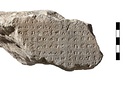
In Section ΒΘ, overlying the Painted Stoa, the Byzantine houses of the 11th century A.D. were further exposed in the western part ... 9 Jun-1 Aug 2014 ... Reused blocks, of which some may be associated with the Painted Stoa, were recovered from the walls. A fragment of an inscribed opisthographic stele turned out to be part of the records of the Poletai.
... In Classical levels, numerous post-holes of various sizes and depths were dug.
|
| Preliminary Report on the 2002 Excavation Season ... John McK. Camp II ... Excavations continued in the northwest corner of the Agora (sections ΒΕ and ΒΖ) and in the Eleusinion area (ΕΛ), and a trial trench was opened up in the Panathenaic Way (Σ).
In section ΒΖ, the exploration ... 10 Jun-2 Aug 2002 ... Within the Byzantine walls some ancient blocks were found, several of them probably coming from funerary monuments. ... In section ΒΕ, various levels in, around and under the Classical Commercial Building were explored. |
|
|