|
|
Mended from thirteen fragments, with a few gaps restored; burned.
Flat underside with slight string marks. Fairly deep body, slightly concave below rim. Prominent wheel ridging inside. Handles tightly ... 290-250 |
Bowl (b) mended from five fragments, lid (a) from three fragments, with a few chips missing; burned.
Flaring foot, slightly concave with string marks underneath.
Horizontally projecting flange. Low, ... 270-260? |
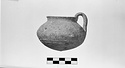
| Whole vessel preserved. Crack running from lip down under curve of body and around base. Various small chips in surface. Squat, round-bottomed vessel with round mouth, single handle. Unglazed miniature ... 4th/3rd c. B.C. |
Pan.
Floor and part of wall.
Cup rests on ridge; slightly convex underside. Conical profile; five grooves preserved on exterior. Emblem surrounded by two to three scraped grooves. Bust of Pan, with head ... 240-200 ... Courby calls the type juvenile satyr (Courby 1922, no. 10, pp. 230--231). ... Cf. also Richter 1958, p. 375, fig. 28, pl. 93, a mold from the Chersonese; Barr-Sharrar 1987, C 95, pp. 56--57, pl. 31, a bronze South Italian(?) Pan, and TC 6, p. 116, pl. 63, a pyxis lid with young satyr, a lagobolon clearly visible behind his shoulder. |
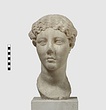
| Intact save for end of nose and ancient chip from right ear and recent chips from hair and left ear.
Socket for fitting into body rough-picked; carried up high in back of neck.
Hair in marked waves above ... Julio-Claudian period. |
|
|