icon

A 20:4: Pyre

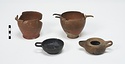
A compact group of four complete vases and a lamp, found on a house floor; possibly the remains of a sacrificial pyre but without evidence of burning or the characteristic votive vases. Layer II, "nest ... 425-400 B.C.

V 24:2: Archaic Well in OA

Well 2: archaic. Diameter, top ca. 1.00; bottom ca. 0.90m. Water level:ca -7.00m In the use filling, along with the plain water pots was a black-figured neck amphora assigned to the Edinburgh painter ... Last quarter of the 6th c. B.C.

J 18:7: Well

Scanty remains of use fill in lowest 0.30m. with Byzantine dump above ... 400-350 B.C.

icon

A 17:1: Well on Lower Slope of Hill of the Nymphs

A well on the lower slope of the Hill of the Nymphs, (diam. 1.20m -water level -7m), to 7.90m. The scanty use filling at the bottom contained water jars and pitchers as well as the inventoried objects; ... Second quarter of 6th. c. B.C.

G 6:3.2: Rectangular Rock-Cut Shaft Lower fill

Containers Lot Α 306-Lot Α 340. Estimated Grid ... Ca. 575-535 B.C.

H 12:15.1: Well POU

Estimated Grid

icon

F 5:2: Sacrificial Pyre under Room 18 in House 3

Grave V, under room 18 in House 3, plus burned deposit at 94/IΘ. Identified as sacrificial pyre by SIR on Agoraios Kolonos: In southeast corner of house 3. 35 artifacts, bone and charred material in pit, ... Ca. 300-275 B.C.

icon

R 12:4: Well in Stoa Shop 3

Well in Stoa Shop 3. Diameter at top 1.20m. The mouth o the well was overlaid by a large conglomerate block placed by the Stoa builders to seal it. Masses of pottery including many water-jars filled the ... Ca 520-480 B.C.

R 12:1: ΘΡΑ Well East of Stoa Room 2

Thra (ΘΡΑ) Well (East of Stoa Room 2). Heavy dumped filling, including figured, black and plain wares, and also a quantity of animal bones, mostly skulls of oxen. On many of these the horns had been sawn ... Ca. 520-480 B.C.

F 19:2.2: Lower fill

It is a considerable deposit including both figured and plain wares, the red-figure consistently of the second quarter of the 4th c. Estimated Grid ... Ca 375-340 B.C.

U 25:2: Well 6 in ΟΑ

Well 6: archaic. Diameter 1.20m Well on the northwest slope of the Acropolis, below the Klepsydra. There are three fills, all thrown into the unfinished well at the same time (end of 6th- beginning of ... Last quarter of 6th c. B.C.

F 19:2: Cistern

Bottle-shaped cistern with dumped fillings on NW slopes of Areopagus; appears not to have been finished in antiquity: the walls and floor show no traces of stucco. Lower filling, ca. 375-340 B.C. Upper ... Ca. 375-275 B.C.

G 11:3: Well

Well (stone-curbed shaft) near middle of Tholos which served the prior building. Period of Use dated to ca. 500-480(?) B.C., Upper fill dated to ca. 480-470 B.C. or soon after in Agora XXX (a gradual ... Ca. 500-480 B.C.

D-E 8-9:1: Theseion Cisterns A and B (1936)

Two chambers connected by a tunnel, all filled at the same time, but with slight Hellenistic disturbance. Chamber A, to west at 14/ΛΗ, B to east at 14-15/ΛΒ on grid for section RR. Cistern system ca. 20.00m ... Ca. 325-275 B.C.

icon

Q 13:5: Well Below Stoa Terrace Fountain

Well below Stoa Terrace Fountain. Heavy dumped filling, including a great variety of figured and plain wares. Never completed in antiquity because of hard bedrock. Estimated Grid ... 575-550 B.C.

G 18:1.2: Middle fill

Heavy deposit of good black and plain wares ... 450-425 B.C

O 18:2: Hedgehog Well

A small square well at 37/ΚΑ (about 0.60x0.70m), on the north slope of the Areopagus. Curbed with rough stones. Filling of a small shallow well which contained nothing from the POU and since no water was ... Ca. 350-320 B.C.

icon

H 12:15: Well

Well A, early 5th c. B.C. Near the Agora Boundary Stone, northwest corner of Middle Stoa; diameter at top 0.92m, widening to 1.15m and more below. Shaft neatly faced with stones to a depth of 0.70m below ... Ca. 520-480 B.C.

N 7:3: Skytha Well

Well at 45/Θ (Skytha Well) near the north side of the market square. No period of use was distinguished, since it was impossible to clear the well to the bottom. The considerable quantity of dumped filling ... Ca. 460-440 B.C.

icon

G 6:3: Rectangular Rock-Cut Shaft

A cave-in not long after the digging of this shaft destroyed its possible usefulness as a well and thereafter it was used as a dump. Two principle periods of such use were noted, and within these several ... Ca. 575-480 B.C.

G 18:1: Well

Dumped filling in a well on the west slope of the Areopagus (apparently separate, no mends between them, but differing little in date) the bottom filling apparently thrown in towards the beginning of the ... Ca. 425-400 B.C. and earlier