|
|
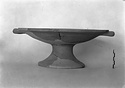
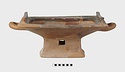
| One handle and many fragments missing; restored in plaster. High base flaring toward bottom; shallow bowl; broad flat rim with two handles under it.
Firm brown clay clinging to the interior suggesting ... 24 February 1935 |
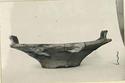
| The bottom entirely missing, also about half the upper part.
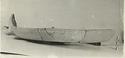
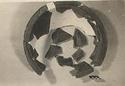
Two non-joining groups. A central bowl, perhaps with rounded bottom and a very broad sloping rim on one side of which is a large lug. Two horizontal ... 13 April 1934 |
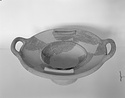
| Badly broken; about half the rim missing; the stand broken. Shallow bowl; flat rim; two lugs on rim.
Cooking ware fabric, blackened in places. Cut at north end of Stoa Terrace, Layer V, on floor of house ... 25 July 1950 |
| About half the rim and part of the floor preserved with one handle and the start of the stand. Shallow bowl with broad nearly flat rim; perforated stand; stubby rolled horizontal handle set just below ... March 1939 |
| About half of rim and body and one handle with a wide horned lug projecting from rim above it, preserved. On underside trace of spring of foot or stand. Flat floor. Low sides, flat on top. Two holes in ... 30 March 1932 |
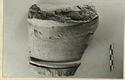
| Nearly one-quarter of the circumference and the full height preserved, of a base with moulded rings at its bottom; the wall pierced by two small round holes. A round hole through the center of the flat ... 20 October 1947 |
| Missing both handles, save for one root, and fragments of rim and base; restored in plaster. Hollow circular stand spreading out of foot to form a resting surface. Four square openings are cut in its sides ... May-June 1951 |
| A single fragment preserves part of the curving wall of a shallow basin or brazier, with a projecting rim slightly round on the top. Attached to the wall below the rim is a wide flat lug handle, its top ... 21 October 1947 |
| a) Basin: Most of wall and rim and one-third of foot missing. A shallow bowl on a high hollow flaring foot, convex underside, carefully finished. Traces of lugs on the lip, one on either side.
Coarse ... 27-28 June 1935 |
| Half of one handle and about one-quarter of rim and body preserved.
Large open basin with deep broad groove on top of projecting rim.
Very flaky reddish-brown clay. Dull brownish glaze on interior.
Cf ... 11-17 May 1938 |
| High flaring stand. Shallow body with flat projecting rim. Two horizontal rolled handles set just below rim. Restored in plaster.
Coarse pink clay with white grits. Blackened inside, perhaps from use ... April-May 1936 |
| The bottom missing. Shallow body and downturned rim, grooved at the inner and outer edges of its upper face. Double rolled horizontal handles applied close to rim.
Pink clay; thin black glaze wash inside ... April-May 1936 |
Fragment of bowl and rim with one handle.
Low spit-rest, slightly concave on top, extending across width of rim.
For a rim fragment used as an ostrakon (Kleippides Deiniou, 443 B.C.) cf. Athens 13795, ... Context ca. 500-470 B.C. |
Fragment of bowl and rim with one handle; start of stand.
Shallow flat-floored bowl curving up to plain rim rounded on top. Heavy rolled horizontal handle at level of floor; above it, rim rises to form ... Context ca. 500-475 B.C. |
Common 5th century type. Others from the Agora are P 2362 R 13:4 Hesperia, IV, 1935, p. 515, fig. 27, 82; J.H.S., LXXXII, 1962, pl. V, 3, right; P 11015 B 15:1 Hesperia, XVIII, 1949, pp. 335-6, 99; P 21695 ... Context ca. 460-440 B.C. |
Upper part.
Deep bowl with concave outer profile; high spits set on rim. Cooking ware.
For another heavy 4th century example cf. Olynthus, XIII, pl. 247, 1023, lug handles; spit-rests broken off ... Context probably third quarter of 4th c. B.C. |
Rim and handle.
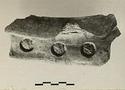
Probably from an eschara. Rectangular lug handle ornamented with three circular palmette stamps; narrow rim rounded on top. Hard red clay with traces of red wash ... Context 4th c. B.C. |
Stand missing.
Broad bowl with deep central concavity; rolled rim with two horizontal rolled handles attached at edge. On floor, just below rim, two low spit-rests. Gritty reddish clay; streaky red to ... Context accumulation of second half of 4th c. B.C. |
Fragments from two closely similar examples; composite drawing.
Profiled rim and base; loop handles doubled back to rim. Gritty pinkish clay; thin black wash inside.
Typical for the second half of the ... Context ca. 375-325 B.C. |
Fragment of rim and floor with handle.
Deep basin with doubled-back loop handle. Broad groove on rim as if to take a heavy lid. Flaky reddish clay; brown wash inside ... Context ca. 350-320 B.C. |
Handles missing.
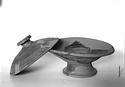
Basin and lid; handles probably as 2035. Deep bowl with plain rim; domed lid, the broad knob hollowed out on top. All much warped. Red clay; thin brown wash on inside and outside of bowl, ... Context, second half of 4th c. B.C. |
Small series. Plain flat-topped rim; flaring base. Cooking ware.
Similar, from the same deposit, but larger, the stand more substantial and pierced with two rectangular openings, P 4869; see also P 21957 ... Context ca. 435-425 B.C. |
Small series. Rim flat on top, roughly moulded outside; doubled-back handles. Household ware; much warped.
Restored in plaster ... Context ca. 375-325 B.C. |
Stand and floor fragment.
Lower edge of stand moulded; two holes in wall. Cut through the center of the floor, a hole ca. 5.8 cm. in diameter. Heavy pink household fabric with buff surfacing; floor worn ... Context 4th c. B.C. |
| Rectangular eschara. Small bits of sides and edges missing; one corner broken of, and a corner of the support gone. Handles missing. The brazier is supported on a rectangular foot, hollow, with a small ... 30 May 1933 |
Rectangular version, to take portable oven, as 2027.
A rim fragment from a rectangular eschara in Aegina, Aegina Museum, preserves part of a low narrow spit-rest and, on the rim, written in the wet clay, ... Context ca. 420-390 B.C. |
|
|