|
|
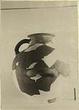
| Walls fragmentary but profile complete; one horizontal handle missing. Plump body low ring foot; flat projecting rim.
Handmade of coarse micaceous cooking ware; thin fabric. Well, bottom fill. Context ... 7-8 July 1947 |
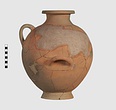
| Mended from many pieces, missing fragments restored in plaster. Typical micaceous-ware hydria; straight ring foot; ovoid body, short neck, rim flat on top. Slightly dented in making. Well. Context ca ... 30 July 1947 |
| The vertical handle and most of one horizontal handle and a few fragments of the wall are missing; restored in plaster. Tall ovoid body on high base ring; short neck, down-turned lip.
Gritty brown clay ... 17 May 1938 |
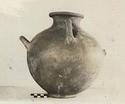
| Small fragments missing throughout. Restored in plaster. Plump body, ring foot; mouth rather irregularly shaped.
Micaceous ware. Well beneath Stoa gutter. Context ca. 520-490 B.C. Leica, IX-54 ... May-June 1954 |
| Very fragmentary; restored in plaster. Much of side and lip missing; one horizontal handle and half of the other remain; nothing of the vertical handle. Low, false ring foot.
Micaceous brown clay. Handmade ... 22 April 1935 |
| Similar to P 5460 (Β 1463). One handle is missing. Somewhat smaller and with very much narrower lip.
The clay appears to be slipped. Unglazed.
ADDENDA P 5460: Round-bodied hydria on ring base; narrow ... 20 April 1935 |
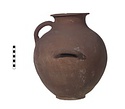
| Household Hydria. Lip chipped. Vertical handle broken but preserved. Very rotund shape. Ring foot, flat projecting rim. Fine slip much worn.
Reddish-brown micaceous clay. Well L, box 6. Context ca. 575-550 ... 16 July 1959 |
Vertical handle and one horizontal handle missing.
Flaring rim, false ring foot.
The flaring rim, heavy body proportions and rudimentary foot are early features, but this piece does not correspond closely ... Context probably as late as the mid 6th c. B.C. |
Low ring foot; vertical handle set high.
Similar, P 23477 J 14:3, before ca. 570 B.C ... Context ca. 575-560 B.C. |
Broad-based, with low ring foot. Contents, measured with water to the brim, 16 liters, or about 5 choes ... Context ca. 575-550 B.C. |
Moderately high ring foot; vertical handle at top of shoulder.
The characteristic shape for the later second and the third quarters of the 6th century, although other examples show variations in the height ... Context ca. 575-550 B.C. |
Globular body. Contents, measured with water to the brim, 6350 cc., or just under two choes.
Others from the same well-filling came apparently from the same shop: P 5460, P 5462 ... Context ca. 550-500 B.C. |
Globular body with well-rounded shoulder; high flaring ring foot; handle set on shoulder.
On some examples of the last quarter of the 6th century the shape is more ovoid; cf. the large inscribed hydria ... Context ca. 520-490 B.C. |
Rim undercut; fusiform body on very high flaring ring foot; the vertical handle set on the shoulder curve and the horizontal handles far down on the wall.
Close, P 874 G 16:1 Hesperia, XXI, 1952, pl ... Context ca. 425-400 B.C. |
| Mended from three pieces, one of them being a handle; cracked. Part of lip restored; small hole below the one horizontal handle. Plain thickened rim; ring foot with straight profile and narrow resting ... 5 May 1953 |
Thickened rim, globular body, straight-sided ring foot. For the handle set still lower see P 24663 R 12:4-POU Pots and Pans, fig. 28 left ... Context ca. 520-480 B.C. |
|
|