|
|
Sacrificial Pit VI in notebook = RSY Grave 18 See also B 21:23 ... Ca. 525-500 B.C. |
| Crevice in Rock (Grave?) at 70/ΝΣΤ (below modern surface accumulation).
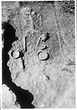
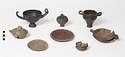
Identified as a sacrificial pyre, with characteristic banded plates and saucers, by SIR ... 4th c. B.C./300-250 B.C. |
| Sacrificial pyre, disturbed; a small pyxis (P 14864) is close to that from B 18:4. First half of 4th. c. B.C., perhaps first quarter.
West of House C. Pottery and cinders in pit in stratum. The pyre was ... First half 4th. c. B.C. |
| Pyre in House T (= House D), Room 2 (5th c.) and fill east of pyre.
Earlier than the other pyres of this house.
Pottery, slivers of burnt bone, and heavy deposit of carbonized material and cinders in ... Ca. 420-410 B.C. |
| Disturbed pyre containing only a pyxis and a chytridion.
No notebook account of excavation exists. The pyre may have been located at the edge of an ancient road. There is no record of bone or burning ... 350-325 B.C. (?) |
Use filling of first half of 1st c.; dumped filling of late 1st c.(?). This well, near its mouth, cuts off the end of the upper passage of the cistern at 53/Ε. Subdivisions:
.1=Dumped filling
.2=POU ... First half of 1st c. A.D. POU |
Containers 1-14. Very fragmentary pottery. Some material earlier than late 1st c. A.D. Coins:
10 May 1939 #4-#5
11 May 1939 #4-#9
12 May 1939 #5
15 May 1939 #7-#9
17 May 1939 #1-#2
23 May 1939 #1 ... Late 1st c. A.D. |
| Pyre(?) in House N, S.W. Room. (=House C, Room 10)
In room 10. Vessels from an earlier pyre were found dispersed in the makeup of the latest "floor" in the room, with tile fragments trodden into its surface ... First quarter of the 4th c. B.C. |
Filling in a sizeable pit. The objects, along with the dimensions of the cutting from which they came, might suggest offerings in a disturbed grave but there was no evidence of skeletal remains ... Ca. 430-415 B.C. |
| Pyre 1 in Central House, Room XI, strosis 3. Sacrificial pyre with characteristic small vases amid carbonized twigs and bone.
Near north side of courtyard. This pit was cut slightly into strosis 3 (lot ... 1st quarter 4th c. B.C. |
Filling around rubble wall (35/ΚΕ). It contained a mass of pottery, most of it uninventoried ... Ca. 425-400 B.C. |
A pit, perhaps a well, extending beneath the foundations of [Building D, the Primitive Bouleuterion] the Hellenistic Metroon. Not completely dug due to its position. A dumped filling so far as dug, apparently ... Ca. 575-525 B.C. |
| Pyre in House C, Room 8 (RSY=Pyre 6).
Near east corner of room 8. Artifacts, burnt bone, burnt sticks, and large cinders in a shallow pit dug into surface of layer 3, and covered by layer 2. Some cinders ... 350-325 B.C.-end of 4th c. B.C. |
Archaic Pit at 25/ΙΓ, near the northeast corner of the market square. Filling in upper part of shaft, cleared only to a depth of 3.10m because of rock conditions ... 600-550 B.C. |
| Artifacts, burnt bone, ash, cinders and charcoal in pit in bedrock. The pyre lay directly under mosaic floor A. the deposit is not badly disturbed, however, and it is possible that it was laid immediately ... Early second quarter of 4th c. B.C. |
| Grave XXVI in notebook = RSY Grave 12 ... Ca. 525-500 B.C. or sightly later |
| Pyre in Room 2, area west of street (RSY=Pyre 12).
In courtyard. Artifacts, bone, ash, carbon, and cinders in pit in floor sequence. The rectangular pit was cut into a white strosis with marble chips (ΠΠ ... 315-300 B.C. |
Refuse pit at 51/Ζ; it had been partly cut away at the north by the late Roman retaining wall; the dumped filling a homogeneous deposit of figured, black and plain wares. Red figure oinochoe in the style ... Ca. 450-420 B.C. |
| At the northwest foot of Areopagus. Square stone-curbed well with no clear evidence for a period of use; appears to be a single dump ... Ca. 500 B.C. |
First half of 5th c. B.C. |
Investigations to the south of the Metroon, in the passageway between the Metroon and the Tholos; accumulated layers, from the Geometric and earlier periods to the 3rd and 2nd centuries B.C.
Cf. Hesperia ... Geometric to second c. B.C. |
| Thamneus' Cellar, a storage cellar on the north slope of the Areopagus. Lower filling of mid-6th c. B.C., upper filling of last quarter of 6th c. B.C ... 6th c. B.C. |
Well at 73/Μ on the lower northeast slope of the Areopagus.
Diameter of 0.90m. It seems to have been abandoned because of the very soft stereo that kept falling in from all sides. Many pieces of terracotta ... Ca. 430-420 B.C. |
| Well below Stoa Terrace Fountain.
Heavy dumped filling, including a great variety of figured and plain wares.
Never completed in antiquity because of hard bedrock. Estimated Grid ... 575-550 B.C. |
High proportion of material in unusually complete codition ... 475-450 B.C. and later |
| North of House G (RSY=Pyre 13).
Concentration of artifacts, small pieces of bone, and burnt material in stratum, no pit discerned. The pyre is cut by the trench of a wall of a Roman house to north. It ... 290-250 B.C. |
Fillings below the courtyard floor of the Poros Enclosure west of the Areopagus. The lowest layer, over bedrock, is of the archaic period and may have accumulated on the spot before the start of building ... First half of 5th c. B.C. |
Within the precinct of the Hephaisteion, about 10m. north of the north stylobate of the temple.
Flask-shaped pit (W. (bottom) 3.14 x 2.73m) probably originally intended as a cistern; used for dumping ... Ca. 375-310 B.C.-Byzantine |
| Coins:
22 May 1937 #1 ... 425-400 B.C. |
| Grave V, under room 18 in House 3, plus burned deposit at 94/IΘ. Identified as sacrificial pyre by SIR on Agoraios Kolonos:
In southeast corner of house 3. 35 artifacts, bone and charred material in pit, ... Ca. 300-275 B.C. |
A well (diameter 1.10m) at the east edge of the valley road leading from the SW corner of the Agora, about 90m SW of the Tholos. The mouth of the well was subsequently covered by the east wall of the Great ... Ca. 500-480 B.C. |
A well on the lower south slope of Kolonos Agoraios. Last quarter of the 5th. c. B.C. But upper fill dated to 3rd. to mid-2nd. century B.C. and lower fill dated to ca. 425-400 B.C. in Agora XXX. Coins: ... 425-400 B.C. |
Thra (ΘΡΑ) Well (East of Stoa Room 2). Heavy dumped filling, including figured, black and plain wares, and also a quantity of animal bones, mostly skulls of oxen. On many of these the horns had been sawn ... Ca. 520-480 B.C. |
Square pit in bedrock southwest of the Hephaisteion. Many marble chips from the construction of the temple of Hephaestus were found here together with a large quantity of pottery and other objects ... Ca. 450 B.C.
Ca. 390-380 B.C. |
A well on the NW slope of the Areopagus; unfinished well-shaft dug to a depth of only 3.05m., and refilled with broken pottery and other debris. The shaft clearly was begun with the intention of digging ... Ca. 520-480 B.C. |
Well 6: archaic. Diameter 1.20m
Well on the northwest slope of the Acropolis, below the Klepsydra.
There are three fills, all thrown into the unfinished well at the same time (end of 6th- beginning of ... Last quarter of 6th c. B.C. |
| Pit, partly cleared; dumped filling of first half of 3rd. c. B.C., but with considerable material of the 4th. c. Hellenistic.
Its rotten schist walls collapsed some time near then and it was filled up ... 4th-3rd c. B.C. |
Well at 115/ΣΤ (all the 5th c. fills of 116/ΣΤ). The lower part of the shaft contained a heavy deposit of pottery and other objects of the late archaic period, both coarse and finer wares; probably a post-Persian ... Ca. 500-480 B.C.-Roman |
|
|