|
|
North of Eleusinion: Fill in Room 3 of Roman Building. 614 sherds (6 miniature shapes, 20 intrusive sherds).
Objects : terracottas; loom weights; spindle whorls; disks; handmade tray; lamps.
Early ware ... First half of 6th c. B.C.-Mixed Fill to ca. 480 B.C. |
Well 12: Archaic.
It lies on a rocky ledge about thirty meters north of the Klepsydra, just east of the Panathenaic street. In spite of its depth, it produced little pottery and its contents were of slight ... 6th c. B.C.? |
Filling associated with construction of Poros Building. A small amount of fragmentary pottery found in the clay filling of the original floor; perhaps deposited as late as ca. 425-400 B.C. Cf. 18:4 and ... Ca. 475-450 B.C. or later. |
| Broken all around.
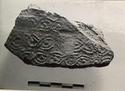
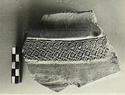
Fragment from side with guilloche pattern in relief.
Thick fabric, red at core, light brown and highly micaceous on surface. Sherds from same fill in B 654. Poros Building floor, second ... 11 June 1949 |
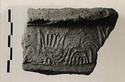
| Cracked from shoulder; raised ridge at top of piece, probably at the junction of neck. Below the ridge, lotus chain in low relief, the flowers alternately upright and reversed.
Micaceous, porous red ... 24 June 1950 |
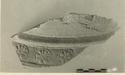
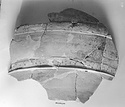
| Fragment preserving part of neck and shoulder of large pithos. Raised band at junction of neck and shoulder. Below this, a band of rosettes in relief. Then a smaller raised band.
Clay dark buff at surface, ... 1932 |
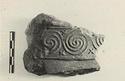
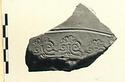
| A running spiral pattern in relief on a slightly raised band; stars as filling ornament.
Clay red at core, gray at surface. Well, upper fill. Leica, 82-534 ... 28 April 1938 |
| The base of the vertical band handle of a coarseware pot. Maze pattern stamped at base of handle.
Highly micaceous red clay with white grits. Ostrakon fill. Context, late archaic accumulation, to ca ... 24 April-13 June 1947 |
| Perhaps from upper shoulder of a large pithos, just below the neck. Below the neck, a raised moulding with a band of guilloche in relief below.
Gritty micaceous pink clay; slipped outside. B' building ... 9 April 1935 |
| A number of joining fragments preserve part of the body of a large pithos around which run two slightly raised bands averaging about 0.04m. wide. The bands are decorated with a geometric pattern of impressed ... September 1932 |
| Single fragment preserves lower part of a handle and the immediately adjacent part of the body of a large coarse pot. In a rectangular stamp at the base of the handle are two spirals.
Micaceous clay with ... September 1932 |
| Fragment preserving a little of shoulder with molded ridge above stamped spiral band.
Slightly micaceous heavy fabric; light brown on exterior, bright red within. Well in Stoa Shop III, upper fill. Context ... March 1955 |
| From the shoulder of a pithos. Three stamped palmettes from the zone decorating the shoulder at the point of junction with the neck.
Reddish-buff coarse clay with bits. Catalogued May 1960. North of ... 24 June 1959 |
| Mended into two large fragments; rim and neck do not join. Much of the upper part; nothing of the bottom. Plain-edged rim; ridge at base of neck. Below the ridge a band of stamped spirals, crosses in the ... (1961) |
Upper part only.
Below the shoulder-ridge a band of running spirals; on the wall two zones of noughts and crosses.
For the shape see the Kerameikos and North Slope pithoi, p. 193, note 4 and 1507. For ... Context to ca. 500 B.C. |
One-piece pithos. Below the shoulder-ridge a zone of lotus flowers, set end-to-end in pairs; on the wall, two zones of noughts and crosses.
Another, fragmentary, also from the Acropolis North Slope, Athens, ... Context ca. 520-480 B.C. |
Neck and wall fragment.
From a one-piece pithos. A nought-and-cross band below the shoulder-ridge, a second further down the wall; no impressed patterns ... Context ca. 575-535 B.C. |
Neck and shoulder fragment.
Pronounced shoulder angle; probably from a neck-pithos. Below the shoulder-ridge a band of tightly wound spirals separated by pairs of drops.
For the shape see p. 194, note ... Context ca. 520-480 B.C. |
Shoulder fragment.
Below the ridge a zone of running spirals loosely wound and separated above and below by small x's.
A closely similar piece, P 25001, comes from Q 13:5, context of ca. 575-540 B.C ... Context ca. 425-400 B.C. |
Handle fragment.
At the base of the handle a stamped rectangle enclosing a pair of spirals. Thin pithos fabric; from an amphora? ... Context ca. 575-535 B.C. |
|
|