D 17:15: Rectangular shaft

Rectangular shaft neighboring the well D 17:12. Dug only to a depth of 4.40m. and provided with two galleries or channels extending from it. Apparently never intended as a well. Refilled with the dug bedrock ... 4th c. B.C.

icon

F 20:1: Pyre

Identified as Pyre by SIR. Debris filling of the middle of the 4th c. B.C. including the remains of a sacrificial pyre. Objects dispersed in red-clay fill uncovered in removal of modern staircase. A broken ... 4th c. B.C. disturbed

U 19:2: Well Y North of the West End of the Yellow Poros Foundation

Well Y, in area North of the West end of the Yellow Poros Foundation. The shaft had cut through the wall of an earlier well and the cavity had been packed with stones by the diggers of the new well. In ... Earth 5th c. B.C.
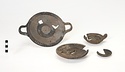

D 10:4: Pit

Deposit in a cutting in bedrock on Kolonos Agoraios. Sherds in container Lot ΠΘ 4a ... Probably 4th c. B.C.

H 7:4: Construction Filling

Filling inside N room of Temple of Apollo, including directly under the foundations of the N room ... Ca. 350 B.C. and earlier

icon

B 18:3: Pyre

Pyre in House T, Room 2 through floor of second period (RSY=Pyre 5) in the industrial area west of the Areopagus. 4th. c. BC. Concentration of artifacts, burnt bone, and charcoal in floor makeup consisting ... 375-350 B.C.

B 12:3: Rectangular Pit

Mixed filling in a well cut rectangular pit. Debris of the second half of the 5th. c., deposited as late as the second quarter of the 4th. c. B.C ... 4th c. B.C. and earlier

I-J 14-15: Filling

Exploration in the peristyle of the Heliaea (1960); evidence for rebuilding in the third quarter of the 4th c. B.C. with some disturbance as late as 1st-2nd c. A.D. Date of reconstruction ca. 325 B.C ... Ca. 350- 325 B.C.

C 19:11.2: Fills 1, 2 and 3

Includes fill behind well tiles ... Ca. 425-400 B.C.

H 12:11.1: Upper fill

The absence of certain shapes (no kantharoi or cup-kantharoi) may be due to the nature of the establishment from which the material came. Also, absence of rouletting save for one example. The lack of these ... Ca. 390-375 B.C.

D 5:1: Stuccoed Pit

Stuccoed pit, 2m x 2.50 m, rock-cut. Coins: 26 March 1937 #1 (not a coin) ... Ca. 400-350 B.C.

icon

B 19:3: Pyre in House C

Pyre in House C, Room 8 (RSY=Pyre 6). Near east corner of room 8. Artifacts, burnt bone, burnt sticks, and large cinders in a shallow pit dug into surface of layer 3, and covered by layer 2. Some cinders ... 350-325 B.C.-end of 4th c. B.C.

P 8:5: Well

Well at 19/ΚΔ, beneath the west colonnade of the Square Market Building in the northeast corner of the Agora. Diameter ca. 1.25m. Water level ca. -3.50m. The construction of the well was rather careless, ... Ca. 580-560 B.C.

icon

M 18:6: Urn burial

Grave 3 in notebook. Outside Archaic cemetery, inhumation burial. Deposit list says black glaze pithos (P 8922) containing the bones of a child and four small vases. The pithos lay on its side with the ... Last quarter of 6th century B.C.

icon

C 14:3: Sacrificial Pyre

Artifacts, burnt bone, ash, cinders and charcoal in pit in bedrock. The pyre lay directly under mosaic floor A. the deposit is not badly disturbed, however, and it is possible that it was laid immediately ... Early second quarter of 4th c. B.C.

H 12:11: Well

A well about 2.00m. SE of the Tholos precinct wall. The presence of the water-clock strengthens the probability, suggested by its location, that the well served one of the public buildings in the neared ... Ca. 410-390 B.C.

C 19:11: Well

Well (diameter 0.91m, water level -7m) in House H, Room 10 (and pit over). Plain shaft cut in stereo; pit at mouth of well,reused as drainage pit at start of tile drain running west. Scanty use filling ... Ca. 425-400 B.C.

E 6:3.3: Layer III

Ca. 375-310 B.C.

J 11:1: Fourth Century Hole

Irregular depression in bedrock (ca. 7x5m), ca. 2m deep; area south of E-W Late Roman wall. Dumped filling apparently intended to level off the area. Coins: 11 March 1952 #10 12 March 1952 #1-#5 13 March ... Ca. 400-325 B.C.