|
|
Pit in deep depression in bedrock. Also includes containers from early fill under late Roman floors down to bedrock at 81-83/ΚΗ-ΛΒ. Notebook cites early fill, ca. 6th. c., with some obviously late disturbance ... 7th c. to ca. 575 B.C. |
Fifth century lekythos deposit in area of Mycenaean Tomb. Lot Η 81a ... 5th c. B.C. |
| Well on lower northwest slope of Areopagus. Dug to 6.60m. and abandoned because of danger. Single dumped deposit.
Perhaps this context: P 528, P 1223 (JWH). Coins:
22 April 1932 #1 ... Second half 1st c. B.C.-early 1st c. A.D. |
Destruction Layer, Brick Building.
It represents material from the layer of fallen brick covering the floor and wall socles of the Brick Building and therefore marking the destruction of the structure ... To ca. 165 |
Fillings immediately antedating the building of the Stoa.
Cf. Hesperia 6 (1937), p. 20 and the debris of a pottery works behind the Stoa (H 7:1). |
Accumulated debris on the west side of the market square.
Related layers added 1999/2000 (JWH), e.g. "Gravelly layer above burning", "Clearing Classical floor", "Lowest level above bedrock", "Below burning", ... First half of 5th c. A.D. |
Square pit in bedrock southwest of the Hephaisteion. Many marble chips from the construction of the temple of Hephaestus were found here together with a large quantity of pottery and other objects ... Ca. 450 B.C.
Ca. 390-380 B.C. |
Investigations within the Stoa of Zeus, the north part, various levels.
Notebook references: Stoa Trench E Layers IV and V, Stoa Pits A, B and C, and Layers I and II of area between back wall and retaining ... 5th c. B.C. |
Pottery Deposit at 57/ΙΔ (also 57/ΙΣΤ and 63-66/Κ-ΚΕ). Contents of pit range from Mycenaean to Turkish; apparently the dump of a modern antiquities dealer ... Modern Context |
Filling behind retaining wall of Stoa of Zeus. The remains of unfired clay adhering to the interior of various pieces make it probable that the material in this filling is a mass of debris from the floor ... Ca. 435-425 B.C. |
"Fauvel Collection"
Collector's dump? Debris in the cellar of a modern house, probably once that of F.S. Fauvel.
The collection included vases of all periods, from Geometric to Turkish; a number of the ... Modern Context |
Carefully cut in bedrock with firm footholds on either side. The use filling is represented by a few fragments of water jars (uninventoried), indicating a short period of use. The dumped filling, below ... Ca. 470-425 B.C. |
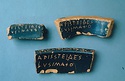
| Pit (6x10) in the valley between the Areopagus and the Hill of the Nymphs. Large cutting in bedrock with 540 ostraka, mainly of the late eighties of the 5th. c. B. C. Much pottery, principally of the early ... Ca. 500-450 B.C. |
| Well below Stoa Gutter opposite Pier 1.
Heavy dumped filling remarkable among Agora well-deposits both for the high quality and the good conditions of pottery of all sorts.
It represents the stock of a ... Ca. 520-490 B.C. |
|
|