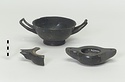
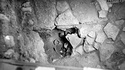
I 17:3: Well

Digging terminated at 14.50m. due to falling bedrock. Scanty pottery remains at 10.00m. In the mouth and upper part of the shaft was a heavy dumped filling of much shattered fragments, for the most part ... Last quarter of 5th c. B.C.

Q 8:1: Narrow Trench in Bedrock

Narrow trench in bedrock. Cf. Section Σ, p. 4358 (nb. XXII) same trench, same filling. EV notes that the cutting probably.. to the "narrow cutting in bedrock". The filling seemed to be ca. 425-420 B.C ... Third Quarter to Last Quarter of 5th c. B.C.

icon

D 17:7: Disturbed Pyre

Pyre /Burial (?) disturbed, in the area of the Poros Building west of the Areopagus. In northeast corner of room 4 west. Concentration of artifacts, tiny slivers of bone, and burning in a layer of fill ... Early 4th c. B.C.

J 18:5: Pit C

Small deposit including red figured fragments ... Second and third quarters of 4th c. B.C.

A 20:9: Fillings

"South Triangle" abandonment filling over Brown House (House A) in the industrial area. Layers 1-3 and layer 4, to floor of second period. As late as the 3rd. c. B.C. but composed largely of earlier material ... 3rd c. B.C. and earlier

I 13:3: Cut between Middle Stoa Piers 1 and 2 from West

Crosscut between Middle stoa Piers 1 and 2 from west (south aisle), layer II. Chiefly late 5th to mid-4th c. B.C. Coins: 2 July 1965 #1 ... Late 5th to mid-4th c. B.C.

H 13:4: Well

Formerly G 13:5. Cleared to a depth of 8.50m. where further collapse made work impossible. Use filling not reached. Lower dumped fill dated to ca. 425-400 B.C., with objects P 24209, P 24210, 24211. Upper ... Ca. 425-375 B.C.

E 19:5: Pit

North and South Rectangular Stereo-cut Rubbish Pits. These two adjacent rock-cut pits, of uncertain original purpose, were filled with deposits of rubbish evidently contemporary and probably dumped simultaneously, ... Second half of 5th c. B.C.

C 19:4: Pit

Debris filling in a pit cut in bedrock at W side of House H, Room 10 ... Ca. 425-400 B.C.

F 14:2: Closed Deposit

Small compact deposit. Cutting. High proportion of good black glaze; 21 loom weights (19 pyramidal, 2 lentoid); a very large red-figured skyphos somewhat recalls the style of earlier work of the Dinos ... Ca. 430-420 B.C.

D 17:9: Well

An unfinished well in the northwest room of the Poros Building, west of the Areopagus. Dumped filling. Chips from marble-working, variety of plain and figured wares ... Ca. 400-385 B.C.

O 22:1: Cistern at 31/ΚΑ

Unfinished cistern at 31/ΚΑ ... Ca. 360-325 B.C.

D 12:4: Pit

Deposit of fine table ware and lekythoi, both black-figured and red; the plain wares closely resemble those from the well H 6:5 ... 470-450 B.C.

N 21:7: Pit

Refuse pit at 51/Ζ; it had been partly cut away at the north by the late Roman retaining wall; the dumped filling a homogeneous deposit of figured, black and plain wares. Red figure oinochoe in the style ... Ca. 450-420 B.C.

A-B 21-22:1: Terrace fillings

West Terrace, South End, Layers IV and V. Heavy dumped filling associated with terrace walls at the extreme south end of the excavations in the Areopagus industrial area. The proportion of figured and ... Ca. 420-390 B.C.

B 19:12: Great Drain South

Ca. 73-81/Drain. Fillings associated with the construction of the Great Drain South, especially the fill thrown in behind the east wall of the drain at the time of its building. Cf. A 20-21:1 and B 19:7 ... Ca. 425-400 B.C.

icon

D 17:6: Filling

Hole at 57/ΛΣΤ = Pottery Dump at 57/ΛΣΤ. May well have accumulated on the spot where it was found, its fragmentary state being attributable to the later rubble wall laid over it. Cf. also P 19982 (ΟΟ ... Ca. 400-375 B.C.

R 13:5: Well

Well at 20/ΙΔ. No POU fill. Bottom packed with sherds, including roof-tile fragments. Above this, were six meters with a "fair quantity" of sherds; then the top meter and a half contained a great quantity ... Ca. 420-390 B.C.

H 19:1.3: Lower fill

Ca. 410-390 B.C.

G-H 10-11: Passage between Metroon and Tholos

Investigations to the south of the Metroon, in the passageway between the Metroon and the Tholos; accumulated layers, from the Geometric and earlier periods to the 3rd and 2nd centuries B.C. Cf. Hesperia ... Geometric to second c. B.C.

E 13:1: Well 5

Carefully cut in bedrock with firm footholds on either side. The use filling is represented by a few fragments of water jars (uninventoried), indicating a short period of use. The dumped filling, below ... Ca. 470-425 B.C.

H 19:1: Rockcut Pit

Dimensions 2.86x1.50x0.70m in depth; stratified fill in rockcut pit (three rockcut steps leading down at one end) which apparently served as a rubbish dump (pottery fragments with carbon and ash). Coins: ... Ca. 410-250 B.C.

M 23:1: Cistern in NW Corner of Byzantine Building

Chamber of water system with one blind tunnel and two cisterns connected by tunnel. Pottery consistent throughout, late Hellenistic. Late 2nd c. B.C. Ten stamped amphora handles. Most of bowls long-petal ... 100-75 B.C.

G 18:1.3: Lower fill

High proportion of material in unusually complete codition ... 475-450 B.C. and later

A-B 19-20:2: Great Drain South in Southern Part of the Area West of the Areopagus

Fillings to either side of the Great Drain, in the southern part of the area west of the Areopagus; various levels, late 6th. and early 5th c. B.C. to Sullan destruction. Coins: 26 July 1946 #1-#2 30 July ... Late 6th. c. B.C.-1st. c. A.D.

B 13:5: Well

Dumped filling in the upper part of a well, to a depth of 6.65m. (the excavation could not be completed and the use filling was not reached). Homogeneous fill dumped from nearby. Coins: 1 June 1936 #1 ... Ca. 425-400 B.C.

H 12:11.1: Upper fill

The absence of certain shapes (no kantharoi or cup-kantharoi) may be due to the nature of the establishment from which the material came. Also, absence of rouletting save for one example. The lack of these ... Ca. 390-375 B.C.

E-F 12-14.3: c) Building fill in disturbed places

See I 870, a piece of which was found in disturbed red fill in Β' southeast of Tholos. Although apparently from the same context as P 5339 (tins 24-26, undisturbed fill), P 5336-P 5338 are recorded from ... 27 February-8 April 1935

A 20-21:1: Drain cutting

Early cutting beside Great Drain: 103-111/Λ-ΛΓ (= "Deep cutting" Pit at 107/ΛΑ). Abandonment filling in channel for early drain; the fragment of a red figured bell krater, P 17000, probably to be dated ... Ca. 425-395 B.C.

E 14:11.3: Dump Fill Associated with Great Drain Construction

Dumped fillings probably to be associated with the construction of the Great Drain in this area. Green fill under North Building ... Ca. 400 B.C.

G 13:1: Pocket in Bedrock

Green Earth at 03-04-05/ΚΑ-ΚΔ, to at least -3.50m. near the southwest corner of the market square. Terracotta figurines; lamps; fragmentary pottery ... Ca. 500-475 B.C. and later

G 6:3.1: Rectangular Rock-Cut Shaft Upper fill

Estimated Grid ... Ca. 510-480 B.C.

E 2:3: Foundry Pit

"Foundry Pit": N-S Cut on 50m. line (area of Stoa, Layer VII, with slag). A foundry pit in the courtyard of a small metalworking establishment outside the Agora to the northwest. Both the courtyard and ... Ca. 375-350 B.C.

B 13:6: Well

Fillings in a well on south slope of Kolonos Agoraios. The shaft reached a depth of 20.28m., but produced no use filling. The lower part, from water level at 12.60m. to bottom, provided only mud and gravel ... Ca. 425-400 B.C.

C 19:9.2: Fill 2

To ca. 410 B.C.

C 9:6: Marble Chips Pit

Square pit in bedrock southwest of the Hephaisteion. Many marble chips from the construction of the temple of Hephaestus were found here together with a large quantity of pottery and other objects ... Ca. 450 B.C. Ca. 390-380 B.C.

E 14:11: Great Drain South, Associated with Southwest and North Buildings

Fillings associated with Southwest and North Buildings (78-99/ΙΣΤ-ΚΘ) and early walls to west of Great Drain. pottery p. 1189, vol VII ... Subdivisions: .1=Filling over bedrock. .2=Fillings behind retaining ... Various levels and dates

K 14:1: Collector's Dump

Pottery Deposit at 57/ΙΔ (also 57/ΙΣΤ and 63-66/Κ-ΚΕ). Contents of pit range from Mycenaean to Turkish; apparently the dump of a modern antiquities dealer ... Modern Context

icon

G 6:3: Rectangular Rock-Cut Shaft

A cave-in not long after the digging of this shaft destroyed its possible usefulness as a well and thereafter it was used as a dump. Two principle periods of such use were noted, and within these several ... Ca. 575-480 B.C.

C 19:9: Well in House R of Industrial Area West of Areopagus

Well in house R of industrial area west of the Areopagus. This well, originally tiled, was abandoned and filled at the time of the conversion of the house into a stone-cutters' workshop. Tiled well but ... Ca. 425-400 B.C.