|
|
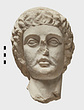
| Life-size head. Curling hair bound by fillet, which passes under mass of hair hanging down back of neck to break at base of neck. Nose broken. Little modeling. Unfinished round mouth and neck.
Roman.
Pentelic ... 16 March 1932 |
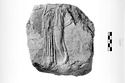
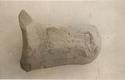
| Fragment of a thick block with a figure in low relief.
Back rough-hewn. Right, part of original surface (?), rough finish. Otherwise broken, save front where the figure is carved, missing from waist up ... 16 March 1932 |
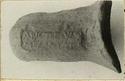
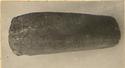
| Broad; distinct right angle curve.
Coarse clay, reddish with large grey core; traces of light slip.
Impression incomplete below, centre; much worn. Par: SS 01814---same die* Ἀριστόβουλος
Μελάντας herm ... 16 March 1932 |
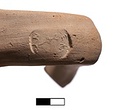
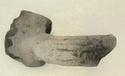
| Typical shape; broken before curve.
Typical clay; traces of light slip. Somewhat micaceous.
Impression set close to neck and so shallow as to be incomplete above and below and in centre. Pressed sharp ... 16 March 1932 |
| Rather thick; broken at curve which is close to neck.
Medium coarse clay; fine particles with mica; orange-red, buff surface and small core.
Small rounded square impression set close to neck. Context ... 16 March 1932 |
| Typical angular; junction with neck not preserved.
Typical clay.
Right end of the impression broken away. Shallow; worn. Retrograde. Finished Dump. Σωκράτευς (retr) burning torch (inv) Leica ... 17 March 1932 |
| Knidian type; rather light. Complete handle preserved, with both attachments.
Coarse reddish-buff clay; greyish at core. Remains of light slip. Somewhat micaceous.
Impression incomplete on two opposite ... 17 March 1932 |
| Shape like Knidian.
Rather coarse pinkish-buff clay; cream slip.
Impression incomplete below; damaged. Ἐπὶ Φιλομβρ
οτίδα Κνί(διον) [Χ]
αρμοκρά
τ[ευς double axe l. in outline]
(Σ lunate) Leica ... 17 March 1932 |
| Broad; broken at curve.
Coarse greyish-red clay, light slip. Worn.
Impression set carelessly, very close to neck. Incomplete right end. Below surface. Θρά̣σ̣ω̣ν̣(ος)
Θηρο̣κ̣ρ̣ά̣(τευς)
(Ν retr, Σ lunate, ... 17 March 1932 |
| Junction with neck not preserved. Seems to be Knidian.
Clay like Knidian; grey core; large.
Inner end of the impression broken away. Chipped. Below surface. [ Ἐπὶ δα{λ}μιοργοῦ]
[ Κ{λ}υδ]οκ(λ)ε̣(ῦ)ς clus- ... 17 March 1932 |
| Broken before curve; typical.
Distinctly micaceous; otherwise typical with remains of light slip.
Impression neat but shallow and worn. Below surface. Πολι bouk- ούχου
Ἀ̣σ̣τ̣ρ̣ ranion αγάλου
(Ρ retr) ... 17 March 1932 |
| Junction with neck not preserved; Knidian type.
Clay similar to Knidian but rather light color.
Right end of the impression broken away; much worn except at left end. Cxt: w/sherds not later than Megarian ... 18 March 1932 |
| Lower attachment preserved with upswinging curve.
Red clay with cream slip.
Sharp impression, incomplete lower right. Clearing plundered foundation channel of Hellenistic building. ΚΛΑΜ Leica ... Hellenistic |
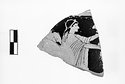
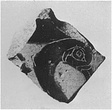
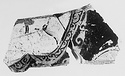
| From wall of stout pot; probably just below rim of krater. Woman right with outstretched arms. Frontal eye. Fine relief lines. Glazed inside. Indifferent work of severe style.
Glaze good but crackled ... 16 March 1932 |
| Head of bird right. Details of eye and beak, and top of head, incised; tip of beak missing. Long curving neck; in field right, remains of some ornament: rosette? At top of fragment, band of glaze.
Coarse ... 16 March 1932 |
| Gray clay, unglazed.
Cf. Agora V, no. F 48. Cistern, west chamber, surface of lowest red deposit. Leica, 4-326, 99-23-9 ... 17 March 1932 |
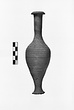
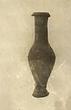
| Oval body tapering to rather short foot. Gray clay; unglazed. Base carelessly made, not level.
Cf. Agora V, no. F 48.
Cf. Agora XXXIII, no. 505. Cistern, west chamber, surface of lowest red deposit. Leica ... 17 March 1932 |
| Slightly concave side of fragment glazed with rather thin and dull black glaze, through which has been scratched in the dry clay the letters:
Other side unglazed.
Attic clay. Leica ... 17 March 1932 |
| Mended from two pieces.
For "figure", white laid on thick, and details drawn on top in thin brown glaze.
Good glaze inside; outside not fired completely black.
ADDENDA Bell or Calyx krater(?), seated ... 16 March 1932 |
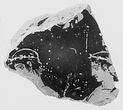
| Two garlanded male heads left. Accessory white used on wreaths, in a garland at upper edge of fragment, and on a branch(?) carried(?) by one of the figures and appearing in the field between them.
Very ... 17 March 1932 |
|
|