|
|
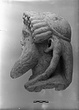
| Archaistic, bearded male head, broken away below. The tip of the nose missing; otherwise the head is complete and unweathered.
The beard represented by wavy lines; the arrangement of the hair is also stylized: ... Roman period. |
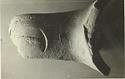
| Curve fragment.
The fabric resembles Knidian.
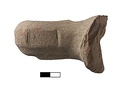
Cluster between lines horizontal. Msc: prob from jar dated in the term of =ARISTOBOULOS= andr,
=MELANTAS= andr* Cistern. [Κ]ν̣ιδίων
[ Ἐπὶ] Ἕρμ cluster ... 2nd quarter of 1st century B.C.(?) |
| Emblem: ear of corn. Msc: prob from jar of =DIOGENHS= dated in the term of
=ARISTOKRATHS=*
Par: no par?(VG)* Cistern. Ἀ[νδρῶν Μύστ]ης Ἰά[σων vac]
ear of corn
(Σ lunate, in O) Leica ... 15 May 1935 |
| Symbol for Helios.
Cf. Hesperia 32 (1963), p. 326, n. 17. Finished Disturbed fill. Helios Ἐπὶ Ξε
symbol ναφά(ντου) Leica ... 18 May 1935 |
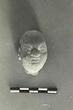
| Male face, fat with double chin.
Broken aaway in back and below.
Late Roman. below level of strosis C Fountain House destruction fill, below level of strosis C.
Hellenistic to late Roman. 1425 Leica ... 18 May 1935 |
| Hood or projecting hairdress (?) at back of head. The hair in gouged scallops around the face.
Traces of white color.
Red clay.
Late Roman. Well 7. Upper fill. Leica ... 17 May 1935 |
| The nose and moustache preserved, broken all around.
Clay painted red.
Orange red clay. Late Roman. Leica ... 17 May 1935 |
| First interpretation: female figurine.
Face and neck painted red, hair and headdress buff colored; traces of yellow paint (?)
Orange red clay.
See T 525. Leica ... 17 May 1935 |
|
|