|
|
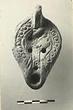
| Intact save minor chips.
Discus, Latin cross, rather blotched decorated with impressed dots. Handle, unpierced, ungrooved.
Reverse, branch within oval grooves; also impressed dots.
Unglazed.
Brown clay ... 20 April 1948 |
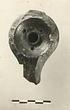
| Handle and end of nozzle missing.
Heavy ribbing on shoulder; on reverse, in relief: "alpha".
Dull purplish-brown glaze wash.
Dirty buff clay.
Type XVIII (post Sullan) of Corinth collection, type 52H of ... 21 April 1948 |
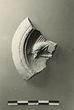
| Part of rim and discus preserved.
Discus, a dolphin holding a trident in his mouth. Rim plain.
Traces of dull glaze, almost all peeled.
Thin fabric, pale buff clay.
Type XXIV of Corinth collection. Road ... 21 April 1948 |
| Handle and end of nozzle missing, and chips.
Raised rim around discus; central filling hole and three smaller ones. Shoulder, relief decoration of rosettes, leaves etc. Low slightly indicated base.
Metallic ... 22 April 1948 |
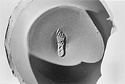
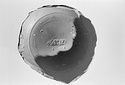
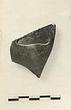
| Foot and lower part of body of a deep Sigillata cup on ring foot.
At center of floor, a foot-shaped stamp:
Buff clay, firm red glaze. Road west of Middle Stoa. 1772 Leica, 93-42-16 PD 1172-8 ... 21 April 1948 |
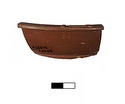
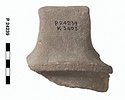
| Foot and lower part of body of a small deep Sigillata cup.
Foot-shaped stamp at center of floor:
Light brown clay; firm red glaze. Road west of Middle Stoa. 1772 Leica, 93-42-21 PD 1172-9 ... 21 April 1948 |
| Two joining fragments from floor of a Sigillata plate with rouletting.
At center of floor, a large foot-shaped stamp:
Dull red glaze; brownish clay.
Cf. P 19372. Road west of Middle Stoa. 1772 Leica ... 21 April 1948 |
| Ten fragments make up to five, preserving parts of base, rim and walls. Hemispherical bowl with plain rim and flattened bottom. Blister decoration inside and out, irregularly speckled.
Thin glaze mottled ... 22 April 1948 |
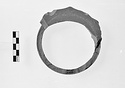
| Rectangular rim fragment.
Double convex bowl with thin narrow downturned rim bearing a groove flanked by incisions on its top surface. Remains of a cavity between grooves on exterior at junction with ... 22 April 1948 |
| From a Hellenistic brazier. Handle and a bit of adjacent rim preserved. Bearded satyr with ivy wreath. Road west of Middle Stoa, layer 4, lower. Early Roman context. 1772 Leica, 93-63-34 ... 22 April 1948 |
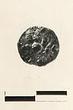
| A: clear but uncertain representation.
B: plain.
ADDENDA, May 2002: Partially disintegrated. Entered as coin no. 21, for the day. Road west of Middle Stoa.
With coins nos. 14-28. 1772 Leica ... 20 April 1948 |
| A: standing figure, facing, with indeterminate objects in downstretched hands.
Dolphin (?) in field to left.
B: plain.
ADDENDA, May 2002: Half of token remains. Entered as coin no. 31, for the day. Road ... 20 April 1948 |
| A: poppy head with wheat to right.
B: plain. Entered as coin no. 33, for the day. Road west of Middle Stoa. Leica ... 20 April 1948 |
| Complete foot (mended from four pieces) with part of floor above; center missing. Chamfered foot ring. Foot diameter rather larger than normal. On floor, slight rouletting between two pairs of grooves ... 22 April 1948 |
| Inscribed fragment.
Two chips join at upper left.
Inscribed face only preserved.
Thirteen lines of the inscription preserved.
Hymettian marble. Finished Found in tumbled stones by late wall, at the southwest ... 4th. century B.C. |
|
|