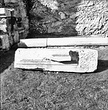
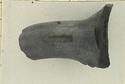
[Agora Object] T 82: Dove Figurine Fragment

Head of dove figurine. Broken at neck. Hooked beak; a very few details: round circle for eye, and oblique line setting off beak, added by large gouges. Mold made with pared join along top. No glaze. Clay ... 19 February 1932

[Agora Object] T 83: Relief Plaque Fragment

Fragment preserves left to right; large ear of grain, fat bodied creature seen from above (frog, mouse ?) and human foot (?) or hand (?). Framed by shallow grooves, near margin. Remains of paint: yellow ... 19 February 1932

icon

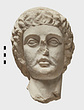
[Agora Object] T 88: Mask Fragment

Bearded head. Chin and lower left side of face missing. Broken at back, except for a bit of the edge preserved at the beard. Large eyes deep set beneath heavy brows and wrinkled forehead. Pupils of eyes ... Card: 325-300 B.C.

[Agora Object] T 93: Head of Female Figurine

Back of head. On left side part of neck preserved with top of garment. Knot of back hair in form of stout peg. From this over head radiate gouged lines with carelessly placed cross hatching. Mold made ... Card: Late 2nd or early 1st c. B.C.

icon

[Agora Object] T 100: Female with Baby Figurine Fragment

Upper part preserved to under elbow left side, and to a little lower, right side. She holds the naked infant with its head in the crook of her left arm, her right hand at its knees. Its hand seems to pull ... 2 March 1932

[Agora Object] T 114: Nose of Figurine

Edges broken all around. Life size nose from head or mask. Short nose, thick at nostrils. Considerable traces of red paint. Pale buff clay. Lowest red stratum. Leica ... 9 March 1932

[Agora Object] T 119: Head of Figurine Lamp

First interpretation: mask. Head of Telesphoros. Back and part of hair at left missing. Fat face with heavy features. Eyeballs indicated by deep holes. Luxuriant hair framing face. Orange red clay with ... 10 March 1932

icon

[Agora Object] T 122: Mold Fragment for Drapery

Fragment of drapery from lower part of figurine. Broken all around. Nearly flat, solid fragment. Back unmodelled with the letters Δ Η incised. Buff clay. For context see Hesp. 52 (1983), p. 260. Cave, ... 15 March 1932