|
|
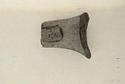
| Broad, broken before curve.
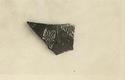
Clay resembles Knidian, with abundant light slip.
Left end of the impression broken away; surface damaged centre, lower part. Msc: prob from jar of =AGAQINOS=? dated in the ... 28 April 1932 |
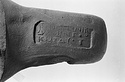
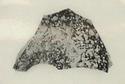
| From sherds, 230. Ἐπὶ Ἐπ̣ι̣ν̣ι̣κί
δα Μέν(η)τος
Κνίδιον (2nd Ν more like Υ)
(Ο small, solid) Leica, 93-20-7 ... 28 April 1932 |
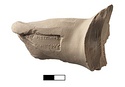
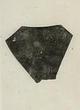
| Surface. Ἐπὶ Ἀρίστωνος
[ Ἀρ]ταμιτίου Leica ... 28 April 1932 |
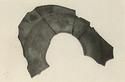
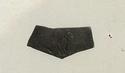
| Late Roman C plate fragment mended from four pieces; none of rim or center of plate preserved, and about one-third of the decorated band lacking. Low ring foot.
Gritty light red clay, gray at core; covered ... 28 April 1932 |
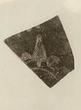
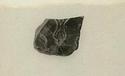
| Fragment from near center of Late Roman C plate. Mended from two pieces. Parts of three conventional stamped motifs preserved.
Light red clay with red wash. Dump. Leica, 2-293 ... 28 April 1932 |
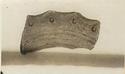
| Late Roman A bowl fragment giving profile from rim to near center. Upturned edge; low ring base. Rouletted decoration on rim, outside, and center, inside.
Red clay, grayish at core; red wash inside and ... 28 April 1932 |
| Fragment from near center of Late Roman C plate. Stamped with palm leaf and two sets of concentric circles on one side, one on the other.
Light red clay; thin red wash. From sherds, B 131. Leica, 2-293 ... 28 April 1932 |
| Flat rim, waved at edge; waves accented by incised garlands; two shallow grooves round inner edge.
ADDENDA From S. Gaul (J.W.H.).
Cf. Agora XXXII, nos. 1427 (P 12047) and 1428 (P 11987). From sherds, ... 28 April 1932 |
| Central part of Late Roman C plate. Stamped with small birds or chickens. Two birds and part of a third.
Light red clay; dull red wash. From sherds, B 142. Leica, 2-314 ... 28 April 1932 |
| Fragment from center of Late Roman C plate. Stamped with cross monogram with eyelets in lower angles; open rho to right.
Red clay; dull red wash. From sherds, B 147. Leica, 2-291 ... 28 April 1932 |
| Fragment from bottom of Late Roman C plate. Low ring foot; sides of plate begin to curve up at outer edge of fragment. Stamped with six-pointed stars formed by interlacing triangles. Two stars preserved, ... 28 April 1932 |
| Pergamene ware plate fragment, flat so far as preserved. Heavy ring base. Mended from several pieces.
Heavy fabric; fine yellow-buff clay; good red glaze, very much chipped. From sherds, B 151. Leica ... 28 April 1932 |
| Bowl fragment stamped with large palm leaf inside. Applied frog motif.
Thin fabric; poor matte brownish paint on inside only. Light red clay.
Joins with P 330.
ADDENDA Knidian Gray Ware. From sherds, ... 28 April 1932 |
| Small fragment from Late Roman B or C plate. Stamped with lion running left. Bit of front paw and tail missing.
Thick fabric. Orange-red clay; red wash. From sherds, B 168. Leica, 2-318 ... 28 April 1932 |
| Late Roman C plate fragment. Bit of low base ring preserved. Stamped design of heart terminating in spirals.
Orange-red clay with red wash. From sherds, B 215. Leica, 2-293 ... 28 April 1932 |
| Late Roman C plate fragment. Plate rises slightly in center. Stamped with running animals radiating from center. One animal and parts of two others preserved.
Orange-red clay with red wash. From sherds, ... 28 April 1932 |
| Fragment from bottom of Late Roman C plate. Ring base. Stamped with lions walking right. One lion and parts of two others preserved, between rouletted outer and grooved inner bands.
Light red clay; red ... 28 April 1932 |
| Fragments from bottom of Late Roman C plate. Stamped motif between multiple rouletted circles.
a) Ring foot. Light orange clay with red wash.
b) Another fragment added August 1964 from same place. Part ... 28 April 1932 |
| Fragment from center of Late Roman C plate. Stamped motifs, resembling flower calyx, radiating from center.
Light red clay; red wash. From sherds, B 220. Leica, 2-293 ... 28 April 1932 |
| Right side of head.
Face framed by wavy locks beneath headdress. Very large eye.
Crude mould-made. Faint trace of yellow color.
Light red clay.
Same mold as T 1237.
Late Roman. 016/ΜΖ* From sherds. Leica ... 28 April 1932 |
| Lower part of mask.
Broken across eyes and chipped at back. Finished edge preserved round lower part.
Beard indicated by incisions around gaping mouth. Eyes and nostrils pierced.
Remains of red paint inside ... 28 April 1932 |
| First interpretation: head of lion (?).
Upper left part of dog 's (?) head.
Gouged technique. Traces of red color in large eye and ear.
Light red to buff clay.
Cf. T 517. From sherds. Container 140. 550 ... 28 April 1932 |
| Right side of head, in high pointed cap.
Broken at chin and top of cap.
Hair in double scallops round face.
Linear technique, but not pronounced. Traces of yellow paint.
Light red clay. From sherds 16a ... 28 April 1932 |
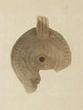
| Fragment from top of multiple lamp with central handle.
Rim, carelessly decorated with impressed circles.
Discus plain, surrounded by a raised ring; single grooved, pierced handle in center; oil holes ... 28 April 1932 |
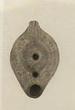
| Nozzle broken away.
On rim, herringbone.
Discus grooved, round central filling hole.
Handle solid; triple grooved.
On bottom, double concentric grooves, enclosing signature: "AΓA".
Traces of orange-red ... 28 April 1932 |
| Part of discus and rim.
On rim, herringbone.
On discus, mask, with projecting twisted horns (?), sidewise, from behind ears; mold much worn. Front part of discus, with filling hole below chin, broken away ... 28 April 1932 |
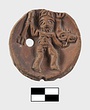
| Part of discus and rim.
On discus, Poseidin facing; large dolphin in left hand; small trident in right; crude linear ("gouged") technique.
Purple wash.
Pinkish-buff clay.
Type XXVIII of Corinth collection ... 28 April 1932 |
| On rim, herringbone.
Discus small, concave, with central filling hole.
Handle solid; double grooved.
Nozzle, plain, with air hole at edge of discus, close to filling hole.
On bottom, double concentric ... 28 April 1932 |
| On rim, herringbone.
On discus, rays with central filling hole.
Handle solid; double grooved. Nozzle, plain, rounded.
On bottom, double oval grooves, with stamped circles below handle and nozzle; remains ... 28 April 1932 |
| Fragment of body and back part.
On rim, vine pattern.
On discus, rosette with five petals.
Handle solid; triple grooved above, double below, with debased heart-shaped motif at bottom.
On bottom, double ... 28 April 1932 |
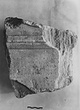
| Inscribed fragment from upper right hand corner of pediment-topped stele.
Rough picked back, and sloping top surface; chiseled right side, preserved; face broken away at corner, and along right side of ... 327/6 B.C. |
| Fragment from left side of inscribed block.
Broken top, bottom, back and right side, surface gone at the left corner.
"POLETAI" record.
Pentelic marble.
Cf. I 236. Finished Found in a marble pile, in ... 5th. century B.C. |
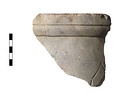
| Fragment from top of circular inscribed pedestal.
Moulding (small flattened ovolo and taenia) round upper edge.
Rough picked sinkage in top, surrounded by smooth finished band.
Inscribed on face below ... 28 April 1932 |
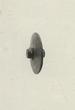
| Thin disk, with hub-like solid cylindrical axis projecting on both sides. It appears in the Illustrated London News, ILN (25 June 1932). Leica, 2-242 ... 28 April 1932 |
|
|