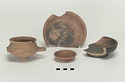
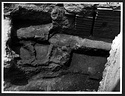
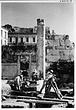
Sacrificial Pyre = Pit in floor (identified as pyre by SIR); with the characteristic small plates and saucers. "Saucer Grave" at 12/ΚΑ.
Dimensions: 2m (length)x 0.70 (width).
North of north wall of building ... First half 4th c. B.C.
Formerly G 13:5.
Cleared to a depth of 8.50m. where further collapse made work impossible. Use filling not reached. Lower dumped fill dated to ca. 425-400 B.C., with objects P 24209, P 24210, 24211. Upper ... Ca. 425-375 B.C.
Hellenistic fill South of Middle Stoa near NW corner of Heliaea. This fill contained material later in date than that which made up the middle Stoa Building Fill.
Only the coins (and a few amphora handles ... To ca. 140 B.C.
Bronze-casting pit and furnace against S apse of Church (106/ΛΕ). Late Roman sherds of the 4th and the 6th c. A.D. were found with fragments of moulds from bronze casting. The west end was destroyed by ... 5th-6th c. A.D.
Pit in bedrock in front of Shop VII (= Pit in Stoa Colonnade in front of Shop VII). It contained a miscellaneous collection of sherds which included one scrap of red-figure ... Ca. 475-460 B.C.
Well below Stoa Gutter opposite Pier 1.
Heavy dumped filling remarkable among Agora well-deposits both for the high quality and the good conditions of pottery of all sorts.
It represents the stock of a ... Ca. 520-490 B.C.
Well E (diameter 1.10-1.20m) just outside the northwest corner of the southwest Fountain House.
Dug initially as a pit (J 15:2) partially covered by an early Roman wall ... Early 7th c. B.C.