|
|
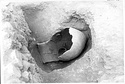
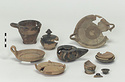
House N, room 6=House T: Pit with Kalikia in Room 2W. Roughly rectangular pit, length 7.10m., possibly dug to obtain clay for flooring in nearby houses ... Ca. 500-480 B.C. |
| Pyre in House N, room 2, layer 5 (RSY=Pyre 8).
Near northern corner of room 6. Artifacts, bone, burnt logs, and cinders in square pit dug from level of layer 5, through layers 5 and 6; thin clay floor ... 325-300 B.C. |
| Pyre in House N, room 4 (RSY=Pyre 7), in the industrial area west of the Areopagus.
Pottery, mall pieces of calcined bone, log, wood cinders, and charcoal in diamond-shaped pit in floor sequence. The pyre ... Late 4th-early 3rd c. B.C. |
House N, Room 4: Fillings in and over floors (Layers 7 and 8). Lower level probably antedating the building of the Great Drain in this area; the upper level apparently contemporary with remodeling of the ... 425-400 B.C. |
Fillings below the courtyard floor of the Poros Enclosure west of the Areopagus. The lowest layer, over bedrock, is of the archaic period and may have accumulated on the spot before the start of building ... First half of 5th c. B.C. |
Surface layer ... First half of 5th c. B.C. |
Pit in floor of House S ... Geometric to mid-5th c. |
| Located in House H, Room 13 on the lower northwest slope of the Areopagus ... Late 2nd c. B.C. |
Debris filling in a pit cut in bedrock at W side of House H, Room 10 ... Ca. 425-400 B.C. |
House R, fill under drain tiles and fillings associated with house K in industrial area, including what was C 19:15, plus C 19:16 and
C 19:17.
a) House built as dwelling in second half of 5th.c.
b) Used ... Ca. 5th and 4th c. B.C. |
Fillings in a stone-curbed well in the industrial area west of the Areopagus. Diameter (shaft)1.45m. Water level -5.20m. Drain at mouth 0.58m., increasing to a regular 74m. Coin:
24 July 1947 #5 Subdivisions: ... 350-325 B.C./3rd c. B.C. |
Well P: EG ... Middle Geometric |
A well in the industrial area west of the Areopagus, in part beneath one corner of the northwest room of the West Bath. A waterless shaft (diameter 1.05m) refilled with dug bedrock containing no pottery ... Early 6th. c. |
Diameter 0.83m. Water level -4.20m. Tiled well; height of tiles 0.60m. Heavy deposit of pottery throughout; stamped amphora handles, five Knidian; one Rhodian; one Parian. Semi-coarse stamnos; funnel-mouthed ... Ca. 120 B.C. |
Cistern in Room 12, House C=House N.
Simple flask-shaped chamber with draw shaft, in House M, Room 1; no tunnels. Excavated as single fill, but later analysis of material suggested two fills. Coins:
24 ... 4th. c. B.C. |
Tiled well (diam. 0.78m); height of tiles 0.61m. Water level -5m. Well found at bottom of Byzantine pit, uppermost tiles cut down. Coins:
7 July 1947 #1-#2 ... Post-Herulian |
| Rubbish Pit . Pit cut through a house floor. In courtyard, beside door to room 3. Artifacts, bone and scattering of large cinders in roughly rectangular pit dug through floor bedding and covered by red, ... 325-300 B.C. |
RSY Grave 49. Outside Archaic Cemetery ... 550-525 B.C. |
| Pyre in House C, Room 8 (RSY=Pyre 6).
Near east corner of room 8. Artifacts, burnt bone, burnt sticks, and large cinders in a shallow pit dug into surface of layer 3, and covered by layer 2. Some cinders ... 350-325 B.C.-end of 4th c. B.C. |
RSY Grave A.
Under the Roman House with three rooms floored with mosaic near the southwest side of the area. The burial consisted of a pot laid on its side over the bedrock, presumably containing a child ... 7 August 1947 |
Pit in House N, Room 2 (RSY, House C). Filling thrown in behind the west wall of the Great Drain South at the time of the building of the drain and the extension of House C.
Cf. Hesperia 20 (1951), pp ... Ca. 430-410 B.C. |
House N, Room 4, Pit through layers 5-6. Debris filling, mixed context. Estimated Grid ... Late 4th. c. B.C. into early 3rd c. B.C. |
Diameter 0.80m. Water level -2m. Tiled well; height of tiles 0.67m. well in court (Room 3) of House N.
Late Hellenistic destruction fill (Pergamene etc) to -7m;
Sand without a well deposit (lamp Type ... 1st c. B.C. to 1st c. A.D. |
A well (diameter 1m) in the industrial area west of the Areopagus, in the area later occupied by House C. Water level 1.50-2.m Dumped filling of broken bedrock with considerable fragmentary pottery in ... Ca. 500-480 B.C. |
Well (diameter shaft 0.95m) with POU and dumped fillings, separated by about 2.00m. of plain mud apparently fallen from the collapsed sides of the well. The fillings are, however, closely contemporary ... Ca. 425-400 B.C. |
Ca. 73-81/Drain. Fillings associated with the construction of the Great Drain South, especially the fill thrown in behind the east wall of the drain at the time of its building.
Cf. A 20-21:1 and B 19:7 ... Ca. 425-400 B.C. |
Dug bedrock filling in a well of unusually large diameter (1.35m.), possibly the original source of water for a factory for making terracotta figurines (water for the workshop with waterproofed floor and ... 4th. c. B.C. |
Deposit in the industrial area west of the Areopagus, underlying a Roman bath. Pottery examined in June 1955; latest pieces noted: one fragment Pergamene and one fragment brittle ware; no certainly post-Sullan ... Late 2nd c. B.C. |
Near the Poros Enclosure. Diameter 0.76m. water level -1.20m. Plain shaft sunk in the stereo ... 14-22 July 1947 |
Well M: EG, under the south court of the Poros Building.
Hesperia 20 (1951), p. 144 (noted) ... Middle Geometric |
First half of 5th c. B.C. |
Great Drain sand fill under Roman bath including small area at north end under tiles that was excavated separately.
See also A-B 19-20:1 for additional Great Drain sand fill at ca. 70-113/* Subdivisions: ... 30 July-11 August 1947 |
Great Drain north end, filling under tiles (55-58).
Only the finds from 55-58/* are recorded here (as found in the notebooks) although the deposit notebook shows additional finds from the entire sand fill ... 3rd-2nd c. B.C. |
Coins:
30 July 1947 #3-#11
31 July 1947 #4-#19
1 August 1947 #1-#9
4 August 1947 #1-#20
5 August 1947 #3-#20
6 August 1947 #1-#38
7 August 1947 #1-#21
8 August 1947 #1-#41
9 August 1947 #3-#6
57-59/*
66-67/* ... 28-31 July 1947
6-9 August 1947 |
| RSY Grave 51.
The grave lay on the slope of the Areopagus in Roman house O, just east of the line where the hillside is scarped for the foundation of the west wall of the house.
Cutting:the pit cut in ... Archaic period/6th or 7th c. |
Small pit in bedrock; nothing later than 3rd qtr. 4th. c. B.C ... 3rd quarter 4th c. B.C. |
Well, unfinished?
The shallow depth, small diameter, lack of water and any use fill make it possible that this was not a well, although the character of the cutting is difficult to explain otherwise. The ... Ca. 440-420 B.C. |
Well in house R of industrial area west of the Areopagus. This well, originally tiled, was abandoned and filled at the time of the conversion of the house into a stone-cutters' workshop.
Tiled well but ... Ca. 425-400 B.C. |
A supplementary fill dumped when the original had settled ... To ca. 390 B.C. |
Well (diameter 0.98m) in House H, Room 13.
Two dumped fills apparently of the same date, but separated by a clay deposit of over 2.00m.
Cf. Hesperia 20 (1951), p. 253. (noted) Subdivisions:
.1=Upper ... Ca. 425-400 B.C. |
Well (diameter 0.91m, water level -7m) in House H, Room 10 (and pit over). Plain shaft cut in stereo; pit at mouth of well,reused as drainage pit at start of tile drain running west.
Scanty use filling ... Ca. 425-400 B.C. |
SS 10172 from fill behind well tiles (second half 4th. c. B.C.)=subdivision .2 ... 3rd c. B.C. |
Includes fill behind well tiles ... Ca. 425-400 B.C. |
Tiled well (diameter 0.78, water level -3.50m) at 65/Κ (64/Κ) with poros wellhead. Built as early as 2nd c. Post-Herulian filling.
Tiled well, tiles 0.60m high ... 4th-5th c. A.D. |
Well at 63/ΙΒ (in House H, Room 15). Upper fill mixed Hellenistic to 2nd c. or later. Probably thrown in in Early Roman times when House H was built. Contained many figurines; probably part of Koukla factory ... 12 August 1947 |
Byzantine pottery begins after 4.70m.; above that Roman.
Diameter 0.92m; water level -5m. Tiled well; height of tiles 0.62m ... Byzantine re-use of Roman well. |
Tiled basin at ΚΗ (66-67/ΚΖ). Finds grouped with and published with C 19:5. Asterisk: C 19:16* ... 22 July 1947 |
"Oinophorus Well".Tiled well in House H (diameter 0.80m, water level -4.70m). Height of tiles 0.64m Heavy well deposit; lamps,, type XXVII; many basket-handled water jars; oinophoros with labors of Herakles ... Use filling of early 2nd-mid.-3rd c. A.D. |
Coins:
31 May 1947 #1-#4 ... Post-Herulean, end 3rd c. |
Coins:
29 May 1947 #1
30 May 1947 #7-#9
31 May 1947 #1-#8
2 June 1947 #1-#3 ... Early 2nd c.-mid-3rd c. |
| In area West of the Areopagus. Fills with many figurines and molds, possibly from a terracotta factory.
Twelve stamped amphora handles; no long-petal bowls; Type 54 A lamp Coins:
31 May 1939 #11
1 June ... Mostly 200-150 B.C. |
| Pyre(?) in House N, S.W. Room. (=House C, Room 10)
In room 10. Vessels from an earlier pyre were found dispersed in the makeup of the latest "floor" in the room, with tile fragments trodden into its surface ... First quarter of the 4th c. B.C. |
| Mycenaean tomb: Myc. III A:1-2.
SAI
Small rectangular chamber, 2.30m wide by 1.80m deep,, entered from the east through a dromos 1.10m wide which contracted to a doorway 0.92m. wide. the doorway preserved ... 2nd half of 14th c. |
Great Drain South (ca. 70-113, from SW edge of section as far north as the Roman Bath) Hellenistic Sand Fill. Silted-up filling of the southern branch of the Great Drain, abandoned due to some damage at ... 4th. c.-86 B.C. |
| A well on the lower slope of the Hill of the Nymphs, (diam. 1.20m -water level -7m), to 7.90m. The scanty use filling at the bottom contained water jars and pitchers as well as the inventoried objects; ... Second quarter of 6th. c. B.C. |
| A well in the industrial area of the Areopagus, about 7.00m. west of the West Bath, to a depth of 14.60m. This well was the direct successor to A 17:1, replacing it when it collapsed. The use filling at ... Second quarter 6th. c. |
| Pit (6x10) in the valley between the Areopagus and the Hill of the Nymphs. Large cutting in bedrock with 540 ostraka, mainly of the late eighties of the 5th. c. B. C. Much pottery, principally of the early ... Ca. 500-450 B.C. |
| Cistern in the valley between the Areopagus and the Hill of the Nymphs. Simple, flask-shaped chamber withdraw-shaft; no tunnels. Mouth cut away in Byzantine times. Lower filling, 3rd c. B.C. Coins:
25 ... 25-30 April 1947 |
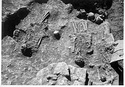
Rodney Young ... Grave. RSY Grave 50. Outside archaic cemetery on the lower slopes of the Hill of the Nymphs, cremation burial. Roughly square pit (0.80x1.00m). This pit contained a heavy deposit of cinders and ash; its ... Beginning of the last quarter of the 6th century |
Nb page 5044: Great shapeless pit with a well (62/Ξ) at its bottom which we were unable to dig because it was too dangerous. Fill in the pit was of sand and white ash. The finds and pottery 4th. and perhaps ... Late 4th.-early 3rd. c. |
|
|