|
|
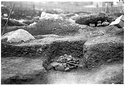
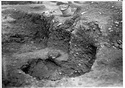
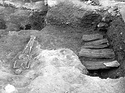
Filling of early N-S road and related fills, in the area of the Geometric Cemetery south of the Tholos; various levels including plundered foundation trench.
For late, disturbed or uncertain levels over ... 7th-6th c. B.C. |
Rodney S. Young ... Grave 1 in notebook. Slightly disturbed by the digging of Pit A.
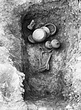
A large oil jar/amphora lay on its side with a flat stone stopping its mouth. The three small vases offered at the burial were found, together ... Ca. 600 B.C. |
Grave 2 in notebook. The burial was destroyed by the digging of Pit A, at the edge of which was found a mass of sherds belonging to the grave amphora. Among the sherds were found small cups, fragments ... Late Geometric |
Grave 3 in notebook. Grave partly destroyed by well B. Skeleton and offerings lost. The amphora mouth was doubly stopped by the bases of two other amphoras, one in its neck, the other in its mouth ... 750-725 B.C. |
| Rodney S. Young ... Grave 4 in notebook. Amphora, no other pots but carbonized remains of food offerings. Over urn two stone slabs, on top, mass of small stones containing Late Geometric sherd ... Late Geometric |
| Rodney S. Young ... Grave 5 in notebook.
The grave had been somewhat disturbed by the digging of Well B. The hydria lay on its side; in it was found the skeleton of a small child lying on its side with the knees drawn up ... Late 8th-early 7th c. B.C. |
Indicated as "Grave 6" in notebook but recognized as not a grave: "probably a rubbish pit" [deposit notebook summary]. Concentration of pottery, burning, animal bones, snail shells and seashells, probably ... Late 4th-early 3rd c B.C. |
| Grave 7 in notebook. Area disturbed in Roman times; outlines of the shaft had been obliterated.
The northwest end, however, was preserved in a cutting in the rock of the sloping hillside. This cutting, ... 750-700 B.C. |
| Grave 7b in notebook. Inhumation in Tholos Cemetery; The skeleton positioned directly below the male in Grave 7, but with direction reversed, i.e., head at southeast end. Most grave offerings at lower ... 750-725 B.C. |
| Grave 8 in notebook.
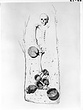
Inhumation in Tholos Cemetery. Length of shaft 1.75m; Width at upper end 0.95m; Depth from cover 0.70m.
One end cut into sloping rock.
Skeleton of a woman, with head southeast. Most ... 750-725 B.C. |
| Urn Burial in Tholos Cemetery. Grave 9 in notebook.
Amphora containing bones of a small child. Little pots had been put under its neck ... Late 8th-Early 7th c. B.C. |
Filling behind retaining wall of Stoa of Zeus. The remains of unfired clay adhering to the interior of various pieces make it probable that the material in this filling is a mass of debris from the floor ... Ca. 435-425 B.C. |
Filling between tongue walls to north of main apse in Late Roman complex, equals "Coroplasts' Dump" overlying Odeion south side.
Containers Ο 17-Ο 20 are from "debris of burnt building" [i.e. Odeion ... 267-ca. 350 A.D. |
| Mycenaean Grave.
One of the first Mycenaean burials found in the Agora. It consisted of a regular cist, carefully cut with vertical sides and a flat bottom, measuring 1.90m by 0.55m. There were apparently ... LH III (c. 1200) |
Some objects listed in deposit nb. V are not on this list because they in fact come from disturbed fills or are part of the material from above well 2 (G 12:21) ... 20 February-1 March 1935
6 March 1935
11 March 1935
20 March 1935
25 March 1935 |
Unfinished well cut in bedrock to the southwest of the Tholos; dumped filling containing much material of the 7th c. B.C. but extending into the 6th ... 7th-ca. 570 B.C. |
Possibly a short period of use but chiefly a debris filling including a number of fragments from disturbed early burials. Two pot fragments, believed to be from lower body of P 18525, added from Well 3 ... Ca. 575-550 B.C. |
Disturbed burial set into a cutting in hardpan. No lot ... 2nd half of 5th c. B.C. |
|
|