|
|
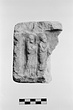
| Top, bottom, left side and back preserved. Broken away at right.
Within a plain frame are two draped standing figures, facing right: in front, a man, behind him, a woman.
Pentelic marble. Demolition of ... 8 February 1935 |
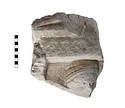
| Part of the upper left corner of the monument is preserved, with a bit of the pedimental top. Surface of band below pediment damaged; inscription obliterated, too faint to measure.
In deep recess below, ... 5 February 1935 |
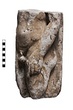
| Broken away above, below and at left. The surface damaged; back rough-picked, probably original, with rough hole for modern door socket. Right side smooth.
Torso and legs to knee of a naked youth, left, ... 7 February 1935 |
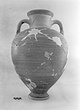
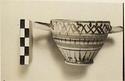
| Most of one side and one handle missing (doubtless taken out when bothros, which cut through area of burials, was dug).
Flaring ring foot with slightly convex profile; egg-shaped body, concave neck, ... Early 6th c. B.C. |
| Complete.
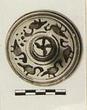
Thin brown glaze inside; a brown band around the top of each handle; also around the underside of the foot; dot and circle at center. Two wide purple-red bands below the handles; the other decoration ... Early 6th. c. B.C. |
| Flaring ring foot, ovoid body, shallow groove at base of neck, raised ring half way up neck; trefoil mouth. One high vertical strap handle, shoulder to back of rim.
The siren, standing right, looking ... Early 6th. c. B.C. |
| a) The pyxis resembles a kalathos: flat bottom, concave sides; small ribbon handles at lip. Unglazed beneath. Inside, glazed and reserved bands alternating. Two broad red horizontal bands on outside; other ... 5 February 1935 |
| Neck, lip, handles and part of shoulder and wall preserved. Slightly concave neck with rounded flaring lip, handles shoulder to mid-neck.
Black glaze on lip and bands on body and at base of neck; a cross ... 6 February 1935 |
|
|