|
|
Called a Turkish pit, located under a Byzantine wall and filled with an upper level of Byzantine material under which a level of Roman material. Coins:
5 April 1932 #1-#3
6 April 1932 #1-#5
7 April 1932 ... 6-11 April 1932 |
Tiled well near the SW corner of the market square between the Southwest Fountain House and the Great Drain, three fills noted: lower fill of earth and stones with a few fragments only of coarse pottery ... 4th-2nd c. B.C.
100-70 B.C. |
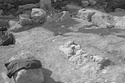
| Wall at 3/ΙΗ-ΙΘ (in foreground) showing its relation to "wine press" complex. Looking northwest ... AMS 352 Horizontal (normal) ... 12 Apr 1932 |
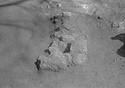
| Closer view of wall at 3/ΙΗ-ΙΘ. Looking east ... AMS 352 Horizontal (normal) ... 12 Apr 1932 |
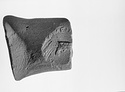
| Typical, broken at curve.
Greyish-red clay, yellow at surface. Blackened.
Impression worn across the middle; sharp. At surface. Ἐ[πὶ Ἀ]σκηπιά (sic)
δευ[ς Νε]ικί̣α
Κνίδ[ιο caduceus r.]
[ν] ... 8 April 1932 |
| Shape similar to Knidian; broken before curve.
Coarse pink clay, grey core; slipped.
Outer edge of the impression broken away; shallow set, circumference incomplete. Cxt: see nt of 7.vii.75 made for ... Late Hellenistic |
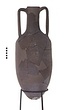
| Jar missing toe, most of one handle, and fragments of neck and body.
On each handle an almost illegible stamp, the device on one a prow, on the other a cluster. Cf. notes of 7/7/1975, made for S. Rotroff ... 7-13 April 1932 |
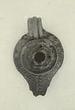
| End of nozzle broken away.
Double convex body with sharp angle between halves.
On rim, raised ovolo. Top surrounded by high edge.
Filling hole with slightly raised edge with three auxiliary holes.
Nozzle, ... 7 April 1932 |
| Part of left side of rim broken away.
On rim, herringbone.
On discus, rosette round central filling hole.
On nozzle, two diagonal grooves on either side of wick hole set off nozzle from rim.
Handle solid, ... 8 April 1932 |
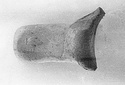
| Preserved: the vertical handle with projecting thumb-hold and part of the rim, neck, shoulder and body. Mouth probably round. At junction of body and shoulder, nicks, then a broad horizontal groove. On ... 12 April 1932 |
| A single fragment preserves some of low profiled foot of open bowl or cup.
Light buff clay; red glaze.
Pergamene. Well, top fill, container 2. 714 ff. Leica ... 7-13 April 1932 |
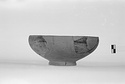
| Much of lip, and fragments of body missing. High rather sharply out-turned rim; rather deep narrow body. Rim plain. On body, a hexagonal net pattern: in top row hexagons are truncated and decorated with ... 7-13 April 1932 |
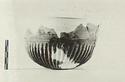
| Most of lip and some of body missing; restored in plaster. Plain rim, out-turned. Raised ribs on body, rosette on bottom.
Dull black glaze.
Cf. P 20518. Well, top fill. 714 ff. Leica PD 901-212 ... 7-13 April 1932 |
| Much of rim and body missing; restored in plaster. A rather deep open bowl, the walls rounding to a plain rim; ring foot. No trace of handles preserved.
Dull brownish glaze on interior and upper exterior ... 7-13 April 1932 |
| About half of mouth and body missing; restored in plaster. Round straight-sided neck-mouth with plain lip, slightly thickened. Spheroid body, flat bottom, no foot. No trace of any handle.
Dull glaze, ... 7-13 April 1932 |
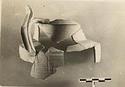
| Spout (or base, if it was a bowl and not a funnel), much of lower part of body and fragment of rim missing; restored as funnel. Plain, inturned rim. On interior, a broad band of light brownish glaze between ... 7-13 April 1932 |
| Two joining pieces preserve part of rim and immediately adjacent portions of body or neck. Rim flat on top, projects slightly and has groove on outer edge. Incised in unbaked clay, on top surface of rim, ... 7-13 April 1932 |
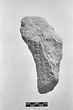
| Fragment of inscription.
Small bit of inscribed surface preserved; otherwise broken or chipped all round.
Pentelic marble. Found in Byzantine context, at bottom, in the southwest corner of the Market Square ... Late 5th. century B.C. |
| Lamp. Type XIX. Progress of Excavation. Conglomerate Wall and Pebble and Cement Floors in Northwest Corner ... Δ-2 333, 334 L 513 Lot Δ 11 Lot Δ 12 Lot Δ 8 Lot Δ 9 Lot Δ 6 Lot Δ 7 L 513 ... 7 April 1932 |
|
|





.jpg.icon.jpg)