|
|
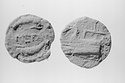
| Megara ... Coin no. 6. House N, Room 3, red fill III C at north. Prow l., on which stands a tripod. ΜΕΓΑ between
Two dolphins swimming r. in circle. Border of dots. 85-11-22 ... last half or third of 4th--early 3rd century B.C. |
Perperene ... RPC I, 2350 Coin no. 2. Well. [θEAN PωMHN] Bust of Roma, turreted, r. [πEPπE-PHNIωN] Bunch of grapes. 750, 4755, 5411 ... 1st century after Christ |
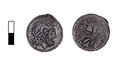
| Ptolemy VIII, Ptolemaic Kings ... Cyrenaica(?) mint. Χάλκινο: Αίγυπτος, Πτολεμαίος VIII Coin no. 4. Casts. Distruction fill of Roman Bath. Head of Zeus Ammon r. ΒΑΣΙ[ΛΕΩΣ ΠΤ]ΟΛΕΜΑΙΟΥ - ΕΥΕΡΓΕΤΟ
Eagle standing r., wings lifted, on thunderbolt ... 145-116 B.C. |
Coin no. 8. Refuse pit in House Ν, Room 3. 2879 ... 330-300 B.C. or later? |
Coin no. 10. Refuse pit in House Ν, Room 3. 2880 ... 330-300 B.C. or later? |
Coin no. 12. Refuse pit in House N, Room 3. 2880 ... 330-300 B.C. or later |
| A well in the industrial area of the Areopagus, about 7.00m. west of the West Bath, to a depth of 14.60m. This well was the direct successor to A 17:1, replacing it when it collapsed. The use filling at ... Second quarter 6th. c. |
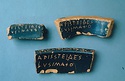
| Pit (6x10) in the valley between the Areopagus and the Hill of the Nymphs. Large cutting in bedrock with 540 ostraka, mainly of the late eighties of the 5th. c. B. C. Much pottery, principally of the early ... Ca. 500-450 B.C. |
| Cistern in the valley between the Areopagus and the Hill of the Nymphs. Simple, flask-shaped chamber withdraw-shaft; no tunnels. Mouth cut away in Byzantine times. Lower filling, 3rd c. B.C. Coins:
25 ... 25-30 April 1947 |
Coins:
25 April 1947 #1
26 April 1947 #1-#5
28 April 1947 #1-#3 |
Not a group, one object only.
Dug bedrock. Coins:
29 April 1947 #1 |
Coins:
29 April 1947 #2-#4
30 April 1947 #1-#2 ... 2nd. c. B.C. |
Nb page 5044: Great shapeless pit with a well (62/Ξ) at its bottom which we were unable to dig because it was too dangerous. Fill in the pit was of sand and white ash. The finds and pottery 4th. and perhaps ... Late 4th.-early 3rd. c. |
| Pyre(?) in House N, S.W. Room. (=House C, Room 10)
In room 10. Vessels from an earlier pyre were found dispersed in the makeup of the latest "floor" in the room, with tile fragments trodden into its surface ... First quarter of the 4th c. B.C. |
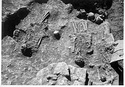
| Mycenaean tomb: Myc. III A:1-2.
SAI
Small rectangular chamber, 2.30m wide by 1.80m deep,, entered from the east through a dromos 1.10m wide which contracted to a doorway 0.92m. wide. the doorway preserved ... 2nd half of 14th c. |
Great Drain South (ca. 70-113, from SW edge of section as far north as the Roman Bath) Hellenistic Sand Fill. Silted-up filling of the southern branch of the Great Drain, abandoned due to some damage at ... 4th. c.-86 B.C. |
POU 3.50-10.30m. dumped filling of 5th or 6th century. Coins:
10 May 1949 #1
16 May 1949 #1
17 May 1949 #1-#2
19 May 1949 #1-#2
20 May 1949 #1-#12
21 May 1949 #1-#4 from dump
23 May 1949 #1-#3 from dump ... 3rd-5th c. A.D. |
Deposit in the industrial area west of the Areopagus, underlying a Roman bath. Pottery examined in June 1955; latest pieces noted: one fragment Pergamene and one fragment brittle ware; no certainly post-Sullan ... Late 2nd c. B.C. |
First half of 5th c. B.C. |
Near the Poros Enclosure. Diameter 0.76m. water level -1.20m. Plain shaft sunk in the stereo ... 14-22 July 1947 |
Well M: EG, under the south court of the Poros Building.
Hesperia 20 (1951), p. 144 (noted) ... Middle Geometric |
Well, neatly stone-curbed to bottom. Diameter 0.70m. The use filling, from about 3.50m to bottom, consisted chiefly of water-jars with a few small vases and some black-figured fragments.
Upper filling, ... Use filling of ca. 575-550 B.C. |
Second half of 6th c. B.C. |
First half of 5th c. B.C. |
Ostrakon deposit, sand fill in a shallow channel in bedrock at the bottom of the Great Drain in the valley between the Areopagus and the Hill of Nymphs.
This group of ostraka may well come from a single ... Ca. 490-480 B.C. |
| Pit with traces of burning ... Probably 3rd qtr. 5th c. B.C. |
Great Drain sand fill under Roman bath including small area at north end under tiles that was excavated separately.
See also A-B 19-20:1 for additional Great Drain sand fill at ca. 70-113/* Subdivisions: ... 30 July-11 August 1947 |
Great Drain north end, filling under tiles (55-58).
Only the finds from 55-58/* are recorded here (as found in the notebooks) although the deposit notebook shows additional finds from the entire sand fill ... 3rd-2nd c. B.C. |
Coins:
30 July 1947 #3-#11
31 July 1947 #4-#19
1 August 1947 #1-#9
4 August 1947 #1-#20
5 August 1947 #3-#20
6 August 1947 #1-#38
7 August 1947 #1-#21
8 August 1947 #1-#41
9 August 1947 #3-#6
57-59/*
66-67/* ... 28-31 July 1947
6-9 August 1947 |
| RSY Grave 51.
The grave lay on the slope of the Areopagus in Roman house O, just east of the line where the hillside is scarped for the foundation of the west wall of the house.
Cutting:the pit cut in ... Archaic period/6th or 7th c. |
Small pit in bedrock; nothing later than 3rd qtr. 4th. c. B.C ... 3rd quarter 4th c. B.C. |
Well in house R of industrial area west of the Areopagus. This well, originally tiled, was abandoned and filled at the time of the conversion of the house into a stone-cutters' workshop.
Tiled well but ... Ca. 425-400 B.C. |
A supplementary fill dumped when the original had settled ... To ca. 390 B.C. |
Tiled well (diameter 0.78, water level -3.50m) at 65/Κ (64/Κ) with poros wellhead. Built as early as 2nd c. Post-Herulian filling.
Tiled well, tiles 0.60m high ... 4th-5th c. A.D. |
|
|