|
|
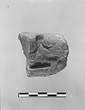
| First interpretation: Mold signed fragment.
Broken at left and chipped along outer edge at top.
Preserved is a male figure, bearded and partly draped, reclining on a couch and playing the double flutes, ... 27 March 1939 |
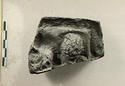
| Fragment from mold for upper left corner of high relief; depressed frame.
Relief widens towards bottom of fragment.
In the positive, upper front part of head in profile left; above it a thyrsos, horizontally, ... 1949 |
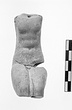
| Nude male figure.
Mended from six fragments. Head and arms missing; with holes for attachment; lower legs missing, and large part from left side.
Traces of white.
Buff clay.
ADENDA Cf. Delos IV, pp. 26 ... 1949 |
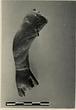
| The right arm, from the shoulder of a large figurine.
Middle fingers missing at knuckles.
The arm is outstretched; the hand clasped to grasp some object, a hole for which is pierced through the hand. A ... 1 April 1939 |
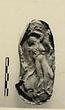
| First interpretation: mold for dancing draped female figurine.
Broken along one edge; otherwise complete.
Figure, left (in mould), in low relief.
Pink to red clay, slightly micaceous and grayish at the ... 21 May 1940 |
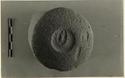
| Small round stamp with uncertain symbol. West terrace, layer V, south, lowest red fill. Γ device (in O) 3014 Leica ... 24 May 1940 |
| Toe of an amphora preserved.
Unglazed, brownish-buff clay.
In circular depression on bottom, an almond-shaped gem stamp; a herm in relief.
Cf. P 26445. West terrace, south end; early fill, layer IV ... 17-24 May 1940 |
West Terrace, South End, Layers IV and V. Heavy dumped filling associated with terrace walls at the extreme south end of the excavations in the Areopagus industrial area. The proportion of figured and ... Ca. 420-390 B.C. |
|
|