|
|
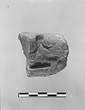
| First interpretation: Mold signed fragment.
Broken at left and chipped along outer edge at top.
Preserved is a male figure, bearded and partly draped, reclining on a couch and playing the double flutes, ... 27 March 1939 |
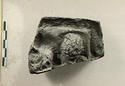
| Fragment from mold for upper left corner of high relief; depressed frame.
Relief widens towards bottom of fragment.
In the positive, upper front part of head in profile left; above it a thyrsos, horizontally, ... 1949 |
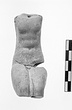
| Nude male figure.
Mended from six fragments. Head and arms missing; with holes for attachment; lower legs missing, and large part from left side.
Traces of white.
Buff clay.
ADENDA Cf. Delos IV, pp. 26 ... 1949 |
| Broken off at neck, hips and behind.
Woman wearing a chiron with long overfold and a shawl drawn around her shoulders and knotted in front. Her hands are clasped on front of her and hold small uncertain ... 28 April 1939 |
| Fingers indicated simply by grooves; in the palm of the hand a small cup or bowl ?
Elaborate gouged decoration suggests a long fitting sleeve (caestus), cf. Gardiner (1930), Athletics of the Ancient World, ... 5 June 1947 |
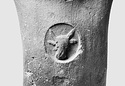
| Fabric like Knidian, but seems better.
Small round stamp with boukranion. Finished Byzantine fill. boukranion (in O) 5061 Leica ... 18 June 1947 |
| A well in the industrial area of the Areopagus, about 7.00m. west of the West Bath, to a depth of 14.60m. This well was the direct successor to A 17:1, replacing it when it collapsed. The use filling at ... Second quarter 6th. c. |
|
|