|
|
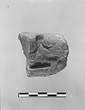
| First interpretation: Mold signed fragment.
Broken at left and chipped along outer edge at top.
Preserved is a male figure, bearded and partly draped, reclining on a couch and playing the double flutes, ... 27 March 1939 |
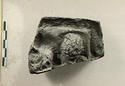
| Fragment from mold for upper left corner of high relief; depressed frame.
Relief widens towards bottom of fragment.
In the positive, upper front part of head in profile left; above it a thyrsos, horizontally, ... 1949 |
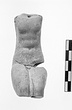
| Nude male figure.
Mended from six fragments. Head and arms missing; with holes for attachment; lower legs missing, and large part from left side.
Traces of white.
Buff clay.
ADENDA Cf. Delos IV, pp. 26 ... 1949 |
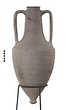
| Whole jar, missing chip from rim.
Capacity: (poly, 12.vi.78) 27.280; Capacity: (wheat, VG 11.xii.86) 29.700.
Stamp on one handle. Prof: PD 1454-92*
Dim: H 0.793, Dmax 0.348, HH 0.27-from record of Roll ... May 1956 |
| Stamp very faint; two gouges have destroyed part. Cistern. [ Ἐπὶ Ἀριστοκ]λ̣εῦς
[ Ἀπολ bouk λωνί]ου
[ Κνίδι ranion ον]
(Σ lunate, Α broken-barred) 2305-2310 Leica ... May 1956 |
| Listed in notebook as at 6/ΛΗ but later found to be at 12/ΛΗ.
Originally B 16:1.
Large cistern distinguished by a short (1.75m) blind tunnel running SW from its floor, and a shallow (ca. 0.80m originally) ... Ca. 150 B.C. |
According to dates of finding: 'Mixed Greek and Roman'. |
Chronology based VG's analysis of jars and stamps, 12 June 1957.
P 25802: Pergamene and Arretine fragments, recorded along with the wine jars, but the pottery apparently not kept separate and these pieces ... To ca. 140 B.C. |
|
|