|
|
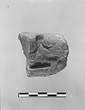
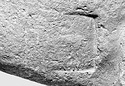
| First interpretation: Mold signed fragment.
Broken at left and chipped along outer edge at top.
Preserved is a male figure, bearded and partly draped, reclining on a couch and playing the double flutes, ... 27 March 1939 |
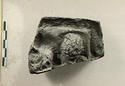
| Fragment from mold for upper left corner of high relief; depressed frame.
Relief widens towards bottom of fragment.
In the positive, upper front part of head in profile left; above it a thyrsos, horizontally, ... 1949 |
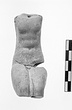
| Nude male figure.
Mended from six fragments. Head and arms missing; with holes for attachment; lower legs missing, and large part from left side.
Traces of white.
Buff clay.
ADENDA Cf. Delos IV, pp. 26 ... 1949 |
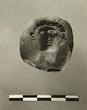
| Head turned, probably female, to left; curly hair framing the face. Beginning of drapery below the neck.
Mold taken, as impression, from a figurine and retouched: (hair)? House N, N.E. area, layer 3 B; ... 26 March 1948 |
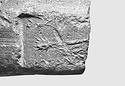
| Rectangular stamp; two lines; symbol across middle.
Cf. Pridik (1917), pl. IV, 1. Par: Pridik 1917, Pl 4, which however is not the same(VG)* Finished Red fill; late Roman and Byzantine. [Θασί]ω̣ν
dolphin ... 12 May 1939 |
| Rectangular stamp well down on curve; two lines; symbol (thyrsos?) across centre. Finished Late brownish-red fill. Θασί[ων]
thyrsos l.
Ἡροφάντου̣ 1467 Leica ... 16 May 1939 |
| Broken into five pieces and very fragmentary.
Inscribed. From the "dump". Store in ziplock polyethylene bag and in area with 40% r.h. or lower.
Wear cotton or latex gloves when handling. Do not bang around ... 25 October 1947 |
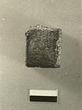
| Block of bronze shaped like a truncated pyramid.
All faces plain.
Possibly a weight. House N, room 2, layer 7 c. Store in ziplock polyethylene bag and in area with 40% r.h. or lower.
Wear cotton or latex ... 2 October 1947 |
|
|