|
|
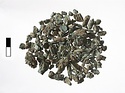
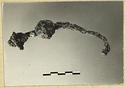
| Over 150 miniscule fragments and amorphous lumps of bronze or copper representing item of jewelry or personal adornment worn by the deceased during cremation and melted out of shape. Original object unidentifiable ... 8-10, 12 April 1948 |
| Inscribed fragments.
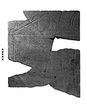
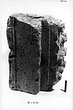
Fragment Δ 382, inscribed stele with outline of pediment cut in preserved top.
Broken into seven pieces. Upper left corner, bottom, and a section from both right and left sides missing ... Late 3rd. century A.D. |
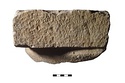
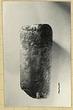
| Fragment of inscribed columnar base for dedication.
Front and left surfaces of the capital preserved, of abacus from corner for distances indicated by "W" and "T" measurements.
Top surface rough picked ... 1931 |
| Fragments from upper part of inscribed stele with relief above.
Fragment Δ 75 a), broken all around save front and back.
The better preserved surface shows legs and feet apart of frontal figure standing ... 100-150 A.D. |
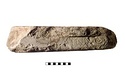
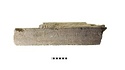
| Fragment of slab with inscribed band on one edge.
The height, though uneven, may be approximately complete; upper and lower surfaces fairly smooth. Back and sides sloping.
The inscription is on a smooth ... 13 February 1932 |
From Section ΟΟ. See other pieces in Study Collection-
For images, see P 20177. Grave 3. |
| Broken at back and sides; edges of molding broken away. Top much worn: tramped on in some reuse. One original edge of mutule preserved, and approximately full depth, with three row of guttae, of which ... 22 April 1948 |
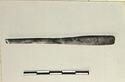
| Surface damaged, point missing.
Shaft ovoid in section, blade long and flat. Trench A, embedded in road II a. Approximately 55% RH, free of insects etc. Polyethylene ziplock bag sealed. 5133 Leica ... 8 August 1968 |
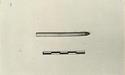
| Shaft is preserved, blade broken away.
Shaft is circular in section, pointed at end. Marble Worker 's House. Below floor IV, layer XVIII. 5051, 5071 Leica ... 14 August 1968 |
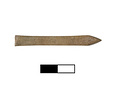
| Inscribed.
Broken at one end. Surface highly polished.
Tool is rectangular in section, sharpened to point (probably repeatedly) at preserved end. Light incised lines separate letters.
Reverse has several ... 3 August 1968 |
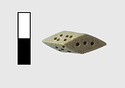
| Very well preserved but for one edge lightly chipped.
Rhombic hexaedron (or trigonal trapezohedron) in shape. Flat sides with drilled dots misaligned on all faces.
Highly polished. Stained light green ... Probably Hellenistic |
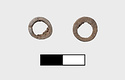
| Two simple undecorated rings, neatly sawn from the same long bone. Finished Grave 3. Inside burial amphora. Stoa Gallery Case 3103-3110 Leica, color slide PD 2774-98 ... 29 June 1949 |
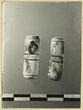
| Hollow cylinder with straight sides, the ends very slightly tapered inward.
Decorated with pairs of closely spaced incised grooves around the outside at each end, and a more widely spaced pair of grooves ... 12 April 1948 |
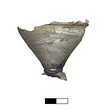
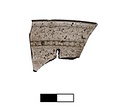
| Fragment from near lower part of wall.
Incised decoration of rather large pentagons and hexagons, each with a double outline.
Silvery iridescent glass. Mud brick layer south of Roman house B, room 1.
6th ... 25 June 1947 |
| Mended from two pieces. About half the body and base preserved; the rim broken away, also the lower edge of the foot.
Small high flaring base, reverse-curved, set off from wall by a moulded ring. Deep ... 24 June 1947 |
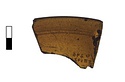
| Rim fragment from a heavy bowl with plain vertical lip.
A groove below the lip inside.
Dark brown glass. Building H, above floor. Destruction debris.
5th-6th c. A.D. 527 Leica, XXXIII-23 PD 505 ... 30 July 1947 |
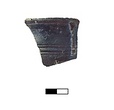
| Rim fragment with straight wall and slightly out-turned lip.
A groove below the lip outside, and several grooves further down on the wall.
Deep iridescent purplish-green glass. Building H, above floor ... 30 July 1947 |
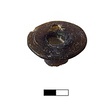
| The base with rounding walls preserved.
The ring foot formed by a series of small irregular projections.
Colorless glass.
Similar to G 300. Roman House B, room 6.
Destruction debris of 5th or 6th c. A.D ... 31 July 1947 |
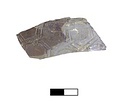
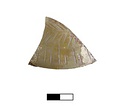
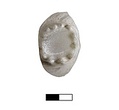
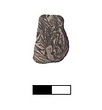
| A nearly flat fragment, turning down along the curved (broken) edge.
Decorated by light incision: along the edge, alternating long and short lines; further in a branch of herringbone pattern.
Nearly colorless ... 31 July 1947 |
| The bottom of a small bowl with rounding walls preserved.
The ring foot formed by a series of small irregular projections.
Colorless glass.
Similat to G 297. Roman House B, room 8, at the floor.
Found ... 4 August 1947 |
| Piece of dark brown glass with creamy striations. North-South Trench VII, north-east corner of latrine.
4th c. B.C. fill. 562, 1042 Leica ... 4 August 1947 |
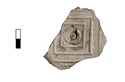
| One piece preserves two-thirds of base.
Square base, rising at the center. Decorated with raised concentric rectangles.
Opaque colorless glass. Agora sample no. 300. Roman House B, destruction fill.
5th-6th ... 1947 |
| Fragment with plain wide flat rim and part of cylindrical neck.
Thick brownish glass. Soft fill in top of cistern A.
Late Roman-Byzantine. 1645 Leica, 81-1-3 ... 6 April 1948 |
| Fragment from plain rim of open bowl.
On inside lip, bounded by two grooves, with notched ridge below lower one. Smaller sharper groove lower down.
Moulded glass. For context see Hesp. 20 (1951), p. 183 ... 22 April 1948 |
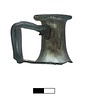
| Narrow neck with flat lip; angular strap handle, and part of horizontal shoulder preserved.
Greenish blue glass. East-west Street, road fill 4.
2nd-3rd c. A.D. 3490 Leica ... 13 October 1949 |
| This and the following number are assigned to the many burned fragments which cannot be joined, and which preserve parts of at least two long pins with flat disk heads and large spheres of bronze on their ... Card: 900 B.C. |
| Fragments of a pin with disk head and ball on shaft.
Less of the shaft preserved (three fragments) than for B 740.
The ball somewhat less corroded.
Cf. B 840 (OO 619) Geometric Grave. Found with bones ... Card: 900 B.C. |
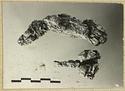
| Part of the bow of one fibula is clear, consisting of two rounded masses of bronze set at an angle to each other. Probably a third made up the bow.
One fragment seems to show the spiral spring at the inner ... Card: 900 B.C. |
| A large fragment probably from the center of the bow of a similar fibula.
Cf. B 842 (OO 621). Geometric Grave. Found with bones inside burial amphora P 19, 228 (OO 594). nestled in ethafoam to prevent ... Card: 900 B.C. |
| Plain band with rectangular key attachment. Building P, room 7, where north floor II lacks to West. 1378 Leica, Various vii-83 ... 26 April 1948 |
| Broken into five pieces and very fragmentary.
Inscribed. From the "dump". Store in ziplock polyethylene bag and in area with 40% r.h. or lower.
Wear cotton or latex gloves when handling. Do not bang around ... 25 October 1947 |
| Hollow hub; apparently uninscribed. 5 meters N.E. of N.E. corner poros Building.
Beside late Roman walls.
Fill at least as late as 3rd c. A.D. Leica ... 31 March 1949 |
| Complete except for chip from head.
Large-headed hook (if right angle in shaft is original); otherwise a nail.
Head flat. Shaft rectangular in section, tapering to a point, now bent. N.W. room, Poros Building, ... 7 June 1949 |
| Right half of a dikast ticket.
No trace of reuse and no symbol at right end. Punched dots at ends of hastas of letters.
Last letters of name and of demotic preserved. Ca. 3 metres north of Poros Building, ... 2 November 1949 |
| Inscribed.
Rectangular weight : half amphora.
Coin no. 77 for May 24 was firmly stuck to back, apparently with circle of iron outside of coin. Accidental ?
At each corner a letter : Δ, Η, Μ, Ο. ΚΒ-ΚΓ/Great ... 24 May 1947 |
| Squat truncated pyramid.
The stub of a projecting pin (for handle or attachment ?) on the bottom. M. Farnsworth reports that although the material is bronze, it appears to contain more lead than is usual ... 15 May 1939 |
| Inscribed fragment of columnar grave monument.
Broken top and bottom.
Four lines of the inscription preserved.
Hymettian marble. Found in modern cellar wall outside the Market Square, on the southeast ... 7 May 1947 |
| Apparently complete.
Along bottom of front face a rough slightly projecting surface at level for setting into ground.
Limestone or hard gray poros. Brought in 1947; length and thickness cannot be measured ... 27 May 1947 |
| Inscribed fragments of statue (?) base.
Fragment ΠΠ 108 a), possible traces of original surface on the under side. Top, sides and recut, with evidence of more than one reuse.
Fragment ΠΠ 108 b), preserves ... a) (ΠΠ 108) 3 July 1947
b) (ΠΠ 108) 10 October 1947 |
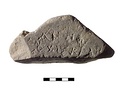
| Inscribed fragment.
Original back, rough picked, preserved, and part of one side, at an angle of 45° to the preserved inscription, at the right.
Letters roughly cut and spaced.
Hymettian marble. Found ... 10 July 1947 |
|
|