|
|
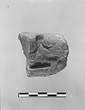
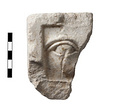
| First interpretation: Mold signed fragment.
Broken at left and chipped along outer edge at top.
Preserved is a male figure, bearded and partly draped, reclining on a couch and playing the double flutes, ... 27 March 1939 |
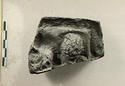
| Fragment from mold for upper left corner of high relief; depressed frame.
Relief widens towards bottom of fragment.
In the positive, upper front part of head in profile left; above it a thyrsos, horizontally, ... 1949 |
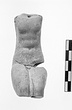
| Nude male figure.
Mended from six fragments. Head and arms missing; with holes for attachment; lower legs missing, and large part from left side.
Traces of white.
Buff clay.
ADENDA Cf. Delos IV, pp. 26 ... 1949 |
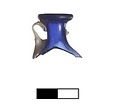
| A single fragment preserves the neck, the flaring rounded rim, and one handle, with the upper attachment of the other, of a miniature amphora.
Dark blue glass; the handles white glass. For contaxt see ... 2 July 1947 |
| Broken into five pieces and very fragmentary.
Inscribed. From the "dump". Store in ziplock polyethylene bag and in area with 40% r.h. or lower.
Wear cotton or latex gloves when handling. Do not bang around ... 25 October 1947 |
| Squat truncated pyramid.
The stub of a projecting pin (for handle or attachment ?) on the bottom. M. Farnsworth reports that although the material is bronze, it appears to contain more lead than is usual ... 15 May 1939 |
| Inscribed fragment of plaque.
Broken at right and bottom.
In sunken panel, of which bottom edge is preserved, an eye carved in relief.
Inscribed along the top on the raised frame of the panel.
Almost certainly ... 221/0 B.C. |
| Inscribed fragment.
Letters inscribed on a partially smoothed down broken surface; back worn smooth; worn breaks at sides and top, in crude pediment form, may be contemporary with inscription; broken at ... 1st. century B.C. |
|
|