|
|
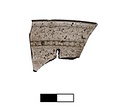
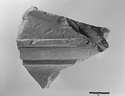
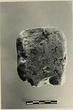
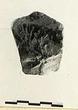
| Small piece, broken all around, from a thin nearly flat tile.
Inside covered with thin black glaze wash; outside unglazed. On outside, circular stamp with anchor.
Gritty light yellowish buff clay. Well ... May-June 1949 |
| Intact.
Standing draped female figure. Hole in bottom for attachment.
No visible arms unless they are conceived as held close to the sides, and folded across the front, concealed by and holding up the ... 3 June 1949 |
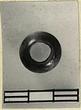
| Globular bead with very large perforation; possibly intended for use around a shaft of pin or the like rather than as a bead.
Bone well polished or worn; stained brown. Pocket with burning.
4th c. B.C ... 4 June 1949 |
| Fragment from plain rim of open bowl.
On inside lip, bounded by two grooves, with notched ridge below lower one. Smaller sharper groove lower down.
Moulded glass. For context see Hesp. 20 (1951), p. 183 ... 22 April 1948 |
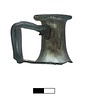
| Narrow neck with flat lip; angular strap handle, and part of horizontal shoulder preserved.
Greenish blue glass. East-west Street, road fill 4.
2nd-3rd c. A.D. 3490 Leica ... 13 October 1949 |
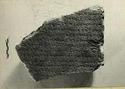
| Broken into five pieces and very fragmentary.
Inscribed. From the "dump". Store in ziplock polyethylene bag and in area with 40% r.h. or lower.
Wear cotton or latex gloves when handling. Do not bang around ... 25 October 1947 |
| Complete except for chip from head.
Large-headed hook (if right angle in shaft is original); otherwise a nail.
Head flat. Shaft rectangular in section, tapering to a point, now bent. N.W. room, Poros Building, ... 7 June 1949 |
| Right half of a dikast ticket.
No trace of reuse and no symbol at right end. Punched dots at ends of hastas of letters.
Last letters of name and of demotic preserved. Ca. 3 metres north of Poros Building, ... 2 November 1949 |
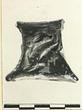
| Squat truncated pyramid.
The stub of a projecting pin (for handle or attachment ?) on the bottom. M. Farnsworth reports that although the material is bronze, it appears to contain more lead than is usual ... 15 May 1939 |
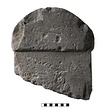
| Inscribed fragment.
Part of right side and rough picked back preserved.
Fifteen lines of the inscription preserved.
Hymettian marble.
ADDENDA Belongs to I 764; joined to IG II2, no. 915.
Cf. Hesperia ... 203/2 B.C. |
| Inscribed fragment of grave stele.
The upper part of a grave stele with rounded top.
On the stele proper, the head and shoulders of a draped man, left. Above him the inscription.
Part of one line of the ... 19 September 1947 |
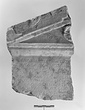
| Inscribed fragment.
Broken at bottom and back. Front and sides smooth-finished.
Top smooth-finished only along front; picked behind.
Four lines of the inscription preserved; complete.
Hymettian marble ... 2 April 1948 |
| Inscribed fragment.
Inscribed face and back surface preserved, with part of the pedimental top.
Remains of five lines of the inscription preserved.
Hymettian marble. Found in Turkish context in the industrial ... 12 April 1948 |
| Inscribed fragment.
Broken at right, bottom and back.
Upper left corner of a stele with pedimental top and part of a central rosette in relief.
Decree of some religious organization having an Alexandrian ... 111/0 B.C. |
| Inscribed family grave stone.
The top broken off.
Tapering stele with a projection (now worn away) across the bottom.
The letters at the right side preserved where they were covered; worn farther to ... 6 May 1949 |
| Inscribed fragment.
Part of the top preserved, and perhaps part of the right side.
Four lines of the inscription preserved; stoichedon.
Space between lines, two including: 0.027m.
Space between letters, ... 6-11 February 1939 |
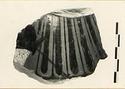
| Small fragment from shoulder.
Head of Athena to right; tongues. Landscaping operations in the excavations; exact provenience unknown. Leica ... January 1955 |
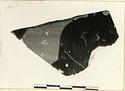
| Broken all around. Unidentified representation from reverse of Panathenaic amphora. Agora excavations. Leica ... 5 February 1962 |
| Handle from large bowl or kantharos; on the top, dolphin in relief.
Pink clay with badly flaked dark red to black glaze. Surface. Leica ... 13 May 1947 |
| From the floor of a heavy plate. Head and shoulders of draped figure right. Very poor condition; added white practically disappeared from face and part of clothes. Agora area, context unknown. Leica ... (February 1957) |
|
|