|
|
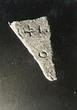
| Two fragments of mould.
a) A fragment from the lower left corner of the mould.
The lead fragments of an ancient mend are partly preserved.
Hind legs and part of the tail and belly of an animal right ... 19 May 1934 |
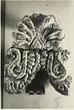
| Broken away at upper part of the neck. The features badly worn.
At back of head, incised crossing diagonally.
Traces of white paint in eyes. Red paint, dull and worn, on head.
Late Roman. Well, bottom ... 26 March 1934 |
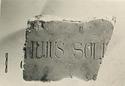
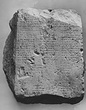
| Inscribed stele.
Broken to right and behind. The top slants downward toward back.
Below the smoothed upper part is a large rough setting tongue.
One line of the inscription remains.
Hymettian marble. Found ... 1st. century B.C. |
| Inscribed fragments.
Inscribed in Latin.
Gott's Epitaph.
Fragment Β 31 a), broken on all sides.
Five and a half letterσ preserved.
Fragment ΚΚ 1190a (b), originally inventoried as I 1257 b, but I 1257 ... a) (Β 31) 2 November 1933
b) (ΚΚ 1190a) 9 March 1939 |
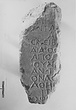
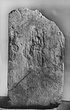
| Fragment from near the top of columnar grave monument.
Two lines of the inscription preserved, the first with only the bottoms of the letters.
Hymettian marble. Found in the wall of the modern house 631β/4 ... 27 December 1933 |
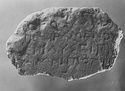
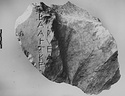
| Fragment of inscription.
Broken on all sides.
Part of four lines of the inscription preserved.
Pentelic marble. Found in the wall of the modern house 631β/4 (631b/4), southwest of the Tholos. Leica, VI-16 ... 4th. century B.C. |
| Fragment inscribed on two adjacent faces.
Broken save for the inscribed faces, which bear separate inscriptions.
Name list. Erechtheis.
Face A, has been used as a threshold, and has a circular door socket ... 180 A.D. |
| Inscribed fragment.
Behind a projecting flange, broken away, part of the right side is preserved, smooth; otherwise broken.
Remains of three lines of the inscription.
Pentelic marble.
ADDENDA Belongs ... 21 March 1934 |
| Inscribed fragment.
Part of toothed right side and rough picked back preserved; otherwise broken.
About half the width of the stele is preserved.
Seven lines of the preamble, and twenty-two lines of the ... 229/8 or 228/7 B.C. |
| Inscribed fragments.
"POLETAI" record.
Fragment Ζ 628, lower part of an inscribed stele.
Preserved to full width and thickness; broken away at the top.
Fragment Β' 358, a small non-joining fragment; ... 4th. century B.C. |
| Inscribed fragment.
Broken all around.
Thin chip, preserving only a very little of the inscribed face, and of two lines of the inscription.
List of names by demes.
Line spacing: 0.018m.
Hymettian marble ... October 1954 |
| Inscribed fragments.
List of Argive fallen at Tanagra.
Fragment a) (Β 826), broken on all sides. A large mass of marble is preserved behind and to the right of the relatively small inscribed surface ... a) (Β 826) 1 May 1934
b) (Ν 121) 13 March 1935 |
| Part of one edge preserved to full thickness; otherwise broken.
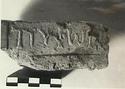
Brownish buff clay, micaceous. Lighter buff slip. Stamped on edge. Well. Leica ... 7 March 1934 |
| Part of one edge preserved to full thickness; otherwise broken.
Brownish buff clay, micaceous. Lighter buff slip. Stamped on edge. Tile dump of well. Leica ... March 1934 |
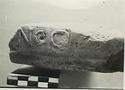
| Mended from three pieces. Broken away behind and on front at lower center.
Coarse red clay. Thick white paint.
Across bottom of front in raised letters: ΜΟ ΙΟΥ. Tile dump of well. Leica ... March 1934 |
| Broken away above at right.
Obverse : a bearded head (Serapis), right.
Reverse : uncertain. Well. in zip lock bag in conservation
with gloves Leica ... 12 March 1934 |
| Broken away below.
Obverse : a head wearing petasos (?) (Hermes?), right.
Reverse : a countermark of dolphin. Well. in zip lock bag in conservation
with gloves Leica ... 12 March 1934 |
| Small fragment from shoulder.
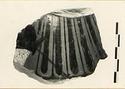
Head of Athena to right; tongues. Landscaping operations in the excavations; exact provenience unknown. Leica ... January 1955 |
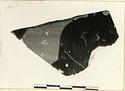
| Broken all around. Unidentified representation from reverse of Panathenaic amphora. Agora excavations. Leica ... 5 February 1962 |
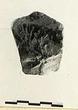
| From the floor of a heavy plate. Head and shoulders of draped figure right. Very poor condition; added white practically disappeared from face and part of clothes. Agora area, context unknown. Leica ... (February 1957) |
|
|