|
|
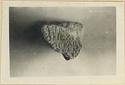
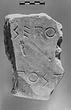
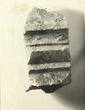
| Inscribed fragment.
Broken all around.
Fragment with imperial letters.
Pentelic marble.
ADDENDA Same inscription with I 10, I 60, I 64, I 815. Finished Found at a late Roman level, above the foundation ... 177-180 A.D. |
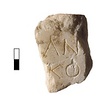
| Inscribed small fragment of grave monument.
The top surface meets the face in a beveled edge; other sides broken.
Traces of red in the letters.
Pentelic marble.
ADDENDA Belongs to I 47. Found at a late ... Late 6th. century B.C. |
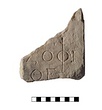
| Fragment of dedicatory base of a grave monument.
Lower edge and surface preserved; other edges broken.
Space between lines 0.065m.
Pentelic marble.
Early Attic.
ADDENDA Joins with I 44. Found at a late ... 5th. century B.C. |
| Wedge-shaped fragment inscribed on both faces.
Circular bit of upper surface preserved, joining face (b); other edge broken.
Pentelic marble. Finished Found in a modern wall, in the north part or northwest ... 2 July 1931 |
| Inscribed fragment from the right side of a block.
Right edge and original thickeness preserved; other edges broken; face roughly dressed; back has been rough picked, but is probably not original.
Pentelic ... 6 July 1931 |
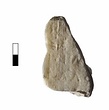
| Inscribed fragment.
Broken on all sides.
Part of a moulding is preserved over the inscription.
Hymettian marble. Found in a marble dump, in the northwestern corner of the Market Square. Leica ... 19 October 1933 |
| Inscribed fragment.
Broken on all sides.
To the right of the piece, one line of the inscription, and a trace of a second.
Pentelic marble. Found in a marble dump, southeast of the Stoa of Zeus. Leica ... 2 January 1934 |
| Inscribed fragment.
Broken on all sides.
Four lines of the inscription preserved.
Pentelic marble. Finished Found in a marble pile, in the northwest corner of the Market Square. Leica ... 12 May 1934 |
| Inscribed fragment.
Lettered face and right side only preserved.
Five lines of the inscription preserved.
Pentelic marble. Found in marble dump, in the northwest corner of the Market Square. Leica ... 23 May 1936 |
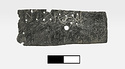
| Thin oblong plaque, inscribed.
The left end of the plaque is broken off. At the right end is the partially obliterated outline of a stamped Gorgoneion. On the reverse are traces of a rectangular stamp ... 20 July 1931 |
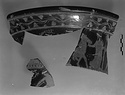
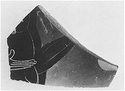
| a) Near the top of the fragment is an ovolo band; below is a nude male figure facing to the left, his hair bound by a white band. He holds some indistinguishable object in his outstretched right hand ... a) 3 July 1931
b) 20 May 1938
c) June 1938 |
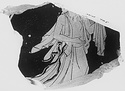
| Draped female figure moving swiftly to right; the head of the figure is missing and the legs below the knees. She wears a peplos bordered with black; a piece of accessory drapery floats behind and is held ... 9 July 1931 |
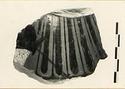
| From a panathenaic amphora?
Broken all around. The under part of an animal (horse?) with extended right foreleg; against the body an outstretched hand. Incised lines carelessly executed.
Inside covered ... 11 July 1931 |
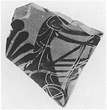
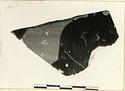
| a) The head of a charioteer and his hands holding the reins; also part of another figure. Accessory purple is used for the hairband of the charioteer and other details.
b) Charioteer in chariot.
Attic ... 11 July 1931 |
| Small fragment from shoulder.
Head of Athena to right; tongues. Landscaping operations in the excavations; exact provenience unknown. Leica ... January 1955 |
| Broken all around. Unidentified representation from reverse of Panathenaic amphora. Agora excavations. Leica ... 5 February 1962 |
| From the floor of a heavy plate. Head and shoulders of draped figure right. Very poor condition; added white practically disappeared from face and part of clothes. Agora area, context unknown. Leica ... (February 1957) |
| Small wall fragment, from bowl(?). Outside: two concentric grooves. Inside: daisy with looped stem, painted in white and applied clay.
Clay pinkish-buff. Disturbed area. Leica ... 1933 |
| Head of satyr. Broken at top and right side, and beard broken off.
Coarse brick-red clay, unglazed.
Cf. Agora XXXIII, no. 786.
Cf. Hesperia 2 (1933), p. 189, noted. Leica ... 25 June 1931 |
| Female head, facing right; around head, a purple band. The white paint on the face was applied over an initial coat of black glaze; the incision for eye, eyebrow and mouth scratched through the white paint ... 29 August 1931 |
|
|