|
|
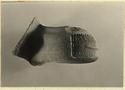
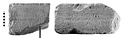
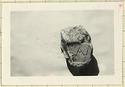
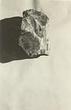
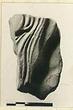
| Broken on all sides.
End of swirling drapery beside a figure (?). From clearing trench of inner rectangle in peristyle court of Heliaia. Context chiefly of late third quarter of 4th. century some later ... 27 April 1960 |
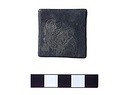
| Intact but somewhat chipped.
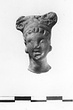
Head of a girl with hair done in a bow on top of head.
Prominent round earrings.
Traces of red on hair.
Pale yellow clay. From dump from South Stoa II. Context of 1st.-2nd ... 3 August 1960 |
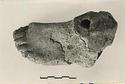
| A left foot with traces on underside of attachment to a sandal sole(?).
Broken away above ankle; heel also broken away and surface abraded at many points.
Shallow grooves above the great toe may mark the ... 4 September 1965 |
| Fragment of a sizable mould, preserving part of a body and some flowing drapery.
Broken all around. Embedded in floor of South Stoa II. Leica ... 4 January 1956 |
| One corner of a thick mold representing griffin's head.
Back smooth.
Coarse clay, pale buff at surface, pink inside. Cleaning modern cellars. 1251 Leica ... 29 March 1958 |
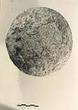
| Small fragment missing from one side.
Cut from hard breccia.
Cf. ST 702. From deep stony fill in middle of peristyle of Heliaia. 3471 Leica, 83-91 ... 3 August 1960 |
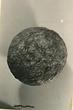
| Small fragment missing from one side.
Cut from hard breccia. From deep stony fill in middle of peristyle of Heliaia. 3471 Leica, 83-91 ... 3 August 1960 |
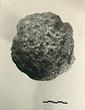
| Flake broken from side of ball.
Cut from hard breccia.
ADDENDA Balls found in Pompeion measure 0.14-0.35m.
Cf. AM 56 (1931), p. 4. From deep stony fill in middle of peristyle of Heliaia. 3471 Leica, 83-91 ... 3 August 1960 |
| Concrete Ring Around Tholos; Southwest Part ... Β-15 2819, 2820 ... Aug 24 1961 |
| Broken at back and below.
In the right eyeball, a small hole.
Remains of red paint and, on the left eye, of white.
Late Roman. Found with late Roman sherds, mixed. Leica ... 26 March 1934 |
Apparently a small bar which could have been cut into two proper flans.
The thickness is too much for it to be a single coin.
Previously catalogued as Θ-199
Now Θ 2249 : B 1639 Catalogued August 1978 ... 6 March 1933 |
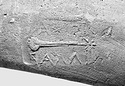
| Piece of handle added; joins with SS 13878.
Oar. Stoa South Area 3-4, layer II, soft earth; Middle Stoa Building fill. Θασίω[ν]
oar
Ναυσικύδ̣[ης] 65 Leica ... 26 February 1953 |
| Part of rim preserved.
Device star.
Early Thasian. Class: early Th* Finished From deep stony fill in middle of Peristyle of Heliaia. Θασίων
device star
Καλλί( 3471 Leica ... 3 August 1960 |
| Part of rim preserved. Cxt: for deposit see Summary of 27.vi.61 (VG)* Finished From clearing trench of inner rectangle in Peristyle court of Heliaia; context chiefly of late third quarter of 4th century ... 27 August 1960 |
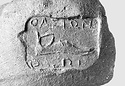
| Shoe. Stoa, Area South 2-3, martyra, layer II; Middle Stoa Building Fill. Θασίων
shoe
Θάσων Leica ... 28 March 1953 |
| Wreath. West of “steps” to 27.00m. square; top of Hellenistic fill, working levels; surface Middle Stoa Building Fill at start of 1953 season. wreath
ΠΟΑ (Α within Ο)
(in O) 2060-2061 Leica ... 8 April 1953 |
Exploration in the peristyle of the Heliaea (1960); evidence for rebuilding in the third quarter of the 4th c. B.C. with some disturbance as late as 1st-2nd c. A.D. Date of reconstruction ca. 325 B.C ... Ca. 350- 325 B.C. |
Pottery Deposit at 57/ΙΔ (also 57/ΙΣΤ and 63-66/Κ-ΚΕ). Contents of pit range from Mycenaean to Turkish; apparently the dump of a modern antiquities dealer ... Modern Context |
Coins:
15 March 1934 #6 ... 6th-7th c. A.D. |
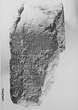
| Inscribed fragment with inscription on two fasciae.
Broken all round, save toward the front of the under side, where the start of a third vertical face appears, set back 0.069m. from the lower of the two ... 1933 |
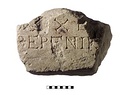
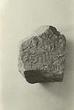
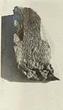
| Inscribed fragment.
Back surface preserved, rough picked; and possibly a bit of the top; other edges broken.
Pentelic marble. Pre-excavation. Found in the modern wall of the house 636/19, over the west ... 4th. century B.C. |
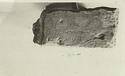
| Fragment from inscribed block; broken all round.
Of the inscribed surface, only a small triangular piece remain; at the top are parts of five pointed leaves, incised in the stone, a wreath (?).
Hymettian ... 1933 |
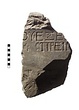
| Fragment Θ 26 a), from right side of inscribed block; fine picked on one side, rough picked on the back.
Fragment Κ 115 b), back and left side preserved. Fifteen lines of the inscription preserved.
Fragment ... 127/6 B.C. |
| Very small inscribed base.
Finished above and below with a plain moulding, very much chipped and broken. At the top of the lower moulding, three fillets; at the bottom of the upper, one.
On the top of ... 1933 |
| Left corner of inscribed block.
Epigram commemorating the victory over the Persians.
Fragment Θ 50 a), top smooth; bottom, very fine picked; side, anathyrosis. Broken at back and right.
Face dressed with ... 1933 |
| The back is scooped out.
On the obverse, an owl, standing left, his head facing, crudely incised.
1/6 mina. It appears in the Illustrated London News, ILN (2 June 1934). Modern fill. Leica, 4-201, 4-214, ... 28 February 1934 |
| Inscribed fragment.
The bottom is preserved, and the back; elsewhere broken.
Honorary monument to council of the Areopagos.
Two letters preserved.
Pentelic marble.
ADDENDA With I 781. Found in the wall ... 12 February 1934 |
| Inscribed fragment.
Broken on all sides.
Part of two lines of the inscription preserved.
Pentelic marble. Found in the wall of the modern house 636α/16 [636/16 on Vrysaki map], south of the central part ... 13 February 1934 |
| Inscribed fragment.
Smoothed back preserved; elsewhere broken.
Part of four lines of the inscription preserved; stoichedon.
Pentelic marble. Found in the wall of the modern house 636α/16 [636/16 on Vrysaki ... Ca. 400 B.C. |
| Fragment from an inscribed Herm.
Broken at top, right side, back and bottom.
Part of the chest, and a strand of hair left preserved.
Part of eleven lines of the inscription preserved.
Pentelic marble ... Ca. 166/7 A.D. |
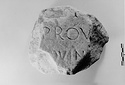
| Fragment inscribed in both Greek and Latin.
Left side perhaps preserved; elsewhere broken.
Part of four lines of the inscription preserved.
Pentelic marble. Found in the wall of the modern house 636α/14 ... Ca. 50 A.D. |
| Inscribed fragment.
Right side preserved; elsewhere broken.
One line of the inscription preserved, and a trace of one letter in a line below.
Hymettian marble.
ADDENDA Joins with I 1471 and I 2034. Found ... 24 February 1934 |
| Inscribed fragment.
Broken all round.
Over the inscription, traces of a moulding.
Parts of two lines of the inscription preserved.
Hymettian marble. Found in the wall of the modern house 635/1, northeast ... 21 October 1933 |
| Inscribed fragment.
A piece of the top preserved; the other sides broken.
Slightly convex surface. Traces of moulding above and low relief at left and below (leaves of a crown?).
Two letters remain.
Pentelic ... 7 December 1933 |
| Inscribed fragment from a stele.
The back preserved, rough picked; the edges broken.
Parts of four lines of the inscription preserved.
Pentelic marble.
ADDENDA Joins with I 2607, which gives right side ... 30 December 1933 |
| Fragments of Latin inscription.
Fragments Λ 46 a and Κ 100 b), broken all round.
Part of three lines of the inscription preserved, on each fragment.
Fragment Λ 119 c), also broken all round; on it, part ... a) (Λ 46) 13 January 1934
b) (Κ 100) 22 February 1934
c) (Λ 119) 21 February 1934 |
| Inscribed fragment.
Left side preserved; otherwise broken all round.
Part of eight lines of the inscription preserved.
Pentelic marble. Found in the wall of the modern house 636α/16 [636/16 on Vrysaki ... 146-165 A.D. |
| Inscribed fragment.
The left side, much weathered, is preserved; otherwise broken.
Part of three lines of the inscription preserved.
Hymettian marble. Found in the wall of the modern house 636α/16 [636/16 ... 22 January 1934 |
| Fragments of an inscribed stele.
Fragment Λ 59a (a), the left hand is preserved, and on the face the first letter in each of seven lines of the inscription, with traces of a second letter in the first ... Ca. 485 B.C. |
| Inscribed fragments.
Honorary monument.
Fragment Λ 61 (a), broken on all sides; above the letters the spring of a moulding.
Parts of five letters preserved.
Cf. I 1228.
Fragment Λ 173a (b), the top is ... 3rd. century A.D. |
|
|


.jpg.icon.jpg)