|
|
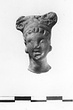
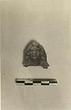
| Intact but somewhat chipped.
Head of a girl with hair done in a bow on top of head.
Prominent round earrings.
Traces of red on hair.
Pale yellow clay. From dump from South Stoa II. Context of 1st.-2nd ... 3 August 1960 |
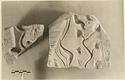
| Part of the leg of a running or dancing figure, with an end of fluttering drapery. Above it right (in the positive) part of a large object decorated with chevrons.
Broken all around.
Impression from metal ... 30 April 1957 |
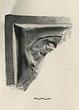
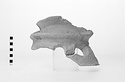
| One corner of a thick mold representing griffin's head.
Back smooth.
Coarse clay, pale buff at surface, pink inside. Cleaning modern cellars. 1251 Leica ... 29 March 1958 |
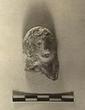
| Face and some of chest preserved. Broken behind.
Modelling rough. Some color preserved; white slip, black around eyes, yellow on chest.
Red clay.
Late Roman. On patch of mosaic floor. Leica ... 10 May 1937 |
| Corner fragment from a large mould, with a heavy frame around the relief surface.
Possibly scene with shield. Context unknown. Leica ... 1950 |
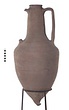
| Whole jar missing one handle and end of toe; part of ring preserved, no groove.
Capacity: (mbw poly 25.vii.89) 30.710; capacity: (mbw poly 25.vii.89) 30.840; capacity: (mbw water 20.vii.89) 31.085; capacity: ... 26 March 1937 |
| Fragment a) part of one side, with raised edge (broken off) preserved.
Along the side, ivy vine; beside in drapery (?)
Heavy fabric. Pink clay, buff at surface and with fine buff slip inside.
Fragment ... 27 March 1937 |
| Part (lap and legs) of a draped woman, seated in a chair.
Broken off above, below and behind.
No color.
Hard clay burned dark red to gray. Late Roman fill over strosis. Leica ... 5 April 1937 |
| Broken away at neck.
Head of child with curly hair and a braid from front to back across the top of the head. A finished hole at the back of the neck.
Dull red glaze, inside and out.
Most probably from ... 22 April 1937 |
| Oval with a thick top and long ridge, partly broken. Around sides, a zone of large pierced holes. Bottom edge flat. Red clay with coarse bits.
A lantern (?). Cf. A 3671 and MC 1346 (?). Herulian destruction ... 18 March 1958 |
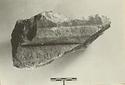
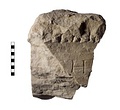
| Inscribed fragment from upper left corner of small pedimental stele.
Rough picked back and left edge preserved; at top rough picked surface near corner preserved; elsewhere broken.
Letters on moulding ... 8 February 1952 |
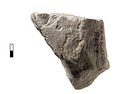
| Inscribed fragment.
Inscribed face, part of rough picked top and probably bit of rough picked back preserved. Break at top of front suggests crowning moulding broken away.
Surface badly worn; traces of ... 1 April 1952 |
| Inscribed fragment.
Part of smooth top and smooth picked right edge preserved.
On front face, parts of two lines of the inscription preserved.
Pentelic marble. Found among marbles, from the area just south ... July 1957 |
| Inscribed fragment.
Broken all around, except left edge.
Pentelic marble. Found in modern house walls, south of the Market Square. Leica ... 21 March 1958 |
| Inscribed fragment.
Broken all around.
Only a small part of face preserved.
Pentelic marble. Finished Found in modern house wall, south of the Market Square. Leica ... 10 April 1958 |
| Inscribed fragment.
One corner of a large base; mouldings chipped off above.
Rough picked face.
Pentelic marble. Found in modern house wall, south of the Market Square. Leica ... 10 April 1958 |
| Inscribed fragment.
Inscribed face only preserved.
Traces of six lines of the inscription preserved.
Pentelic marble. Found in marble dump, in the southeastern part of the Market Square. Leica ... 19 March 1936 |
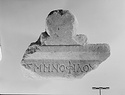
| Inscribed fragment of crowning member of grave monument.
Broken at both ends and at back below.
One line of the inscription preserved.
Pentelic marble. Finished Found in modern wall, at the north foot ... 1 February 1937 |
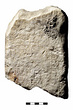
| Inscribed fragment.
Inscribed face, original left edge and perhaps right preserved.
Surface and back worn.
Seven lines of the inscription preserved; stoichedon.
Pentelic marble. Found in marble pile, on ... 2 February 1937 |
| Inscribed fragments.
List of names, arranged by tribes: names from Aigeis, Pandionis, and Leontis.
Fragment X 39, inscribed face, left face and original back preserved.
Eleven lines of the inscription ... Mid. 3rd. century B.C. |
|
|