|
|
| Part of one edge preserved.
Uncertain representation: extended arm with drapery behind (?).
Clay buff with coarse pink particles.
ADDENDA: Animal combat. Surface. Leica ... 7 April 1938 |
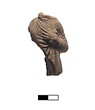
| Girl, "Tanagra" type, wrapped tightly in her himation that she pulls tight to a "chou" fold with her left hand against her breast.
Delicate modelling.
Buff clay. Catalogued 23 July 1966. Container B 236 ... |
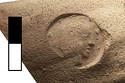
| Part of rim preserved.
Head right, within ivy wreath. Dip: traces of red colour(VG)*Par: see Pnyx 1956, AH nrs 47, 48, 155,
(from Assembly Place, Fillings of Period III)(VG)* Well, upper fill. head r ... 19 April 1938 |
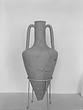
| One handle and tip of foot missing; long neck, rolled rim; no groove on neck.
Capacity: (barley, Lang 1954) 23.790.
Orange-brown micaceous clay.
Stamp on neck; graffito on shoulder. Dim: LH 0.019(VG)*Class: ... 6 May 1938 |
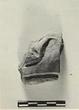
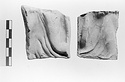
| Piece of curved plaque with drapery.
One edge preserved.
Gray buff clay, gray at core.
Cf. Hesperia 64 (1995), p. 419, n. 49. Agora sample no. 409. NEUT. ACT. ANAL. Brookhaven, 1978. Well, upper fill ... 18 April 1938 |
| Left edge preserved; broken at top, bottom and right.
Figure moving right, preserved from waist to knee.
Gray buff clay.
Cf. Hesperia 64 (1995), p. 450, n. 208; p. 459, n. 248. Agora sample no. 416. ... 27 May 1938 |
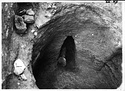
| Cistern at 53/ΚΓ and channels. The pottery in the cistern and in the two channels was a thoroughly mixed lot of broken material from 5th c. B.C. to 4th c. A.D. and all seemed the same except the bottom ... 5th c. B.C.-4th c. A.D. |
Pit at 57/ΚΑ; small pit on the lower north slope of the Areopagus, measuring 1.05x0.80mx0.80m deep. There were traces of burning and a few bones in it, since none of them are recognizably human it is probably ... 480 - 470 B.C. |
|
|