|
|
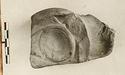
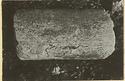
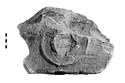
| Broken at both ends and at back; finished lower edge. Chipped.
Part of a large muzzle and eye (?).
Good roof tile fabric with smooth buff slip.
ADDENDA A spout of an eaves tile? Published as an archetype ... 1933 |
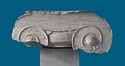
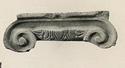
| Lower edges of volutes broken away, otherwise in good condition and fresh.
Note in place of eggs a cyma reversa and above this a taenia with fainted maeander. The crowning molding is an ovolo. The eyes ... May 1950 |
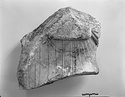
| Fragment from volute and resting surface, much battered. Off-white laminated marble, finished with toothed chisel.
Note scratch line 0.012m. inside limit of resting surface.
Marble.
Series as A 1595, from ... May 1950 |
| Lower end preserved with cutting for empolion; unfluted, finished with fine toothed chisel. Fine work.
Grayish blue marble identical with that in capitals A 1595 (Ι 1355) and A 1596 (Ι1356), with which ... 1950 |
| Two joining fragments of column shaft, fragment a) is lower part, fragment b) is upper part. Unfluted; finished with fine -toothed chisel. Masons' mark, Τ, in top of fragment b).
Gray blue marble.
Same ... 1950 |
| Fragment finished with fine toothed chisel; unfluted. Small part of lower end preserved, upper end broken.
Ionic column drum of same series as A 1597 (Ι 1357), Sounion series.
Top preserved, bottom broken ... 1950 |
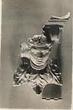
| Preserved in three joining fragments is the upper right hand corner, except the top, the face entire and the whole lower part.
The head, with hair parted and waved, crowned with a diadem and bunches of ... May-June 1936 |
| Fragment of lower right corner of a bracket like A 678 ( Ι 907), from the same mold. Clay is the same, but fired pinker. Great Drain. Leica ... May-June 1936 |
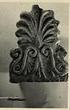
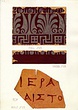
| All the upper projecting part of the palmette is missing, and only a small bit of the cover tile remains.
Across the face, below the palmette, in relief: ΑΘΗΝΑΙΟΥ
Coarse orange clay, full of impurities ... May-June 1936 |
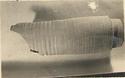
| Appears to have fallen into the drain from above, after the drain was filled up. Hence need not to be contemporary.
Most of lip gone at one end. Simple tongue joint; broad shallow corrugation, more marked ... May-June 1936 |
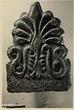
| Top of palmette antefix missing. Minor fractures. Cover tile completely broken off.
Coarse red clay with bits; coating of white on surface. Well, container 31. Leica ... 20 May 1938 |
| From a raking cornice; the full width preserved at the front, and the full height of the sima; much of the tile remains behind, with part of the right edge, but not the full depth.
Broad red band on soffit ... 20 May 1938 |
| The palmette antefix intact save minor fractures; cover-tile broken behind.
In raised letters across bottom: Μ Α Ξ Ι Μ Ο Υ
Coarse reddish clay; abundant traces of thick white.
Well, container 33. Leica ... 21 May 1938 |
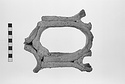
| A single fragment preserves a corner and parts of six holes.
Small impressed circles along edge on one side.
Coarse buff to reddish clay; unglazed. Well, Container 12. 524 Leica ... 18 May 1938 |
| Broken all around.
A tile with large openings made with arch-shaped strips of clay.
Coarse reddish clay. Well, Container 32. 525 Leica, 82-65-27, 82-65-28 ... 21 May 1938 |
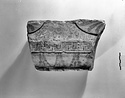
| Bottom preserved and full height of echinus of Archaic Ionic capital. The fragment has been roughly squared to make a small building stone. Traces of painted pattern: leaf and dart on lower molding of ... July 1946 |
| Broken all around. Fragment preserving one volute and part of resting surface of a large Ionic capital, similar in tooling and scale to other assigned to the Temple of Athena at Sounion.
Light gray marble ... 22 June 1972 |
| About one half preserved. Small Ionic capital. Egg and dart in somewhat low relief. Plain band on bolster.
Pentelic marble.
Similar in scale, though different series, to A 4434 and A 4435. Modern fill ... 10 August 1972 |
| Missing: upper part of left ear, edges of right ear, tip of nose, left side of neck at join. Mended from two adjoining pieces. The tenon is chipped and broken. The head is preserved from top to tenon, ... 10 B.C.-20 A.D. |
| The fragment first found comes from the middle of the back of the figure. The hair, worn in a heavy mass, square at the bottom, falls nearly to the small of the back. The folds of the garment, drawn tight, ... Early Roman Period (?). |
|
|