|
|
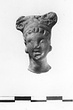
| Intact but somewhat chipped.
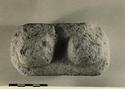
Head of a girl with hair done in a bow on top of head.
Prominent round earrings.
Traces of red on hair.
Pale yellow clay. From dump from South Stoa II. Context of 1st.-2nd ... 3 August 1960 |
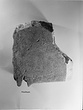
| Part of one edge preserved.
Uncertain representation: extended arm with drapery behind (?).
Clay buff with coarse pink particles.
ADDENDA: Animal combat. Surface. Leica ... 7 April 1938 |
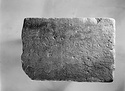
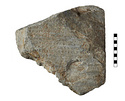
| A rough field stone with letters incised on it.
Destruction of Byzantine Wall K. Leica ... 27 May 1959 |
Well at 112/Ν.
Shallow well with a short period of use. The scattering of fragments in the upper dumped filling is consistently earlier. Lot Τ 12 (all sherds saved) and Lot Τ 13a (Dirt Pile) ... 520-500 B.C. |
Well at ΜΣΤ,ΜΗ/112. Collapsing bedrock prevented us from reaching bottom. Not A. Walker but same scenario ... 7th-Mid 6th c. B.C. |
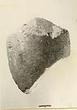
| Apparently intact.
Solid hub. Mixed fill. Store in ziplock polyethylene bag and in area with 40% r.h. or lower.
Wear cotton or latex gloves when handling. Leica ... 8 June 1938 |
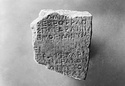
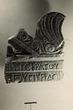
| Fragments of an inscribed stele.
Fragment Λ 59a (a), the left hand is preserved, and on the face the first letter in each of seven lines of the inscription, with traces of a second letter in the first ... Ca. 485 B.C. |
| Inscribed fragments.
List of names; "POLETAI" record.
Fragment Ζ 331 a), inscribed fragment.
Broken on all sides.
Nine lines of the inscription preserved, with a space between the fourth and fifth.
Fragment ... First half of 4th. century B.C. |
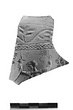
| Fragment from side of a shallow bowl.
Broken all around.
Decoration from top to bottom: 1) Bottom of a row of hooks; four grooves as border. 2) Zone with tree and curved garland. Border of cross hatching ... 31 March 1953 |
| Base and stem preserved.
Chip missing from side of base.
Wide base with downturned edge.
Colorless glass. Trench to stone Drain at S.E. corner of section. 3357 Leica PD 2023-8 ... 31 March 1953 |
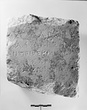
| Inscribed fragment.
Broken below; recut (?) above; at center of top a square dowel hole. At top of inscribed face, bit of moulding preserved.
A rectangular Herm-like pillar, smoothly dressed on all four ... 4 March 1938 |
| Inscribed mastoid weight.
Very battered, but intact.
On one of the long faces the letters: "ΛΔΚ".
Pentelic marble. Found in late context outside the Market Square, in the area south of the church of the ... 21 March 1938 |
| Inscribed fragment.
Inscribed face, back and bottom preserved.
Damaged along left and right sides; minor fractures.
Five lines of the inscription preserved.
Hymettian marble. Found in wall of the modern ... 22 March 1938 |
| Inscribed fragment.
Broken all around. Back covered with hard cement. Surface pitted along left edge and bottom.
In column I, thirty-nine lines of the inscription preserved; in column II, thirty-three ... 22 March 1938 |
| Inscribed fragment of grave stele.
Inscribed face and part of rough picked back only preserved.
Stone with a list of names probably of those who fell in some campaign.
Sixteen lines of the inscription ... Ca. 450 B.C. |
| Inscribed fragment of statue base.
The block has been re-cut for one or more reuses.
Bottom and top are probably the original surfaces; bit of original right edge preserved at front of right side. Rough ... Ca. 403 B.C. |
| Inscribed fragment of columnar grave monument.
Broken except in front.
Part of a five-line inscription preserved.
Hymettian marble. Found in modern wall, south of the church of the Holy Apostles. Leica ... 21 March 1953 |
| Inscribed fragment.
Broken at left and behind.
Upper right corner of a grave monument with palmette akroterion and part of pediment.
The inscription on the two fasciae below. Underside smooth picked.
Pentelic ... February 1954 |
| Inscribed fragment of columnar grave monument.
About half of the upper part preserved.
Two lines of the inscription preserved.
Hymettian marble. Found in masonry of Tomb 5 of the Turkish period, in the ... 17 March 1954 |
| Inscribed fragment of a stele.
Inscribed face and right side preserved.
Broken at top, bottom, left and back.
Most of the right edge of inscribed surface is chipped off, and remaining surface much worn ... 1 February 1952 |
|
|