|
|
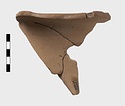
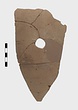
| Roughly triangular fragment from neck and upper shoulder of large closed pot, probably an amphora. Circular hole, 0.02 in diam., cut into neck at about mid-height (nearly half of circumference missing) ... July 1946 |
| Part of the body and rim, with the stump of one handle attachment preserved. Round hole, cut before firing, beside handle. Inside glazed; outside, broad rough band of glaze around body(?) below handles, ... July 1946 |
| Part of the lower body and ring foot of a closed pot. A round hole, neatly cut before firing through the bottom, preserved at one side near the ring foot. Outside unglazed except for band on foot; coarse ... July 1946 |
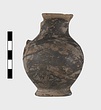
| Chips from the flaring round mouth, the rolled vertical handle and the feeding spout missing. Flaring ring foot and convex-concave body and neck forming continuous reverse curves. Feeding spout placed ... July 1946 |
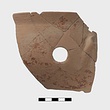
| Triangular sherd from the side wall of a closed pot; round hole made before firing, at center. Unglazed outside. Inside, crossed vertical and horizontal bands of thick dull black to brown glaze, in places ... July 1946 |
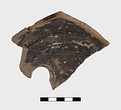
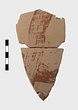
| Triangular fragment from the side wall of a closed(?) pot. Crossed vertical and horizontal bands of glaze inside and out. At one edge the glaze runs over the break, showing that it was added after the ... July 1946 |
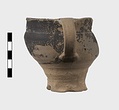
| Profile complete with one vertical handle; there may have been two. Very high thick stem-like base, flat underneath; wide flaring rim, very slightly inset.
Thick glaze, black to tan inside and out; base ... July 1946 |
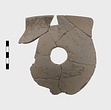
| Irregular fragment from side wall of closed pot. Near center of fragment, circular hole (diam. 0.029). Inside and out, wide loop of glaze surrounding hole. Glaze runs onto break on one side and bottom ... July 1946 |
|
|