|
|
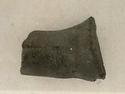
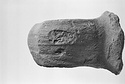
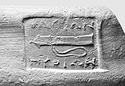
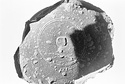
| Fragment from left side of inscribed block.
Left side, tooth chisel marks; front rasp finished.
Rounded edge between. Otherwise, breaks.
Pentelic marble. Found in a marble pile, in the western part of ... 17 March 1932 |
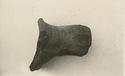
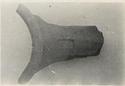
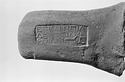
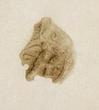
| Slightly rising; twisted; broad; ribbed; broken before curve.
Coarse clay; red, slightly greyish at core; light slip.
Impression sert badly, close to neck; only upper part complete.
Cf. SS 4410. Par: ... 9 March 1932 |
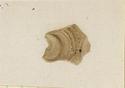
| Probably typical; broken at curve.
Typical clay; fired yellow at surface; traces of light slip.
Diamond-shaped impression; sharp. Ἀπολλων | ίου (ΙΟΥ retr)
bee
Κνιδι(
(in diamond) Leica ... 15 March 1932 |
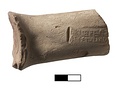
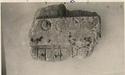
| Broad, level, slightly twisted; broken at curve.
Coarse red clay, grey at core.
Impression damaged and incomplete above. Rdg: nt a mark (inv =G=) on lower r. corner (MSP)* [ Ἐπὶ Φιλίπ]
που Κλε(υ)π̣[ό] ... 29 February 1932 |
| Typical shape; broken at curve.
Coarse clay; greyish-red, buff surface, light slip.
Impression set very shallow; incomplete below and above(?). [ Ἐπὶ Κ̣α̣λ̣λ̣ιδάμα]
Ξενοκλεῦς
Κνι̣δ̣[ι(] oar r.
(Σ ... 31 March 1932 |
| Knidian type; broken before curve.
Coarse, greyish-red clay, yellow at surface; traces of slip.
Left end of the impression broken away; incomplete below; worn. Retrograde. Ἐπὶ Σωκρά(τευς)
φρουράρχο[υ] ... 4 April 1932 |
| Broad, slightly arched; broken at curve.
Clay similar to Knidian; baked yellow at surface. Traces of light slip.
Impression incomplete towrad edges of handle. Six-petalled rosette in centre. Retrograde ... 19 March 1932 |
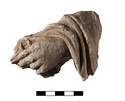
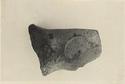
| Small left hand. Back surface at break. The hand grasps some indistinguishable object (sistrum?), holding it against garment, part of which falls over the wrist.
Rasp finished.
Same scale as S 192 (E ... 1 March 1932 |
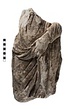
| Back rough-picked, the other sides broken. Figure preserved from below breast to knees, right arm missing. Figure thinly draped and wrapped in himation held at hips with left hand. On the right breast ... 4 April 1932 |
| Broken before curve; ribbed; broad, narrowing to junction with neck from which it rises. Inside neck, hollow where thumb was impressed in attaching handle.
Coarse greyish-red clay, full of large bits ... 8 March 1932 |
| Rather broad, ribbed; broken at curve.
Clay similar to typical Knidian, slip much worn, pitted.
Impression shallow set so as to be incomplete left side and above boukranion. Parts of a few letters on ... 11 March 1932 |
| Shape like Knidian.
Rather coarse pinkish-buff clay; cream slip.
Impression incomplete below; damaged. Ἐπὶ Φιλομβρ
οτίδα Κνί(διον) [Χ]
αρμοκρά
τ[ευς double axe l. in outline]
(Σ lunate) Leica ... 17 March 1932 |
| Early Roman stamped ware showing remains of three impressed tree motifs around center of plate. High ring base.
Clay gray at core, orange at surface; covered on inside of plate only with thin purplish-brown ... 10 March 1932 |
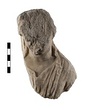
| Fragment from upper part, right side of draped figurine with fat folded arm.
To left, remains of a crude joint.
Distributed down left side in a manner unsuggestive of buttons, five pellets.
Slight traces ... 1 April 1932 |
| Thick, high rising; broken at curve.
Typical Rhodian.
Right ends of the impression broken away; much worn; large thick letters for Rhodian. Finished Ἐπ' Ἰερέως
Ἀριστωνίδ̣α̣ Leica ... 8 March 1932 |
| Slightly descending, broad; ribbed; broken before curve.
Coarse red clay, greyish at core, yellowish at surface; light slip, somewhat micaceous.
Small impression, set close to neck; worn.
Early Knidian ... 9 March 1932 |
| Broad; ribbed; rises and curves down abruptly close to neck.
Coarse clay, somewhat micaceous; red, greyish at core; dark wash (vestiges).
Impression incomplete on right end. vine Ἀθη(ναίου)
leaf? ... 11 March 1932 |
| Typical shape.
Clay fired yellow at surface; otherwise typical.
Impression sharp but not worn down middle; slightly incomplete on lower left(?). Ἐπὶ Ἀσκηπιά (sic)
δευς Νεικία
Κνίδιο caduceus r.
... 15 March 1932 |
| Broad, widening to neck; broken before curve.
Coarse reddish-buff clay; greyish at core; light slip; slightly micaceous.
Two-thirds of the impression broken away; only traces of emblem in centre. Drain ... 23 February 1932 |
| Knidian type; flat on top.
Coarse, reddish-buff clay, grey at core, remains of light slip.
Impression set close to neck but so large as to be incomplete right end and somewhat below. Msc: prob from jar ... 31 March 1932 |
| Broad, broken at curve close to neck.
Coarse red clay; traces of light slip.
Impression set violently, so as to be incomplete below and present a marked curve; left end broken away. Msc: prob from jar ... 4 April 1932 |
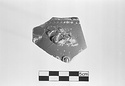
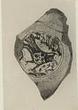
| Fragment from side of bowl. Between a row of dots and a tongue pattern is a cupid riding a dolphin with long bent tail, all in relief.
Clay is fine; pinkish-buff. Thick red glaze inside and out.
Western ... 9 March 1932 |
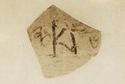
| Slightly concave side of fragment glazed with rather thin and dull black glaze, through which has been scratched in the dry clay the letters:
Other side unglazed.
Attic clay. Leica ... 17 March 1932 |
| Late Roman C fragment from a flat dish depicting rabbit running right. Curve of groove above and below beast indicate his feet are centrifugal.
Coarse red clay left rough outside, red glazed inside ... 18 March 1932 |
| Buff surface seems to be slipped; light red coarse clay.
Dipinto in matte red: Leica, 2-294 PD 1133-38(Ha 40) ... 4 April 1932 |
| Fragment from body of an amphora(?). Part of two decorated bands preserved, the upper one very fragmentary, with part of a dot rosette to the right. The lower band has, to the left, the hind quarters of ... 29 February 1932 |
| Late Roman C dish fragment. Stamped on rising center with fat imp holding bunch of grapes in raised left hand.
Clay red, rather fine; thin red glaze. Leica, 2-317 ... 29 February 1932 |
| Seems to preserve part of central tube for setting on stand.
Good brownish-black glaze, much worn.
Gray clay.
Type XIX (?) of Corinth collection, type 27 variants of Agora collection. Leica, L-91 PD 635-100 ... 4 April 1932 |
| Behind the head, part of the back of the relief is preserved, the thickest point may be the complete thickness. Left side of figure preserved to below shoulder and breast. Front, left side of head shaved ... 1 March 1932 |
| Broad; irregularly ribbed; junction with neck not preserved.
Reddish-buff clay, micaceous.
Impression comparatiovely neat and well preserved. Θασίων (Σ lunate)
quiver l.
Πυθίων Leica ... 31 March 1932 |
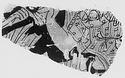
| Fragment from wall of large vase. To the right, a figure draped in a cloak, seated on a cross-legged stool. Figure facing right; top of body and front of legs missing. The stool is tipped sharply forward, ... 12 March 1932 |
| Ring foot, most of the central medallion and the start of the curving sides of a bowl. In the medallion, a small bird, with long beak and claws, and extensive tail, facing right; small branch in front; ... 28 March 1932 |
| Samian B pot base. Bottom of small footed bowl with square stamp in center: probably ΔΩΡΟΝ (F.W.).
Light red clay with fine particles of mica; all over good red glaze. Leica, 93-30-23, 2-290 PD 1171-180, ... 4 April 1932 |
| Fragment of discus and rim.
On rim, vine pattern.
On discus, Eros, running right, carrying a goose.
Thin purplish-black wash.
Grayish-buff clay.
Type XXVIII of Corinth collection. Leica ... 4 April 1932 |
| Back part of rim. Vertical band handle broken away.
Rim slightly sunk beneath upper edge of vertical sides; small leaves in relief.
Rather good red glaze.
Soft red to buff clay.
Type XXII (?) of Corinth ... 4 April 1932 |
| Fragment of discus and rim. Very small bit of rim and start of top of nozzle preserved.
Apparently narrow rim, plain, with a row of large dots round the inner edge.
Discus, concave, with three grooves ... 4 April 1932 |
| Inscribed fragment.
Broken all round, save on inscribed surface.
Inscribed on broad bevelled band and also on recessed lower surface.
Pentelic marble.
ADDENDA Joined with I 1319. Found at a late Roman ... 9 March 1932 |
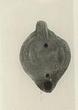
| On rim, herringbone.
On discus, spotted collared dog left; filling hole above back between head turned back and tail turned forward.
Nozzle set off by transverse groove with air hole in middle.
Handle ... 31 March 1932 |
| Top part of lamp preserved. Tip of nozzle broken away.
Rim sunk, with raised spiral pattern.
On discus, palm tree, with filling hole on either side with raised spirals below.
Projecting nozzle set off ... 1 April 1932 |
| Parts of two draped figures: to right, seated figure with right arm bent at elbow and hand raised. Figure clad in elaborately ornamented garment. The hand seems to touch another draped figure(?). Drapery ... 29 February 1932 |
|
|