|
|
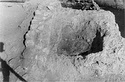
Pit 6 in Grave area. South cut, Metroon Section. Pit with burning ... Late 5th. c. B.C. |
| Pocket with burning at 60/ΚΗ. "Is this perhaps a disturbed pyre burial." [Nbp. 2928].
Identified as pyre by SIR.
Near north end of corridor, beside its west wall. Concentration of artifacts, tiny scraps ... 4th c. B.C. |
| Pit with traces of burning ... Probably 3rd qtr. 5th c. B.C. |
Pit 4 in Grave area (= Cistern). Not completely cleared. Filling probably late Hellenistic, though with some earlier material ... Hellenistic |
| Disturbed Pyre at 59/ΚΗ (ΚΖ), in the area of the Poros Building west of the Areopagus.
Against east wall of room 5 west. concentration of artifacts, ash, carbon and a few bones in stratum, no pit discerned ... 3rd c. B.C. |
Casting pit near SE corner of Poros Building, Room C 3. Combined with D 18:4 ... 1st c. B.C.-1st c. A.D. |
Pit 2 in Grave area. Small deposit in a pit; a fragment of a red-figured nuptial lebes recalls the early Kerch style of the second quarter of the 4th c.; the deposit as a whole runs somewhat later ... Ca. 375-315 B.C. |
| Pyre /Burial (?) disturbed, in the area of the Poros Building west of the Areopagus. In northeast corner of room 4 west.
Concentration of artifacts, tiny slivers of bone, and burning in a layer of fill ... Early 4th c. B.C. |
Rectangular shaft neighboring the well D 17:12. Dug only to a depth of 4.40m. and provided with two galleries or channels extending from it. Apparently never intended as a well. Refilled with the dug bedrock ... 4th c. B.C. |
| Sacrificial pyre in Poros Building, NW Room (RSY= Pyre 1).
Against east wall of room 5 west. artifacts, bone, carbon and ash in pit in floor sequence. the pyre lay below a floor covered with marble dust, ... Middle of 4th c. B.C. |
A rubbish pit at the foot of the northwest slope of the Areopagus. Black figured, plain glazed vases and several lamps. A pair of lekythoi recall both in make and in style the products of the Haimon Painter ... Ca. 480-475 B.C. |
Upper fill early Roman. Lower fill latest Hellenistic.
No house walls clearly associated with it, and apparently no attempt made to assign it to any particular house. Subdivisions:
.1=Upper fill
.2=Lower ... Late Hellenistic-Early Roman |
| Hole at 57/ΛΣΤ = Pottery Dump at 57/ΛΣΤ. May well have accumulated on the spot where it was found, its fragmentary state being attributable to the later rubble wall laid over it.
Cf. also P 19982 (ΟΟ ... Ca. 400-375 B.C. |
Construction filling of the Poros Building west of the Areopagus. Patch of stony fill beneath the courtyard. Accumulation of the second quarter of the 5th c., deposited in the last quarter ... Ca. 475-450 B.C. and later |
Well, neatly stone-curbed to bottom. Diameter 0.70m. The use filling, from about 3.50m to bottom, consisted chiefly of water-jars with a few small vases and some black-figured fragments.
Upper filling, ... Use filling of ca. 575-550 B.C. |
| Roman Bath, Herulian destruction debris in A3. The high proportion of vessels for eating suggests that this was not the actual bath fill but was probably dumped in from the ruined houses higher on the ... Second half of 3rd and into 4th c. A.D. |
| Large tile-lined well in SW Bath, Room A4. The top had been sealed with ca. 1.30m of concrete, and the floor to carry the hypocaust columns of the room in Phase C had been carried over it.
The well was ... Late 2nd-early 1st c. B.C. |
Well under Poros Building Drain at 62/ΛΣΤ, west of the Areopagus. Digging abandoned at 6.10m due to a collapse of the soft bedrock at the west. Small amount of supplementary filling was added in the upper ... Ca. 520-480 B.C. |
Displaced curbing stone had fallen into top of shaft; fill with and around it is presumably second half of 2nd c. A.D. Below tumbled filling at top, shaft was empty to 10.80m. Tiles were missing to ca ... Late 1st-early 2nd c. |
|
|