|
|
| Eugene Vanderpool ... Grave (E.L. Smithson: Grave III: SM).
The close proximity and similarity of this tomb and tomb M 16-17:1 strongly suggests that they were intentionally laid out in relation to one another and were contemporary ... Late Mycenaean/Submycenaean-Earliest Protogeometric |
| Eugene Vanderpool ... Grave (E.L. Smithson: Grave XVI: PG). Bones discarded.
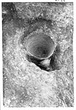
Only the lower portion of the urn-hole was preserved in bedrock, roughly oval in outline, with a maximum preserved width at the top of 0.70m narrowing ... Late Protogeometric/Early Geometric I |
| Eugene Vanderpool ... Grave (adult female). (In some records as Grave XXXI).
The tomb was partly destroyed in antiquity; there are sherds of all periods down to Late Roman (and later) note din the fill immediately above it ... Middle Geometric I |
| Eugene Vanderpool ... Grave (E.L. Smithson: Grave II: SM).
Unlined trench, roughly the size of the deceased, cut into bedrock to a depth of just over 1.50m. Oriented north-south, the tomb pit measured 1.69m in length (length ... Late Mycenaean/Submycenaean-Earliest Protogeometric |
Tomb at 53-54/ΛΕ-ΛΣΤ-ΛΗ (Late Roman), on the lower north slope of the Areopagus Nb. says ΛΕ-ΛΗ. Deposit list and deposit DB say: ΛΕ-ΛΣΤ ... 350-400 A.D. |
Well on lower slopes of Areopagus.
Diameter ca. 1.50m. Dumped filling of 8th c. at the top. Fill mostly Geometric but containing bits of later (even Roman) pottery. Perhaps cleaned out and refilled with ... 730-700 B.C. |
Appears to be use filling from 3rd c. A.D., pre-Herulian into 4th c. or later. Lined with tiles. Coins:
6 May 1937 #1-#2 (disintegrated) ... Early 3rd-early 6th c. |
Well shaft cut through a cistern channel which was then packed with three amphorae (P 3123, P 3125, P 4201) of 1st or at latest early 2nd c. A.D. (These three amphorae could be considered with F 15:2) ... 3rd-4th c. A.D. |
|
|