|
|
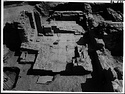
Greek House J, under room 8 of Roman House H.
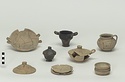
Typical though very fragmentary pyre pottery lay dispersed in a stratum over bedrock with pottery ranging from the 5th to the mid-3rd c.
In same general area ... Early 4th c. B.C.? |
Deposit alongside Greek House I, perhaps giving the construction date of the second phase. Deposit list title it as : outside of east wall of Roman House H ... Last quarter of the 4th c. B.C. |
Destruction fill in "Storeroom" south of fish mosaic., outside SW corner of Roman House H. In SW corner of room an area of broken jars. heavy deposit (ca. 0.45m thick) of destruction fill over whole room ... 3rd c. A.D. |
Pit under floor of "Storeroom" south of fish mosaic in Roman House H.
Small peanut-shaped pit ca. 0.50x0.90. No association with architecture. Small group of votive miniatures ... 4th c. B.C. ? |
| Well in Room 7 of Roman House H, partially covered by caldarium of added bath complex (Room 6). Stone well-head; 0.85m in diameter. Stpped because of danger of collapse. Cut through bedrock, water from ... 6th c. A.D. |
| Pyre in north central room of house, measuring 0.50m east-west by 0.35m north-south. Pottery, bone, and burnt material in pit dug into layer IIb (crushed bedrock floor: lot Ω 464, 4th c.) and covered by ... 350-325 B.C. |
Well in Room 5 of Roman House H.
Under cement border of andron of Greek House G. Diameter 1.10m, cut through bedrock. water at ca. 3.55m. Hand or foot holes along one side.
0-7.25m crushed bedrock fill ... 5th c. B.C. |
| Pyre in Room 8 of Roman House H. Concentration of artifacts, bone, and flecks of carbon in stratum, no pit discerned. the pyre lay within a red fill apparently contemporary with it, but with some later ... 300-290 B.C. |
|
|